
Why Could a Woman Stop the Sun From Rising?
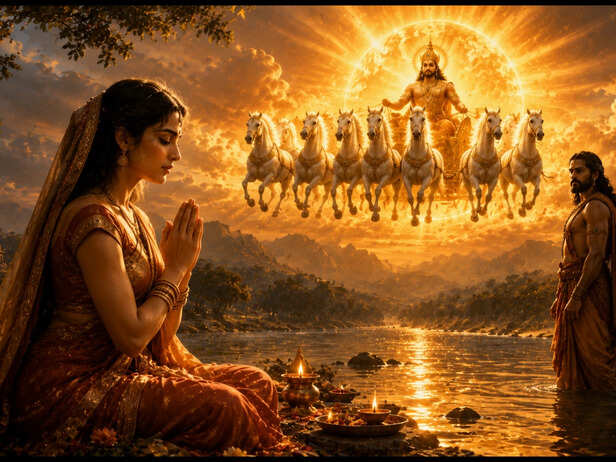
What if a woman's unwavering vow could become so powerful that even the sunrise had to wait?
An extraordinary story in Hindu narrative tradition tells of a woman named Varuni, whose devotion and determination were tested in the most unexpected way. She was once rejected because of her appearance, chose the path of severe penance, and eventually married a physically disabled man named Kaushika. Her devotion to her husband later became the centre of a remarkable episode involving the sage Mandavya, a curse and the rising of the Sun.
The story is not simply about supernatural power. At its heart, it explores devotion, determination, marital vows and the extraordinary spiritual strength attributed to tapasya and steadfastness.
Rejected for Her Appearance
According to the story, Varuni was a deeply virtuous young woman who was rejected by the men in her village because they considered her unattractive. Their words left her heartbroken, and she eventually went into the forest. Instead of allowing rejection to define her life, she began a period of intense penance. Her tapasya eventually pleased the divine, and she was advised to return to worldly life and marry. This marked the beginning of a journey that would eventually place Varuni at the centre of an extraordinary story about devotion and spiritual resolve.
A Marriage Built on Devotion
When Varuni returned to her village, she announced that she would share the spiritual merit of her penance with the man who married her. Kaushika, a physically disabled man, stepped forward and accepted her. The two were married, and their relationship became one of mutual companionship. Later, Kaushika expressed a desire to undertake a pilgrimage. Varuni did not leave him behind because of his disability. She carried him in a basket on her head and began the journey with him. Her actions became an important part of the story's portrayal of devotion.
A Sage’s Curse Changes Everything
During the pilgrimage, Varuni passed through a place where the sage Mandavya had been punished by the king and placed on a stake. In the darkness, the basket carrying Kaushika accidentally struck the sage. Already suffering immense pain, Mandavya became furious and pronounced a curse. He declared that Kaushika would die at sunrise the following morning. For Varuni, the journey suddenly became a fight against time. The woman who had already endured rejection and hardship now faced the possibility of losing her husband because of an accident.
The Vow That Stopped Sunrise
Varuni responded with a powerful declaration. She stated that if she had remained completely faithful to her husband after their marriage, then the Sun would not rise the following morning. In the story, sunrise did not occur. The unusual event alarmed the gods, who approached Varuni and asked her to withdraw her vow. Her determination had created a crisis that affected the natural order itself. The episode presents an ancient narrative idea in which steadfast devotion and spiritual merit could become extraordinarily powerful.
The Gods Ask Her to Relent
The absence of sunrise could not continue indefinitely. According to the traditional story, the gods approached Varuni and requested that she withdraw her vow. She eventually agreed. Kaushika died as foretold for a time, but divine intervention restored him and returned him to health. The dramatic ending reinforces the central theme of the narrative: Varuni's determination had become powerful enough to influence events far beyond her own life. Her journey from rejection to spiritual strength forms the emotional core of the story.
What the Story Says About Devotion
The story is often interpreted as an example of the spiritual strength traditionally associated with pativrata dharma, the ideal of a wife remaining devoted to her husband. However, it is important to understand such stories within their traditional and cultural context. They express religious and moral ideas through extraordinary events rather than functioning as scientific explanations. The claim that a woman's speech can literally revive the dead or control the Sun belongs to the realm of mythology and spiritual storytelling. The deeper message centres on faith, commitment and the power of unwavering resolve.
Why This Story Still Fascinates People
The most fascinating part of Varuni's story is not simply that sunrise stopped. It is the transformation of the woman at the centre of it. She began as someone rejected because of her appearance. Yet through penance, marriage and unwavering determination, she became the person whose vow changed the course of the story. Her journey shows why ancient narratives continue to attract readers today. They often use impossible events to explore very human emotions such as rejection, loyalty, fear, courage and the desire to protect someone we love.
The Real Mystery Behind Her Power
The extraordinary claim in the story raises an important question: was Varuni powerful because of a magical boon, or because of the spiritual merit created by her unwavering devotion?
The narrative presents her strength through the second idea.
Her power is connected to her tapasya, vow and steadfastness.
That is why the sunrise becomes such a powerful symbol. The story is not presented as a scientific account of how the Sun works. Instead, it uses the impossible to show how powerful unwavering spiritual resolve could be in the imagination of ancient storytelling.
Unlock insightful tips and inspiration on personal growth, productivity, and well-being. Stay motivated and updated with the latest at My Life XP