
Why Could Hanuman Not Recognise Shiva? The Hidden Truth
In many devotional traditions, Hanuman's greatness is not presented as coming from constantly knowing his own divine status. Instead, his character is defined by devotion and service. This creates a powerful idea: sometimes, the greatest spiritual strength is not knowing how powerful you are, but using that power without pride.
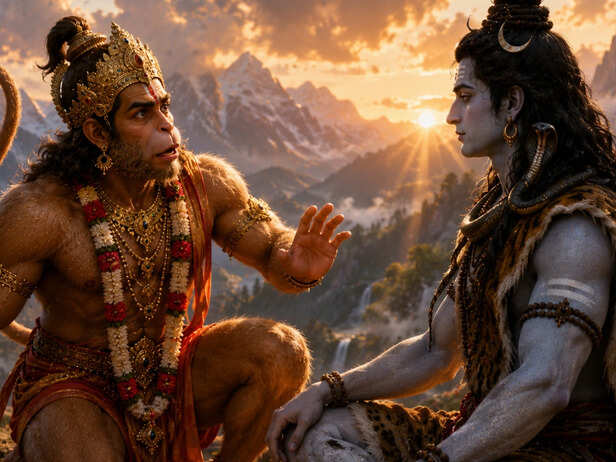
Hanuman is remembered as one of the greatest devotees in Hindu tradition. His devotion to Lord Rama, extraordinary strength and complete humility are celebrated across generations. But there is a fascinating question that often appears in popular retellings:
If Hanuman was himself connected with Lord Shiva, why would he not recognise Shiva when they met? The answer becomes even more interesting when we look at the different traditions surrounding Hanuman's origin. According to a widely known belief, Hanuman is regarded as an Anjana Putra and a manifestation or son associated with Lord Shiva, with Vayu playing an important role in his birth story. Yet many popular stories about Hanuman and Shiva are later devotional traditions rather than episodes explicitly narrated in the Valmiki Ramayana.
Hanuman’s Birth Was Already Divine
Different Hindu traditions describe Hanuman's birth in different ways.
He is widely known as the son of Anjana and Kesari, while Vayu is closely associated with his birth and divine powers. Some Shaiva traditions also describe Hanuman as an incarnation or manifestation of Lord Shiva.
This is important because Hanuman's divine nature is not simply about physical strength.
His story combines devotion, divine purpose and extraordinary spiritual power.
Yet Hanuman's personality remains remarkably humble. He does not constantly announce his own greatness.
That humility becomes central to understanding why stories about his identity can be so powerful.
The Meeting Story Has Many Versions
Here is the part that is often missed.
There is no single universally accepted scriptural episode in which the Valmiki Ramayana clearly says Hanuman met Shiva, failed to recognise him and then discovered that he was connected to Shiva.
Such versions are found in later devotional literature, regional traditions and popular storytelling.
That does not make the story meaningless.
Instead, it shows how Hindu storytelling developed across centuries, with different traditions highlighting different spiritual ideas.
So the question should not always be treated as a literal episode from the Ramayana.
It is better understood as a devotional story about Hanuman's divine identity and humility.
Why Would Hanuman Not Know His Identity?
If a particular tradition says Hanuman did not immediately recognise Shiva, the story can be understood symbolically.
Hanuman's greatness was never based on his ego.
He did not walk around thinking, "I am divine, therefore I am superior."
Instead, his identity was shaped by seva, devotion and loyalty.
This is why the story carries a beautiful spiritual message.
A person can possess enormous strength and still remain humble.
In devotional storytelling, Hanuman's lack of self-awareness can represent the idea that true greatness does not need constant recognition.
His power becomes meaningful because he uses it for dharma and devotion, not personal pride.
The Realisation Becomes the Turning Point
In devotional interpretations, the moment Hanuman learns about his divine connection becomes more than a simple revelation.
It represents self-realisation.
The lesson is not that Hanuman suddenly became powerful after discovering Shiva.
He was already powerful.
The revelation simply gave meaning to what was already within him.
This is similar to many spiritual stories in which a person does not receive a new power but finally understands the power they already possess.
For Hanuman, however, that knowledge never becomes an excuse for pride.
His greatest quality remains his willingness to serve.
Hanuman’s Strength Was His Humility
This is perhaps the most meaningful part of the story.
Hanuman possessed extraordinary abilities. Yet when he met Lord Rama, his greatest identity became that of a devotee and servant.
His famous declaration of devotion is often understood through three levels: at the physical level he sees himself as Rama's servant, at the level of the individual soul he sees himself as a part of Rama, and at the highest spiritual level he recognises unity with the divine.
The message is powerful.
Knowing your strength is useful. Knowing when to remain humble is greater.
Why the Story Still Connects Today
Modern life often teaches people to prove who they are.
Hanuman's story suggests something very different.
You do not have to constantly announce your abilities to make them real.
You can be strong without being arrogant. You can be capable without seeking praise. You can know your worth while remaining respectful toward others.
That is why Hanuman continues to inspire millions of devotees.
Whether one reads the meeting-with-Shiva story literally, symbolically or as a later devotional tradition, its central message remains meaningful:
True strength becomes beautiful when it is guided by humility and service.
The Hidden Lesson Behind Hanuman and Shiva
So, did Hanuman really fail to recognise Shiva?
There is no single authoritative Ramayana account confirming this exact incident.
The story belongs mainly to later devotional and popular traditions.
But its spiritual message is worth remembering.
Hanuman's greatness was never dependent on knowing that he was extraordinary. His greatness came from what he did with his strength.
He served. He protected. He remained devoted.
And perhaps that is why the story feels so powerful.
The strongest person in the room does not always need to announce that he is strong.
Sometimes, true greatness is simply having immense power and choosing to use it for something greater than yourself.
Unlock insightful tips and inspiration on personal growth, productivity, and well-being. Stay motivated and updated with the latest at My Life XP.