According to Hindu mythology, Hiranyakashipu was a powerful Asura king who wanted to become immortal and rule over the three worlds. He hated Lord Vishnu because Vishnu had killed his brother, Hiranyaksha, in the Varaha Avatar.Determined to avenge his brother's death and gain supreme power, Hiranyakashipu began performing severe penance to please Lord Brahma.
How Did Hiranyakashipu Become So Powerful?
His devotion and intense austerities eventually attracted Brahma's attention. When the creator deity appeared before him and offered him a boon, Hiranyakashipu asked for something that would make him almost impossible to defeat.He wanted protection from death in every possible situation.However, Lord Brahma could not grant him absolute immortality. Instead, Hiranyakashipu requested a series of conditions that he believed would protect him from every possible cause of death.
What Were the Conditions of Hiranyakashipu's Boon?
The most fascinating part of this story is the unusual list of protections Hiranyakashipu requested.
According to the
Bhagavata Purana, Seventh Skandha, Chapter 3, he asked that his death should not occur:
- Inside a house or outside it.
- During the day or at night.
- On the ground or in the sky.
- Through any human being or animal.
- Through any weapon.
- Through living or lifeless beings.
- At the hands of Devas, Asuras or other supernatural beings mentioned in his prayer.
He also sought immense power, supremacy over other beings and freedom from defeat in battle.Lord Brahma granted the boons he had requested.
Hiranyakashipu believed he had successfully defeated death itself. With these protections, he became increasingly arrogant and began terrorising the Devas, sages and ordinary people.But there was one thing he could not control: the devotion of his own son.
Why Did Hiranyakashipu Become an Enemy of His Own Son?
Hiranyakashipu's son, Prahlada, was a devoted follower of Lord Vishnu.Despite growing up in a family that hated Vishnu, Prahlada continued worshipping him. He believed that Vishnu was the supreme protector and that devotion was more important than power.This angered Hiranyakashipu.
The king tried repeatedly to force his son to abandon his devotion. When Prahlada refused, Hiranyakashipu ordered several attempts to punish and kill him.According to the
Bhagavata Purana, these attempts included throwing Prahlada from a height, exposing him to dangerous animals and trying to burn him.
Yet Prahlada remained unharmed through the divine protection he believed he received from Lord Vishnu.Hiranyakashipu finally lost his patience and challenged his son.He asked Prahlada whether Vishnu was present in the pillar standing inside the palace.Prahlada answered that the Lord was present everywhere.Angered by his son's response, Hiranyakashipu struck the pillar.What happened next changed the course of the story.
Why Did Lord Vishnu Appear as Narasimha?
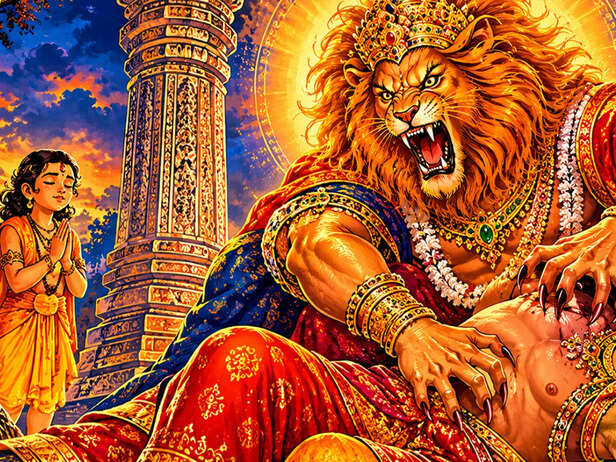
As Hiranyakashipu struck the pillar, a terrifying divine form emerged from it.It was neither completely human nor completely animal.Lord Vishnu appeared as
Narasimha, with the body of a human and the face of a lion.This unusual form was significant because Hiranyakashipu had specifically asked Lord Brahma to protect him from death at the hands of either a human or an animal.Narasimha was neither one nor the other in the ordinary sense.
The Lord had appeared in a form that could overcome the conditions of the boon.A fierce battle followed. Despite his strength and weapons, Hiranyakashipu could not defeat Narasimha.Eventually, the Lord captured him and prepared to end his reign of terror.
How Did Narasimha Defeat Hiranyakashipu Without Breaking the Boon?
![Did Narasimha Defeat Hiranyakashipu]()
Did Narasimha Defeat Hiranyakashipu
Image credit : ChatGPT
This is the most extraordinary part of the story.Lord Narasimha defeated Hiranyakashipu by choosing a time, place and method that did not fall within the protections he had requested.
Each detail had a special significance.
1. Neither day nor nightThe Lord killed Hiranyakashipu during twilight, the period between daytime and nighttime. It was neither fully day nor fully night.
2. Neither inside nor outsideNarasimha took him to the threshold of the palace. This was neither inside the building nor outside it.
3. Neither on the ground nor in the skyThe Lord placed Hiranyakashipu on his lap. He was therefore neither lying on the ground nor suspended in the sky.
4. Neither a human nor an animalNarasimha's form was a combination of human and lion. He was not an ordinary human or an ordinary animal.
5. Without using a conventional weaponHiranyakashipu had asked for protection from weapons. Narasimha used the sharp nails of his own hands to kill him rather than using a conventional weapon.
The
Bhagavata Purana, Seventh Skandha, Chapter 8, Verse 29, describes how Narasimha placed Hiranyakashipu on his lap at the doorway and tore him apart with his nails.In this way, the Lord overcame every condition of the boon.
What Does the Story of Hiranyakashipu and Narasimha Teach Us?
The story is remembered as one of the most powerful examples of Lord Vishnu protecting his devotee.Hiranyakashipu believed that his strength, intelligence and divine protections made him invincible. However, his growing arrogance eventually became the reason for his downfall.
Prahlada, on the other hand, remained devoted to Vishnu despite facing repeated threats from his own father.
The story also explains why Lord Narasimha is worshipped as a protector who appears when evil becomes unbearable and devotees need divine help.His appearance demonstrates that divine power cannot be restricted by the conditions created by human arrogance.The Narasimha Avatar is therefore not just a story about defeating a powerful Asura. It is also a reminder that power without humility can lead to destruction, while faith and devotion can remain strong even in the most difficult circumstances.
Unlock insightful tips and inspiration on personal growth, productivity, and well-being. Stay motivated and updated with the latest at My Life XP.