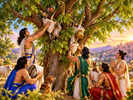
This is one of the most fascinating and morally complex stories from the Mahabharata, the great Indian epic. It revolves around King Yayati, a ruler who became so consumed by his desire for pleasure that he made an extraordinary request to his sons. His story raises a timeless question: Can a person ever have enough of what they desire, or does fulfilling every desire only create the hunger for more?
Who Was King Yayati in the Mahabharata?
![story of desire in the Mahabharata]()
story of desire in the Mahabharata
Image credit : AI
King Yayati was a powerful ruler belonging to the Lunar dynasty, also known as the Chandravansha. He was known for his royal status, ambition, and worldly desires. His life took a dramatic turn when he became involved with Devayani, the daughter of Shukracharya, the revered teacher of the Asuras.Yayati married Devayani, but his relationship with Sharmishtha, who was closely connected to Devayani, eventually created a serious conflict.
According to the traditional account, Sharmishtha became Yayati's second partner, and they had children together. When Devayani discovered the relationship, she was deeply hurt and turned to her father, Shukracharya, for justice.Shukracharya was furious with Yayati for violating the trust placed in him. He pronounced a curse that would force the king to experience premature old age.For Yayati, this was a devastating punishment. He had enjoyed the privileges of kingship and the pleasures of life, and he was unwilling to surrender them so soon.
But the story was far from over.
Why Did Shukracharya Curse King Yayati With Old Age?
Yayati's punishment was connected to his relationship with Devayani and Sharmishtha. Shukracharya believed that the king had acted wrongly despite the trust and relationship he had established with his daughter.His curse transformed Yayati into an old man before he was ready to accept the consequences of ageing.The sudden change was more than a physical transformation. It represented the loss of the vitality and freedom that Yayati associated with youth. Although he remained a king, his body could no longer support the life of pleasure he wanted to continue enjoying.
However, Shukracharya also offered a way for the curse to be exchanged. Yayati could transfer his old age to another person who willingly accepted it and receive that person's youth in return.This unusual condition opened the door to one of the most striking decisions in the Mahabharata: the king would ask his own sons to make the sacrifice.
Why Did Yayati Ask His Sons to Give Him Their Youth?
Yayati was not ready to give up his worldly desires. Rather than accepting old age, he decided to seek youth from his sons.He approached them one by one and asked whether any of them would exchange their youth for his old age. If a son agreed, Yayati could regain his youthful body and continue enjoying the pleasures he believed he had not yet experienced enough.The request placed the sons in an extraordinary position. They were being asked to surrender the best years of their lives so their father could regain something he had lost.
For Yayati, the exchange seemed like a chance to continue living as he wished. For his sons, it meant accepting premature ageing and its burdens.The episode also reveals a difficult conflict between a parent's authority and a child's individual future. In a royal family, obedience to one's father could be seen as a duty, but the sacrifice Yayati demanded was far greater than an ordinary act of obedience.Would any son agree to give up his youth for his father's desires?
How Did Yayati's Sons Respond to His Request?
![Mahabharata stories]()
Mahabharata stories
Image credit : AI
In the traditional Mahabharata account, Yayati approached his sons, including Yadu, Turvasu, Druhyu, Anu, and Puru. Their responses differed, revealing their individual attitudes toward duty, family, and personal life.
1. Yadu Refused to Exchange His Youth
Yadu, Yayati's eldest son in the commonly told account, declined his father's request. He was unwilling to accept old age while still young.From his perspective, surrendering his youth would mean losing the opportunity to experience his own life. He did not wish to bear the physical limitations and suffering associated with premature ageing.
Yayati was displeased with his refusal. The episode highlights the tension between a king's expectations and a son's right to make his own decision.
2. The Other Sons Also Declined
Yayati then approached his other sons. In the traditional narrative, Turvasu, Druhyu, and Anu also refused to take on their father's old age.Their reasons are presented through the hardships associated with ageing and the reluctance to give up youth before its time.Their refusals angered Yayati, who expected his sons to make the sacrifice he wanted. Yet none of them was willing to accept the exchange.
3. Puru Agreed to Sacrifice His Youth
The turning point came when Yayati approached his youngest son, Puru.Unlike his brothers, Puru agreed to accept his father's old age and give him his youth. He was willing to endure the consequences of the exchange out of respect for his father.This decision made Puru central to the story. While his brothers chose to preserve their youth, Puru accepted a sacrifice that would change the course of his own life.
Yayati received Puru's youth, while Puru became old before his time.The exchange allowed the king to return to the life he desired—but it also set the stage for the most important lesson of the story.
What Did Yayati Do After Regaining His Youth?
With his youth restored, Yayati returned to the pleasures of worldly life. He enjoyed the comforts, experiences, and desires that old age had appeared to take away from him.He believed that he could satisfy his cravings by continuing to experience pleasure. Yet the more he indulged himself, the clearer it became that desire did not necessarily disappear after being fulfilled.The story's central insight is captured in a famous teaching associated with Yayati's reflection on desire: desires do not come to an end simply because we keep satisfying them.
The traditional account compares the attempt to extinguish desire through indulgence to pouring fuel onto a fire. Instead of making the fire disappear, more fuel makes it burn stronger.Yayati's experience forced him to confront a truth he had avoided. Youth could be exchanged, and pleasure could be pursued, but neither could guarantee lasting contentment.His problem was not simply that he had grown old. It was that he believed happiness depended on continuing to obtain whatever he wanted.
Why Did Yayati Finally Return His Son's Youth?
After spending a long period enjoying renewed youth, Yayati came to understand the limits of his pursuit. His desires had not vanished, even after he received the opportunity to fulfil them.Eventually, he decided that continuing to indulge himself would not bring the lasting satisfaction he had hoped for. He returned Puru's youth and accepted his own old age.The exchange was reversed, and Puru was restored to youth.
Yayati's decision marked a turning point in his understanding of life. He recognised that endless enjoyment could not provide an escape from the deeper problem of uncontrolled desire.His story suggests that maturity does not come merely from growing older. Sometimes, it comes from recognising when enough is enough.
Why Was Puru Rewarded by Yayati?
Puru's willingness to accept his father's old age had a lasting consequence. In the traditional narrative, Yayati favoured Puru for his obedience and sacrifice, ultimately choosing him as his successor.This decision was significant because Puru was not the eldest son. His conduct, rather than birth order alone, became central to Yayati's choice.Puru went on to become an important figure in the lineage associated with the Kuru dynasty, to which major characters of the Mahabharata, including the Pandavas and Kauravas, belonged.
The episode therefore connects a deeply personal family conflict with the larger dynastic history of the epic.At the same time, Puru's reward raises a question that remains relevant today: should sacrifice for a parent always be expected, or does it become meaningful only when it is freely chosen?The story presents Puru's action as an act of filial devotion, but readers can also reflect on the difficult balance between family duty and personal freedom.
What Is the Real Meaning Behind the Story of King Yayati?
The story of Yayati is not simply about a king who wanted to become young again. It is about the human tendency to believe that happiness lies just beyond the next achievement, possession, or experience.
There are several lessons to draw from his story.
1. Desire can become endless.Yayati believed that more time and more pleasure would satisfy him. His experience showed that fulfilling desires does not automatically eliminate the desire for more.
2. Youth cannot solve every problem.Regaining his youth changed Yayati's physical condition, but it did not immediately change his relationship with pleasure. The story separates physical vitality from inner contentment.
3. Family duty can demand difficult choices.Puru's decision illustrates the value placed on devotion to one's parents in the epic. It also invites reflection on how far a person should be expected to sacrifice for another.
4. Wisdom can come from recognising one's limits.Yayati's eventual decision to give back his son's youth shows that he learned something he could not understand through pleasure alone: there is a difference between enjoying life and becoming controlled by one's desires.
The Timeless Lesson of Yayati's Story
![The King’s Journey Desire and Renunciation]()
The King’s Journey Desire and Renunciation
Image credit : AI
Why did a king ask his own son to give him his youth? Because he was unwilling to accept that his time of youthful pleasure had ended. Yayati believed that if he could regain his youth, he could continue enjoying life until his desires were satisfied.But the exchange did not deliver the lasting fulfilment he expected.Through Yayati, the Mahabharata explores a question that still matters: If we keep getting what we want, will we ever reach a point where we want nothing more?
His story does not suggest that all pleasure is wrong. Instead, it warns against allowing desire to become the force that governs our lives.Yayati could borrow his son's youth, but he could not borrow wisdom. That had to come through his own experience.And perhaps that is the deepest lesson of this ancient tale: time may give us more opportunities to pursue happiness, but only self-understanding can help us recognise when we already have enough.
Unlock insightful tips and inspiration on personal growth, productivity, and well-being. Stay motivated and updated with the latest at
My Life XP.