
Why Did Bhishma Refuse to Fight One Warrior in the Mahabharata?
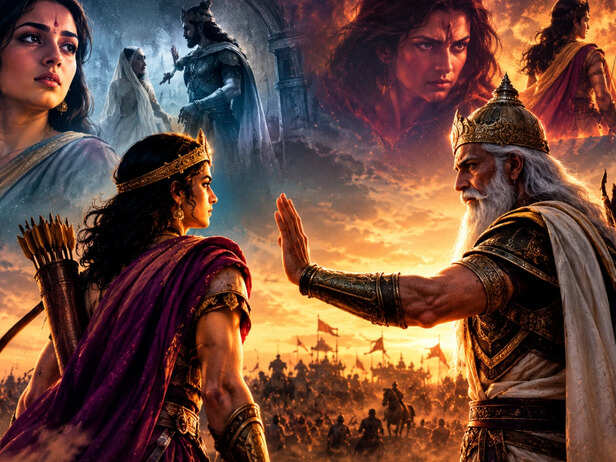
Bhishma, also known as Devavrata, was among the most respected figures in the Mahabharata. He was renowned for his military skill, wisdom, discipline, and extraordinary vow of celibacy, which earned him the name Bhishma.His commitment to the throne of Hastinapura shaped his entire life. During the Kurukshetra war, he fought on the side of the Kauravas, serving as their commander-in-chief despite his affection for the Pandavas.
Why Was Bhishma Nearly Impossible to Defeat?
For ten days, Bhishma proved to be a formidable force on the battlefield. His mastery of weapons made it difficult for the Pandava army to overcome him.But Bhishma had one unusual limitation. According to a widely told version of the Mahabharata, he would not fight Shikhandi because he regarded Shikhandi as a woman in a previous or present identity.
To understand this decision, we must look back at a story that began long before the war.
1. The Story of Amba: The Princess Whose Life Was Changed by Bhishma
The roots of Bhishma’s refusal go back to three princesses of Kashi: Amba, Ambika, and Ambalika.
Bhishma abducted the three princesses during their swayamvara, intending to arrange their marriages to his half-brother, Vichitravirya, the king of Hastinapura.However, Amba revealed that she had already given her heart to King Shalva and wished to marry him. Bhishma allowed her to leave so she could pursue that relationship.But Shalva rejected Amba, arguing that Bhishma had defeated him and taken her away. When Amba returned to Bhishma and asked him to marry her, he refused because of his lifelong vow of celibacy.Amba was left in a painful situation. Her future had been disrupted, and neither Bhishma nor Shalva would accept the marriage she wanted.
Filled with anger and grief, she held Bhishma responsible for her suffering and sought a way to bring about his downfall.Her story became one of the most important examples in the Mahabharata of how a decision made by a powerful person can have consequences far beyond the moment.
2. Amba’s Vow of Revenge: Could Anyone Defeat Bhishma?
Amba was determined to avenge the injustice she believed she had suffered. She approached powerful warriors and sought help in defeating Bhishma, but overcoming him was no easy task.In several tellings of the story, she performed intense austerities and sought divine assistance. She was eventually blessed with the possibility of becoming the cause of Bhishma’s death in a future life.Unable to fulfil her mission in that lifetime, Amba eventually died, carrying her determination into the story of rebirth.
Her story did not end there.According to the Mahabharata, she was reborn as Shikhandi, a figure whose identity and life would become central to the events of the Kurukshetra war.The connection between Amba and Shikhandi transformed a personal grievance from the past into a decisive moment in one of Hindu mythology’s greatest battles.
3. Who Was Shikhandi, and Why Did Bhishma Refuse to Fight?
Shikhandi was born to King Drupada of Panchala. In the Mahabharata’s account, Shikhandi was born female and raised as a son. Later, through events involving a yaksha, Shikhandi acquired a male identity.The details of Shikhandi’s story are complex, and different retellings explain aspects of the transformation in different ways. The crucial point for Bhishma was the connection with Amba and his refusal to fight someone he regarded as a woman.Bhishma recognised Shikhandi as Amba reborn. Because of his principles and his view of Shikhandi’s identity, he would not raise his weapons against Shikhandi.
This was the opening the Pandavas needed.
Bhishma’s refusal was not simply a sign of weakness. It reflected his own code of conduct, but it also created a vulnerability that his opponents could use on the battlefield.
4. How Did Shikhandi Help Bring Bhishma Down?
As the Kurukshetra war continued, the Pandavas realised that defeating Bhishma directly would be extremely difficult. They needed a strategy that could overcome his extraordinary skill without requiring them to defeat him in a conventional duel.According to the epic, Arjuna fought with Shikhandi positioned in front of him. Bhishma refused to attack Shikhandi, leaving himself exposed to Arjuna’s arrows.
Arjuna then struck Bhishma repeatedly, eventually bringing the great warrior down.Bhishma fell onto a bed of arrows, but he did not die immediately. Because of a boon associated with choosing the time of his death, he remained alive until he decided the moment had come.His fall marked a major turning point in the Kurukshetra war. The Kauravas lost their powerful commander, while the Pandavas gained a crucial strategic advantage.Shikhandi did not defeat Bhishma alone through superior strength. Rather, Shikhandi’s presence made it possible for Arjuna to attack a warrior who otherwise seemed almost impossible to overcome.
5. Was Bhishma’s Decision a Weakness or a Matter of Honour?
Bhishma’s refusal to fight Shikhandi raises a fascinating question: was his decision a mistake, or was he simply remaining faithful to his principles?From one perspective, his code of conduct prevented him from fighting someone he considered ineligible for combat. He chose to uphold that principle even when it put him at a disadvantage.From another perspective, his decision had serious consequences for the Kaurava army. By refusing to fight Shikhandi, he gave Arjuna the opportunity to bring him down.
The Mahabharata often explores the tension between personal vows, moral duties, and the responsibilities that come with power. Bhishma’s life is filled with such conflicts. His famous vow shaped the destiny of the Kuru dynasty, and his loyalty to the throne eventually placed him on the side of the Kauravas.His encounter with Shikhandi shows that even the greatest warrior can be caught between personal principles and the demands of a larger conflict.
The Deeper Lesson Behind Bhishma and Shikhandi
The story of Bhishma and Shikhandi is more than a tale of revenge. It connects the consequences of past actions with the unexpected turns of destiny.Amba’s suffering set in motion a chain of events that eventually affected the Kurukshetra war. Bhishma, despite his strength and wisdom, could not escape the consequences of his earlier decisions.At the same time, the episode reminds us that strength alone does not determine the outcome of a conflict. Strategy, personal convictions, and circumstances can shape events just as powerfully as weapons.
Bhishma was not brought down because he lacked courage. He fell because his own principles created an opening that his enemies understood how to use.And that is what makes this episode one of the most compelling stories in the Mahabharata: a warrior who seemed unbeatable was ultimately brought down not by a stronger opponent alone, but by a decision rooted in his own past.
Unlock insightful tips and inspiration on personal growth, productivity, and well-being. Stay motivated and updated with the latest at My Life XP.