
Why Did Krishna Wait So Long to Kill Kansa Despite Knowing His Evil Plans?
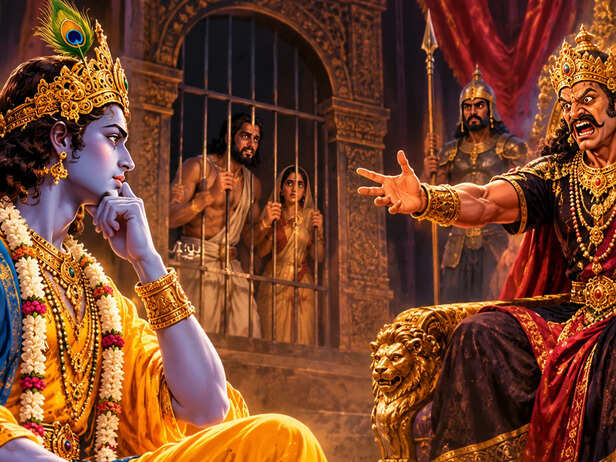
The story begins with the marriage of Devaki and Vasudeva. Devaki was the sister of King Kansa, who ruled Mathura. According to the Bhagavata Purana, during their wedding celebrations, a divine voice made a prophecy that changed Kansa's life.
The Prophecy That Made Kansa Fear Krishna
The voice declared that Devaki's eighth son would become the cause of Kansa's death.Terrified by this prediction, Kansa immediately decided to kill Devaki. However, Vasudeva pleaded with him and promised to hand over every child born to them.Kansa agreed but imprisoned both Devaki and Vasudeva. As their children were born, he killed them one after another.However, the seventh child, Balarama, was transferred to the womb of Rohini through divine intervention. When the eighth child, Lord Krishna, was born, something extraordinary happened.
Why Was Krishna Taken to Gokul Immediately After Birth?
When Krishna was born in the prison of Mathura, the doors opened miraculously, the guards fell asleep and Vasudeva was able to carry the newborn across the Yamuna River.He took Krishna to Gokul and left him in the care of Nanda and Yashoda. In exchange, he brought their newborn daughter back to the prison.When Kansa heard that Devaki had given birth, he rushed to kill the newborn child. But the baby slipped from his hands and appeared in a divine form as Goddess Yogamaya.She warned Kansa that the child destined to destroy him was already safe elsewhere.This made Kansa even more fearful. He began searching for Krishna and ordered demons to kill him.
Why Didn't Krishna Kill Kansa During His Childhood?
One question naturally arises: if Krishna was an incarnation of Lord Vishnu and already knew about Kansa's evil plans, why did he not simply return to Mathura and kill him as a baby?According to the traditional narrative, Krishna's birth was not meant only to end Kansa's rule. His incarnation had a larger purpose connected with protecting dharma, restoring righteousness and relieving the suffering caused by evil forces.His childhood in Gokul and Vrindavan was also an important part of his divine story.During these years, Krishna grew up among the cowherds, formed a deep bond with the people and protected them from several dangers. He also defeated demons sent by Kansa, including Putana, Trinavarta, Aghasura and Bakasura.Each encounter revealed his divine strength and showed that Kansa's attempts to destroy him would never succeed.Rather than rushing directly to Mathura, Krishna's story unfolded through these events, each carrying its own spiritual significance.
How Did Krishna Defeat the Demons Sent by Kansa?
Kansa repeatedly tried to eliminate Krishna because he believed that killing the child would prevent the prophecy from coming true.However, every attempt failed.Some of the most memorable incidents include:
1. Putana's Failed Attempt
Kansa sent the demoness Putana to Gokul to kill Krishna. She disguised herself as a beautiful woman and offered to feed him with poisoned milk. However, Krishna recognised her intention and defeated her.
2. Trinavarta's Attack
Trinavarta appeared as a powerful whirlwind and carried baby Krishna into the sky. Instead of being harmed, Krishna became so heavy that the demon could no longer carry him and eventually fell to the ground.
3. Aghasura's Disguise
Aghasura took the form of an enormous serpent and tried to swallow Krishna and his friends. Krishna entered the serpent's mouth and expanded his body, eventually defeating the demon and saving the cowherd boys.These incidents made Kansa increasingly desperate. Despite sending powerful demons, he could not stop the child who was destined to end his rule.
Why Did Krishna Finally Return to Mathura?
As Krishna grew older, Kansa's fear continued to increase. Eventually, he decided to bring Krishna and Balarama to Mathura through a wrestling competition.He sent Akrura to invite the brothers to the city. Although the invitation appeared respectful, Kansa secretly planned to have them killed.He arranged for a powerful elephant named Kuvalayapida to attack them at the entrance of the wrestling arena. He also prepared two formidable wrestlers, Chanura and Mushtika, to defeat them.However, Krishna and Balarama overcame every challenge.Krishna defeated Kuvalayapida and later fought Chanura, while Balarama defeated Mushtika. When Kansa realised that his plans had failed, he ordered his guards to capture the brothers.That was the moment Krishna finally confronted him.
How Did Krishna Fulfil the Prophecy and Kill Kansa?
Seeing Kansa's cruelty and repeated attempts to harm the people, Krishna jumped onto the royal platform.He seized Kansa and brought an end to his reign. Thus, the prophecy made at Devaki and Vasudeva's wedding was fulfilled.Krishna then freed his imprisoned parents and restored Ugrasena, Kansa's father, to the throne of Mathura.His actions ended a period of fear and oppression for the people of the kingdom.
What Does Krishna's Story Teach Us About Destiny and Dharma?
Krishna's decision to wait until the right moment carries several spiritual lessons.
Destiny Cannot Always Be Escaped: Kansa tried everything to prevent the prophecy from coming true. Yet, his fear and cruelty only brought him closer to the fate he wanted to avoid.
Power Must Be Used for the Right Purpose: Krishna did not use his strength merely to prove his superiority. His actions were connected with protecting innocent people and restoring righteousness.
Patience Is Not Weakness: Krishna's childhood journey shows that waiting for the appropriate moment can be as important as taking action. Patience does not mean accepting injustice forever.
Evil Cannot Continue Forever: Kansa's kingdom appeared powerful, but his cruelty eventually led to his downfall. The story reminds devotees that injustice may continue for a time, but it cannot escape the consequences of its actions.
Why Krishna's Victory Over Kansa Remains Important
The story of Krishna and Kansa is more than a tale of a divine child defeating a cruel king. It is a story about fear, destiny, devotion and the restoration of dharma.Krishna did not rush to Mathura immediately after birth. His journey through Gokul and Vrindavan became an essential part of his divine life, and his eventual return brought an end to Kansa's tyranny.The deeper message is that divine action unfolds according to its purpose and timing. Kansa had power, an army and a kingdom, but none of these could change the destiny foretold at Krishna's birth.
Unlock insightful tips and inspiration on personal growth, productivity, and well-being. Stay motivated and updated with the latest at My Life XP.