Why Did Krishna’s Own Clan Destroy Itself? The Hidden Truth
Noopur Kumari | Aug 24, 2026, 16:00 IST
The most surprising part of this story is that the Yadavas were not destroyed by an outside army. Their downfall came from within their own community.
According to the traditional account, some Yadavas mocked the powerful sage Durvasa by disguising a young man as a pregnant woman and asking whether the “woman” would give birth to a boy or a girl. The sage recognised the insult and cursed that a mace, or musala, would emerge from the youth and eventually become connected with the destruction of the Yadava clan. The curse later unfolded alongside Gandhari’s earlier prophecy, leading toward the tragic end of Krishna’s own people.
According to the traditional account, some Yadavas mocked the powerful sage Durvasa by disguising a young man as a pregnant woman and asking whether the “woman” would give birth to a boy or a girl. The sage recognised the insult and cursed that a mace, or musala, would emerge from the youth and eventually become connected with the destruction of the Yadava clan. The curse later unfolded alongside Gandhari’s earlier prophecy, leading toward the tragic end of Krishna’s own people.

downfall came from within their own community.
Image credit : chatgpt(ai)
How could the mighty Yadava dynasty, protected by the presence of Lord Krishna, eventually destroy itself? The answer lies in one of the most haunting stories connected with the end of the Mahabharata era. After the Kurukshetra war, Krishna visited Gandhari to offer comfort after the destruction of her sons and the Kuru dynasty. But Gandhari held Krishna responsible for allowing the terrible war to happen. In her grief and anger, she cursed him, saying that his own clan would one day face destruction. Years later, a seemingly foolish prank involving a disguised Yadava youth and Rishi Durvasa triggered another terrible curse. What followed would eventually lead to the destruction of the Yadavas themselves.
![Gandhari Curses Lord Krishn]()
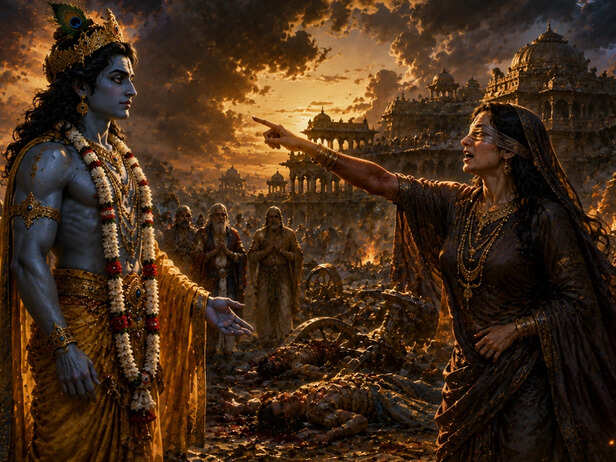
The Kurukshetra war left Gandhari devastated. Her sons and much of her family had been destroyed. Krishna came to her to offer comfort, but Gandhari believed that Krishna could have prevented the catastrophe. Overwhelmed by grief, she cursed Krishna and declared that his own Yadava clan would eventually destroy itself. This moment is important because it introduces the idea that even a powerful dynasty cannot escape the consequences of time, destiny and human actions. The curse did not bring immediate destruction. Instead, its fulfilment unfolded years later through a chain of unexpected events.
![The Yadavas Mock Rishi Durvasa]()
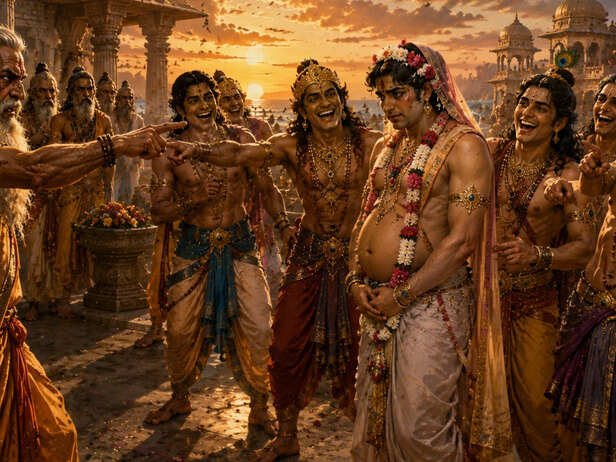
Years later, a group of Yadava youths made a serious mistake. According to the traditional story, they dressed a young man named Samba in women's clothing and placed something beneath the clothing to make him appear pregnant. They then approached the sage Durvasa and mockingly asked whether the “woman” would give birth to a boy or a girl. What seemed like a joke to the young men was viewed as a serious insult by the sage. Their arrogance had crossed a line. The prank became the spark that would eventually connect their actions with the destruction of their own dynasty.
Rishi Durvasa was known in Hindu tradition for his intense temper and powerful curses. When he understood the deception, he responded with a frightening declaration. According to the traditional account, the disguised youth would produce a musala, a mace-like weapon, and that object would become an instrument in the destruction of the Yadava clan. The irony is striking. The people who believed they were simply making a joke unknowingly created the beginning of a tragedy. Their mistake shows how the Mahabharata often turns small acts of arrogance into consequences far greater than anyone expects.
The curse eventually began to take shape when the object described in the prophecy appeared. The Yadavas became frightened and tried to prevent the danger associated with it. In traditional versions of the story, efforts were made to destroy or dispose of the weapon, but its destructive consequence could not simply be erased. This is one of the story’s most powerful ideas: attempting to hide the result of a mistake does not necessarily remove its consequences. The musala became a symbol of a destiny that the Yadavas were unable to escape, despite their attempts to control what was coming.
Eventually, the Yadavas reached the tragic moment foretold by the curse. A dispute erupted among them and turned into violence. Instead of facing an outside enemy, members of the same powerful clan began fighting one another. The very people who had once stood together now became each other’s opponents. The destruction was devastating because the Yadavas possessed immense strength and warrior skills. Yet none of that power could save them once their unity collapsed. Their downfall became a warning about what can happen when pride, conflict and uncontrolled anger consume a community from within.
The story becomes even more powerful because the Yadavas were not an ordinary dynasty. They were Krishna’s own people, and many were formidable warriors. Yet the Mahabharata repeatedly presents the idea that no earthly power lasts forever. The end of the Yadavas is traditionally connected with Gandhari’s curse, Durvasa’s curse and the unfolding of destiny. But the story also highlights human behaviour. Arrogance, mockery, conflict and unchecked anger played important roles in the chain of events. Their destruction therefore feels less like a sudden accident and more like the final result of many forces coming together.
The deepest lesson is not simply that curses are powerful. It is that great strength cannot protect a community that destroys itself from within. The Yadavas had power, status and extraordinary warriors, yet their own behaviour contributed to their downfall. A careless joke became an insult. An insult became a curse. A curse became fear. Fear and conflict eventually became violence. The story reminds us that small acts should not always be dismissed as harmless. Respect, self-control and unity can protect a family or community far more effectively than power alone. The greatest danger can sometimes come from within.
The destruction of the Yadava dynasty is traditionally seen as part of the closing of Krishna’s earthly era. Its story combines grief, curses, human mistakes and destiny in a way that makes it unforgettable. Gandhari’s anger, the Yadavas’ arrogance and Durvasa’s curse all became parts of a much larger chain of events. Whether read through faith, mythology or as a moral story, the message remains striking. No dynasty, family or community becomes invincible simply because it is powerful. When pride replaces humility and unity disappears, even the strongest group can become vulnerable to its own internal conflicts.
Unlock insightful tips and inspiration on personal growth, productivity, and well-being. Stay motivated and updated with the latest at My Life XP.
Gandhari’s Grief Became a Curse
Gandhari Curses Lord Krishn
Image credit : ChatGPT(ai)
The Kurukshetra war left Gandhari devastated. Her sons and much of her family had been destroyed. Krishna came to her to offer comfort, but Gandhari believed that Krishna could have prevented the catastrophe. Overwhelmed by grief, she cursed Krishna and declared that his own Yadava clan would eventually destroy itself. This moment is important because it introduces the idea that even a powerful dynasty cannot escape the consequences of time, destiny and human actions. The curse did not bring immediate destruction. Instead, its fulfilment unfolded years later through a chain of unexpected events.
The Yadavas Made a Dangerous Mistake
The Yadavas Mock Rishi Durvasa
Image credit : ChatGPT(ai)
Years later, a group of Yadava youths made a serious mistake. According to the traditional story, they dressed a young man named Samba in women's clothing and placed something beneath the clothing to make him appear pregnant. They then approached the sage Durvasa and mockingly asked whether the “woman” would give birth to a boy or a girl. What seemed like a joke to the young men was viewed as a serious insult by the sage. Their arrogance had crossed a line. The prank became the spark that would eventually connect their actions with the destruction of their own dynasty.
Durvasa’s Curse Was Unexpected
The Musala Became a Terrifying Sign
The Yadavas Turned Against Each Other
Krishna’s Dynasty Could Not Escape Time
The Real Warning Behind the Curse
The Final Lesson From Krishna’s Clan
Unlock insightful tips and inspiration on personal growth, productivity, and well-being. Stay motivated and updated with the latest at My Life XP.