
Why Did Lord Brahma Lose One of His Five Heads? The Lesser-Known Mythological Story
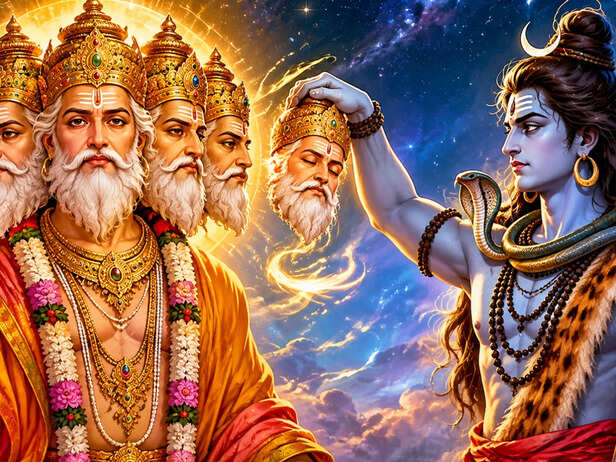
Lord Brahma is known as the creator of the universe in Hindu tradition. He is usually shown with four faces, each looking in a different direction. These four heads are commonly associated with the four Vedas, which represent sacred knowledge.However, some Puranic accounts describe Brahma as having five heads. One explanation for the additional head appears in stories about his relationship with Shatarupa, a female figure created by Brahma. According to one version, Brahma developed additional faces to keep looking at her as she moved in different directions. A fifth head appeared above him when she moved upwards.
This is one explanation found in mythological accounts, but it is not the only version. Other stories focus on Brahma's pride and his conflict with Lord Shiva.
The Dispute That Changed Brahma's Fate
According to a popular Shaiva version of the story, a dispute once arose among the gods and sages about who was the supreme creator of the universe.Brahma claimed that he was the greatest because he was responsible for creation. Lord Shiva, however, represented a power beyond creation and destruction.
Their disagreement became more intense as neither was willing to accept the other's claim. In some versions, Lord Vishnu also becomes involved in the discussion.To settle the dispute, a mysterious pillar of light appeared before Brahma and Vishnu. It stretched endlessly in both directions. The two deities decided to find its limits. Vishnu travelled downwards, while Brahma went upwards.
Neither could discover the beginning or end of the extraordinary light.However, Brahma returned and falsely claimed that he had reached its top. His claim was seen as an act of dishonesty and pride. This incident became the reason for Shiva's anger in one widely known version of the legend.
Why Did Lord Shiva Send Kala Bhairava?
Lord Shiva decided that Brahma's arrogance could not go unchallenged. From his fierce energy emerged Kala Bhairava, a powerful and fearsome manifestation of Shiva.
Shiva instructed Bhairava to punish Brahma. Bhairava then cut off Brahma's fifth head.In the Shiva Purana and other Shaiva accounts, the act is connected with the fifth head's arrogant speech and false claims. The story is often interpreted as a warning that even someone associated with immense knowledge and creative power should not become consumed by ego.The fifth head was removed, leaving Brahma with the four faces seen in most traditional depictions today.
Why Did Lord Shiva Carry Brahma's Severed Skull?
The story takes another unexpected turn after Bhairava cuts off Brahma's head.According to the Bhairava tradition, the act brings the sin of Brahmahatya, or the killing of a Brahmin. The severed skull becomes attached to Bhairava's hand, and he must wander as a mendicant carrying it.
He visits sacred places in search of liberation from this burden. Eventually, he reaches Kashi, also known as Varanasi.There, at the sacred site associated with Kapala Mochana, he is freed from the skull and the burden of the sin. This episode explains the close association between Kala Bhairava and Kashi, where he is worshipped as an important guardian deity.The story is described with some differences across Puranic traditions, but the journey and liberation at Kashi remain important elements of the Bhairava narrative.
Are There Other Stories About Brahma Losing His Fifth Head?
Yes. Hindu mythology contains several versions of this incident.In one account associated with the Varaha Purana, Brahma creates Rudra and addresses him as Kapali, a name associated with carrying a skull. Rudra feels insulted and cuts off Brahma's fifth head.
Another account focuses on Brahma claiming superiority over Shiva and refusing to accept Shiva's greatness. In this version, Bhairava removes the head that speaks arrogantly.These differences show how the same mythological event has been retold in different ways across Hindu texts. The central theme in several Shaiva versions remains the punishment of arrogance and disrespect.
What Does the Story Teach Us?
The story of Brahma's fifth head is more than an account of a divine conflict. It carries lessons that remain meaningful even today.
1. Knowledge should come with humility
Brahma represents creation and sacred knowledge. Yet the story reminds us that knowledge alone does not make someone superior. Humility is equally important.
2. Ego can lead to serious consequences
Brahma's claim of superiority becomes the turning point of the story. It highlights how pride can affect judgement and lead to wrongdoing.
3. Truth matters more than recognition
The pillar of light episode shows the importance of accepting one's limitations rather than making false claims to appear powerful or important.
4. Even powerful beings face consequences
Bhairava's journey after cutting off the head also carries a message about responsibility. Even a powerful divine figure is shown undergoing a process of atonement.
Why Is Lord Brahma Still Shown With Four Heads?
Most traditional images of Brahma show four faces because they are associated with the four Vedas and his role as the creator.
The fifth head appears in particular mythological narratives explaining his conflict with Shiva. Different traditions offer different explanations for its origin and removal.The story remains a fascinating part of Hindu mythology because it connects the ideas of creation, truth, humility and divine responsibility.
Unlock insightful tips and inspiration on personal growth, productivity, and well-being. Stay motivated and updated with the latest at My Life XP.