
Why Did Lord Ganesha Break His Own Tusk to Write the Mahabharata?
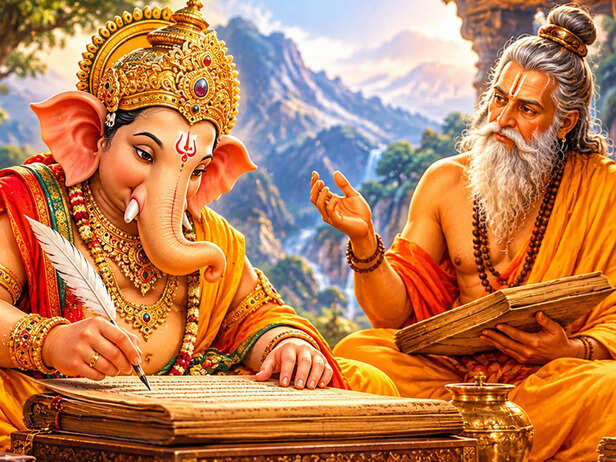
Lord Ganesha is worshipped as the remover of obstacles and the god of wisdom. His elephant head, large ears and single broken tusk make him one of the most recognisable deities in Hindu mythology.But unlike other gods, Lord Ganesha is often depicted with one complete tusk and one broken tusk. This unusual appearance has an interesting story behind it.According to a popular legend, Ganesha broke his own tusk to write one of the greatest epics in Hindu tradition, the Mahabharata. But why did he need to sacrifice a part of himself? And what made him agree to undertake such a challenging task?The answer lies in a fascinating meeting between Lord Ganesha and Sage Ved Vyasa.
Why Did Sage Ved Vyasa Need Lord Ganesha's Help?
According to the legend, Sage Ved Vyasa wished to compose the Mahabharata, an epic that would narrate the story of the Kauravas and Pandavas, their rivalry, the Kurukshetra war and the teachings of Lord Krishna.However, the Mahabharata was not an ordinary story. It contained thousands of verses covering complex ideas about duty, morality, family, politics, devotion and human behaviour.Sage Vyasa wanted someone who could write down the entire epic as he dictated it. He needed a writer who was not only intelligent but also capable of understanding the depth of his verses.He realised that Lord Ganesha, known for his extraordinary wisdom and knowledge, was the perfect choice.Vyasa approached Ganesha and requested him to become the writer of the Mahabharata.Ganesha agreed, but he placed one condition before the sage.
The One Condition Lord Ganesha Placed Before Vyasa
Lord Ganesha agreed to write the epic on one condition: Sage Vyasa must recite the verses continuously without stopping.Ganesha explained that his writing would not pause once he began recording the epic. If Vyasa stopped dictating, Ganesha would stop writing as well.This created a challenge for the sage. The Mahabharata was an enormous composition, and Vyasa needed time to think about the meaning and structure of certain verses.So, he placed his own condition before Ganesha.Vyasa said that Ganesha must understand the meaning of every verse before writing it down.Ganesha accepted this condition.The agreement allowed both to continue their work. Whenever Vyasa needed time to compose the next verse, he would recite a particularly complex shloka. Ganesha would pause to understand its meaning before writing it.This gave the sage enough time to prepare the following verses while ensuring that the writing continued.
Why Did Lord Ganesha Break His Own Tusk?
As the dictation began, Ganesha started writing the Mahabharata with great concentration.However, according to the popular legend, the writing instrument he was using broke during the process.The challenge was now in front of him. He had promised not to interrupt the writing, and stopping would mean breaking his agreement with Sage Vyasa.Rather than allowing the work to come to a halt, Ganesha made an extraordinary decision.He broke off one of his own tusks and used it as a writing instrument.Without waiting for another pen or writing tool, he continued recording the epic.
This act became a symbol of his dedication to knowledge and his willingness to sacrifice something of himself for a greater purpose.The broken tusk also became one of the most distinctive features of Lord Ganesha's appearance. He is therefore widely known as Ekadanta, meaning the one with a single tusk.
What Does the Name Ekadanta Mean?
The name Ekadanta comes from two Sanskrit words: Eka, meaning one, and Danta, meaning tusk.Together, they describe Lord Ganesha's appearance with one complete tusk.Ekadanta is also one of the many names used to worship Lord Ganesha.His broken tusk is not simply an unusual physical feature. In this story, it represents determination, sacrifice and commitment to a meaningful responsibility.The legend teaches that knowledge requires patience and dedication. Sometimes, achieving something valuable means putting personal comfort aside.
Is There Another Story Behind Lord Ganesha's Broken Tusk?
Interestingly, the Mahabharata writing episode is not the only explanation associated with Ganesha's broken tusk.Another popular legend connects it to a battle with Parashurama, an incarnation of Lord Vishnu.According to this story, Parashurama once visited Mount Kailash to meet Lord Shiva. However, Ganesha was guarding the entrance and did not allow him to enter because Shiva was resting.This angered Parashurama, who challenged Ganesha.
During their encounter, Parashurama threw his divine axe towards Ganesha. Recognising that the weapon had been gifted to him by his father, Lord Shiva, Ganesha chose not to resist it with full force.The axe struck one of his tusks, breaking it.This is another traditional explanation for why Ganesha is depicted with a broken tusk. Different Hindu texts and regional traditions preserve different versions of the story.
The Deeper Lesson Behind Ganesha's Broken Tusk
The story of Lord Ganesha breaking his tusk to write the Mahabharata carries a message that goes beyond mythology.
It highlights three important qualities:
1. Dedication towards knowledge: Ganesha did not allow an unexpected difficulty to interrupt an important responsibility. His actions symbolise commitment to learning and wisdom.
2. Presence of mind: Instead of becoming helpless when his writing instrument broke, he immediately found another way to continue his work.
3. Sacrifice for a greater purpose: Ganesha's willingness to use his own tusk represents the importance of dedication and putting meaningful responsibilities above personal convenience.
Why Lord Ganesha's Broken Tusk Is More Than Just a Symbol
The story of Lord Ganesha and Sage Ved Vyasa reminds devotees that even the greatest tasks require patience, intelligence and determination.
Ganesha could have stopped writing when his instrument broke. Instead, he chose to continue by sacrificing one of his own tusks.That is why his broken tusk is remembered as a symbol of wisdom and commitment.The next time you see Lord Ganesha's idol, look closely at his tusks. Behind that distinctive appearance lies a story about the importance of knowledge, overcoming difficulties and never giving up on a meaningful responsibility.
Unlock insightful tips and inspiration on personal growth, productivity, and well-being. Stay motivated and updated with the latest at My Life XP.