
Why Did Lord Ganesha Write the Mahabharata Without Taking a Break? The Story Behind His Broken Tusk
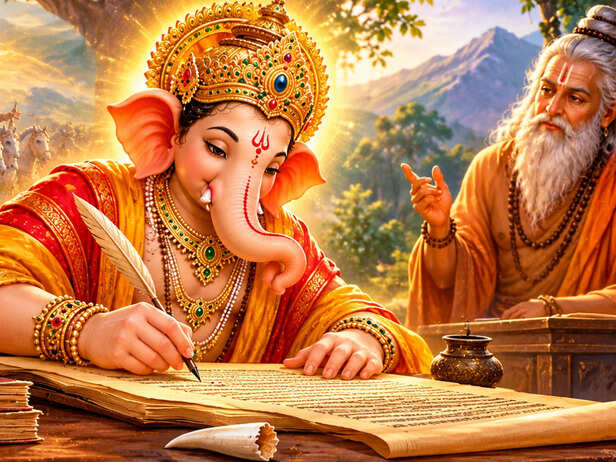
According to Hindu tradition, Lord Ganesha served as the scribe who recorded the Mahabharata as Sage Vyasa narrated it. But there was an unusual condition behind this task. Ganesha agreed to write the entire epic without stopping, and he made Vyasa promise that he would never pause while dictating.
This fascinating story also explains why Lord Ganesha is often depicted with a broken tusk. It reveals how his intelligence, patience and determination helped preserve one of Hinduism's most important sacred texts.
Why Did Sage Vyasa Need Lord Ganesha's Help?
Sage Vyasa is traditionally credited with composing the Mahabharata. The epic contains stories of kings, warriors, sages, divine interventions, moral dilemmas and the famous Bhagavad Gita.
According to the popular legend, Vyasa wanted to preserve his composition in written form so that future generations could learn from it. However, the epic was extremely long and contained complex philosophical teachings.He needed someone who could understand his words and write them down quickly without losing their meaning.Sage Vyasa realised that Lord Ganesha, known for his wisdom and intelligence, was the perfect choice. He approached the deity and requested him to become the scribe of the Mahabharata.Ganesha agreed, but he placed one condition before accepting the responsibility.
What Condition Did Lord Ganesha Place Before Vyasa?
Lord Ganesha told Sage Vyasa that he would write the Mahabharata only if Vyasa promised to narrate it continuously.Ganesha explained that he would not stop writing once the narration began. If Vyasa paused even for a moment, Ganesha would stop his work.
This condition made the task difficult for Vyasa. The Mahabharata was not an ordinary story that could be narrated quickly. It contained thousands of verses and complicated ideas that required careful thought.However, Vyasa was equally wise. He accepted Ganesha's condition but placed a condition of his own.He told Ganesha that he must understand every verse completely before writing it down. Ganesha agreed to this requirement.This arrangement allowed both of them to begin their extraordinary task.
Why Did Lord Ganesha Break His Own Tusk?
As Sage Vyasa began narrating the Mahabharata, Lord Ganesha started writing continuously.However, according to one widely told version of the story, the writing instrument he was using broke during the narration.Ganesha now faced a difficult situation. He had promised not to stop writing, and Vyasa was continuing to recite the verses.Rather than interrupt the narration or abandon his promise, Ganesha broke off one of his own tusks and used it as a writing instrument.
He continued recording the epic with the broken tusk.This is one of the popular explanations for why Lord Ganesha is known as Ekadanta, meaning the one with a single tusk.The story highlights his determination and willingness to make a personal sacrifice to fulfil his responsibility.
How Did Sage Vyasa Use Difficult Verses to Get Time?
Although Ganesha had agreed to write without stopping, Sage Vyasa had to think carefully about the verses he was narrating.The Mahabharata contains complex philosophical ideas, and Vyasa needed time to organise his thoughts and prepare the next part of the narration.
According to the popular account, he used a clever approach. Occasionally, he would recite particularly complicated verses that required Ganesha to understand their meaning before writing them down.While Ganesha reflected on these verses, Vyasa gained a little time to prepare what he would narrate next.This arrangement allowed the two great figures to continue their work without breaking their promises.It also demonstrates that intelligence is not limited to speed. Understanding, patience and careful thinking are equally important.
Why Is Lord Ganesha Called Ekadanta?
The story of writing the Mahabharata is closely associated with one of Lord Ganesha's most recognisable features: his single tusk.The word Ekadanta comes from two Sanskrit words. 'Eka' means one, while 'Danta' means tusk or tooth.Lord Ganesha is therefore known as Ekadanta because he is traditionally depicted with one complete tusk and one broken tusk.Different Hindu traditions offer different explanations for his broken tusk. Apart from the Mahabharata story, another popular legend connects it with his encounter with Lord Parashurama.
In that account, Parashurama became angry after Ganesha stopped him from meeting Lord Shiva. During their confrontation, Ganesha lost one of his tusks.Both stories are remembered in Hindu mythology and explain the unusual appearance of the deity in different ways.
What Does the Story of Ganesha Writing the Mahabharata Teach Us?
The story is more than an explanation of Lord Ganesha's broken tusk. It carries several meaningful lessons.
1. Determination helps overcome difficulties
When Ganesha's writing instrument broke, he did not abandon his responsibility. He found another way to continue his work. This teaches devotees to remain determined when unexpected problems arise.
2. Wisdom is more important than speed
Ganesha agreed to understand every verse before writing it. This highlights the importance of thinking carefully rather than simply completing a task quickly.
3. Promises should be respected
Both Ganesha and Sage Vyasa followed the conditions they had accepted. Their cooperation shows the importance of commitment and mutual respect.
4. Sacrifice can serve a greater purpose
Ganesha gave up one of his tusks to continue writing the epic. His action is remembered as a symbol of dedication and willingness to put a greater responsibility above personal comfort.
Why Is This Story Still Remembered Today?
Lord Ganesha is worshipped as the deity of wisdom, knowledge and new beginnings. Before starting important activities, many devotees offer prayers to him, seeking clarity and the ability to overcome obstacles.His role in writing the Mahabharata gives another reason for this association with learning and intelligence. Students, writers and scholars often seek his blessings before beginning their studies or important work.
The story also reminds people that even a difficult task can be completed through patience, determination and intelligent thinking.The next time you see an idol of Lord Ganesha with one broken tusk, remember the popular legend behind it. It is not simply a feature of his appearance but a reminder of the extraordinary dedication associated with his role as the scribe of the Mahabharata.
Unlock insightful tips and inspiration on personal growth, productivity, and well-being. Stay motivated and updated with the latest at My Life XP.