
Why Did Lord Ram Shoot Just One Arrow Through 7 Trees?
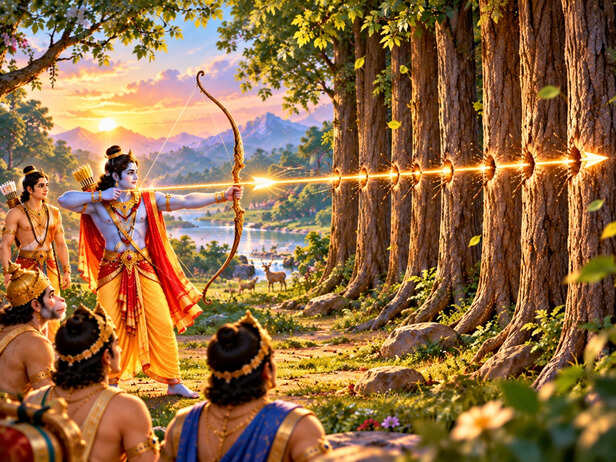
One arrow. Seven trees. And a journey that did not end where anyone might expect. In the Ramayana, Lord Ram performs an extraordinary feat to remove Sugriva’s doubts about his strength. But the most fascinating detail is not just what the arrow pierced. It is where the arrow went after completing its path. The episode offers a memorable glimpse into Lord Ram’s power and the moment Sugriva’s uncertainty turned into complete faith.
Sugriva Had One Big Doubt About Ram
The story begins in Kishkindha, where Sugriva formed an alliance with Lord Ram. Sugriva wanted Ram’s help against his brother Vali, but he was unsure whether Ram possessed the strength needed for the challenge. His hesitation was understandable because the outcome mattered deeply to him. Rather than relying on promises alone, Sugriva wanted to see proof. This doubt led to one of the most memorable episodes in the Valmiki Ramayana, where Lord Ram demonstrated his extraordinary ability with a single arrow.
Ram Chose Seven Sala Trees
To answer Sugriva’s doubts, Lord Ram lifted his bow and released a golden arrow. According to the account in the Valmiki Ramayana, the arrow passed through seven sala trees, demonstrating a level of strength that left Sugriva astonished. The scene is remembered not simply because of the number of trees, but because Ram used one arrow to accomplish what Sugriva had struggled to imagine. This moment became a turning point in their relationship, replacing uncertainty with trust in Ram’s promise to help him.
The Arrow Continued Beyond the Trees
The astonishing part of the story did not end with the seven trees. The Valmiki Ramayana describes the arrow continuing onward, passing through a mountain before entering the earth. This detail made the demonstration even more remarkable for Sugriva, who had wanted to understand the extent of Ram’s strength. The golden arrow’s journey showed that Ram’s demonstration was far beyond what Sugriva had expected. It was the complete sequence, rather than just the trees, that made this episode so memorable in the story of their alliance.
Where Did Lord Ram’s Arrow Return?
Here is the answer to the central question: according to the account described in the Valmiki Ramayana, the arrow emerged from the earth and returned directly to Lord Ram’s quiver within a muhurta, a traditional unit of time. It did not simply stop after passing through the trees or disappear into the ground. Its return completed the extraordinary demonstration. Sugriva was amazed by what he had witnessed, and his doubts about Ram’s ability to help him were replaced by faith in his new ally.
How Sugriva Responded to the Feat
Sugriva was overwhelmed by the demonstration and bowed before Lord Ram in respect. The moment strengthened the bond between them and helped establish the trust their alliance needed. For Sugriva, Ram’s actions provided the reassurance that words alone could not offer. The episode also highlights an important theme in the Ramayana: trust can grow when a promise is supported by action. Their relationship would go on to play a significant role in the search for Mata Sita, making this meeting an important step in the larger epic.
The Answer Behind Ram’s Seven-Tree Arrow
So, where did Lord Ram’s arrow return after passing through seven trees? The traditional account says it travelled through the mountain, entered the earth, emerged again and returned to his quiver within a muhurta.
This episode from the Valmiki Ramayana is remembered for more than the extraordinary feat itself. It marks the moment Sugriva’s doubts gave way to trust. Sometimes, one decisive act can communicate what many words cannot. In this story, Ram’s arrow became the proof Sugriva needed to believe in the promise of a powerful ally.
Unlock insightful tips and inspiration on personal growth, productivity, and well-being. Stay motivated and updated with the latest at My Life XP