
Why Did Lord Vishnu Take the Form of Hayagriva to Restore the Vedas?
In Hindu tradition, the Vedas are considered among the oldest and most sacred sources of spiritual knowledge. They contain hymns, prayers, rituals and philosophical teachings that explain the relationship between human beings, nature and the divine.There are four Vedas: Rigveda, Samaveda, Yajurveda and Atharvaveda. Together, they form an important foundation of Hindu religious and philosophical traditions.
According to Hindu cosmology, Lord Brahma is responsible for creation, Lord Vishnu preserves the universe, and Lord Shiva performs the work of destruction and transformation.The Vedas are closely associated with Lord Brahma because they provide the knowledge necessary for creation and the proper functioning of the universe.
However, a fascinating mythological story describes how this sacred knowledge once disappeared, creating a serious threat to cosmic balance.
How Did Demons Madhu and Kaitabha Steal the Vedas?
According to a popular Puranic account, during the beginning of creation, Lord Vishnu was resting on the cosmic serpent Shesha in the primordial ocean.Meanwhile, Lord Brahma was engaged in the process of creation. The sacred Vedas were essential to his work because they contained the knowledge needed to establish order in the universe.At this time, two powerful demons named Madhu and Kaitabha emerged from the earwax of Lord Vishnu, according to the traditional narrative.
The demons became extremely powerful and eventually stole the Vedas from Lord Brahma.They took the sacred scriptures away and hid them in the depths of the cosmic ocean.Without the Vedas, Lord Brahma faced difficulties in continuing the process of creation. The knowledge that guided the universe had disappeared, threatening the balance of the cosmic system.The situation required divine intervention.
Why Did Lord Vishnu Take the Form of Hayagriva?
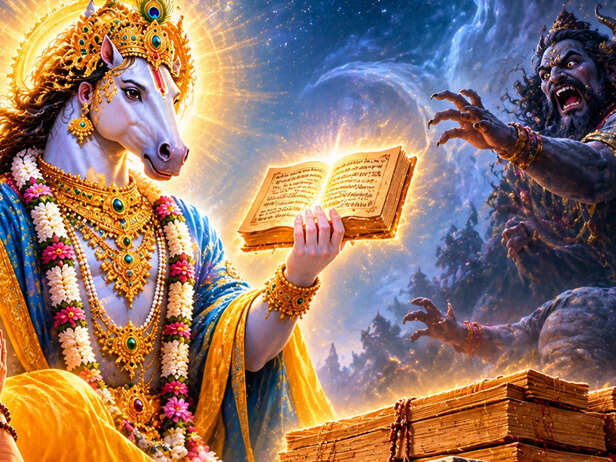
When the sacred knowledge disappeared, Lord Vishnu decided to recover the Vedas and restore cosmic order.He assumed a remarkable form known as Hayagriva.The name Hayagriva comes from two Sanskrit words: Haya, meaning horse, and Griva, meaning neck. Hayagriva is therefore recognised by his distinctive horse-headed appearance.In this divine form, Lord Vishnu is generally depicted with a white horse's head, a human body and a peaceful, radiant appearance. He is often shown holding sacred scriptures, representing knowledge and wisdom.
But why did Vishnu choose such an unusual form?In Hindu symbolism, the horse is associated with energy, strength, speed and alertness. Hayagriva's appearance represents the power of divine knowledge and the ability to overcome ignorance.His incarnation also highlights an important belief in Hinduism: whenever knowledge and righteousness are threatened, the divine appears to protect them.
How Did Hayagriva Recover the Sacred Vedas?
According to the popular version of the story, Lord Vishnu assumed the Hayagriva form and entered the depths of the cosmic ocean to recover the stolen scriptures.The demons Madhu and Kaitabha had hidden the Vedas in the waters, believing that nobody could retrieve them.However, Hayagriva was determined to restore the sacred knowledge.He confronted the forces responsible for taking the scriptures and ultimately recovered the Vedas.
The sacred texts were then returned to Lord Brahma, allowing him to continue the work of creation.With the restoration of the Vedas, the cosmic order was protected and the knowledge required to guide the universe became available again.The story presents Hayagriva not merely as a powerful divine warrior but also as the protector of sacred wisdom. Different Puranic and regional traditions narrate the Hayagriva story differently. In some accounts, Hayagriva is described primarily as the divine form of Vishnu associated with knowledge, while other narratives connect the recovery of the Vedas with the demons Madhu and Kaitabha.
Why Is Lord Hayagriva Considered the God of Knowledge?
The significance of Hayagriva extends beyond the story of recovering the Vedas.In Hindu tradition, Lord Hayagriva is worshipped as a deity associated with education, intelligence, memory and wisdom.Students, teachers and scholars seek His blessings for better understanding and learning.He is particularly revered in several Vaishnava traditions, where He is considered the divine source of knowledge.
His horse-headed appearance is also deeply symbolic.The horse represents alertness, speed and strength, while the scriptures associated with Him represent wisdom and spiritual understanding.Together, these qualities reflect the belief that true knowledge requires both intelligence and discipline.Unlike knowledge that is used for personal power or selfish purposes, Hayagriva represents wisdom that protects righteousness and benefits the world.
Why Are Lord Hayagriva's Images Usually White?
One interesting detail about Lord Hayagriva is that He is frequently depicted with a white complexion.In Hindu symbolism, white is associated with purity, peace, clarity and spiritual knowledge.His white appearance represents the purity of wisdom and the removal of ignorance.He is also commonly shown holding a book, a conch, a discus and other divine attributes, although the details vary across different artistic and religious traditions.
The book represents sacred knowledge, while the conch and discus connect Him with Lord Vishnu's divine identity.These symbols explain why Hayagriva is considered an important deity for those seeking education and spiritual understanding.
What Does the Story of Hayagriva Teach Us?
The story of Lord Vishnu taking the Hayagriva form carries several important lessons.
1. Knowledge Must Be Protected: The recovery of the Vedas reminds us that knowledge is essential for maintaining order and guiding society.
2. Wisdom Is More Powerful Than Ignorance: The demons represent forces that threaten sacred knowledge, while Hayagriva represents the divine power that protects wisdom.
3. Every Form of the Divine Has a Purpose: Vishnu's unusual horse-headed appearance reminds devotees that the divine can take different forms to fulfil a particular responsibility.
4. Knowledge Should Be Used for Good: The story highlights that wisdom is meaningful when it supports righteousness and benefits the larger world.
5. Learning Requires Humility: Worship of Hayagriva reminds students and seekers that gaining knowledge requires patience, dedication and respect for wisdom.
The Divine Protector of Sacred Wisdom
The story of Lord Vishnu's Hayagriva form is a reminder that knowledge holds a special place in Hindu philosophy. When the sacred Vedas disappeared, the balance of creation was threatened, and Vishnu appeared to restore what had been lost.His unusual horse-headed form became a symbol of wisdom, learning and the protection of truth.Even today, devotees worship Lord Hayagriva for knowledge and clarity, remembering the divine form that protected the sacred teachings and helped preserve cosmic order.
Unlock insightful tips and inspiration on personal growth, productivity, and well-being. Stay motivated and updated with the latest at My Life XP.