
Why Did Shiva Hide From the Pandavas at Kedarnath?
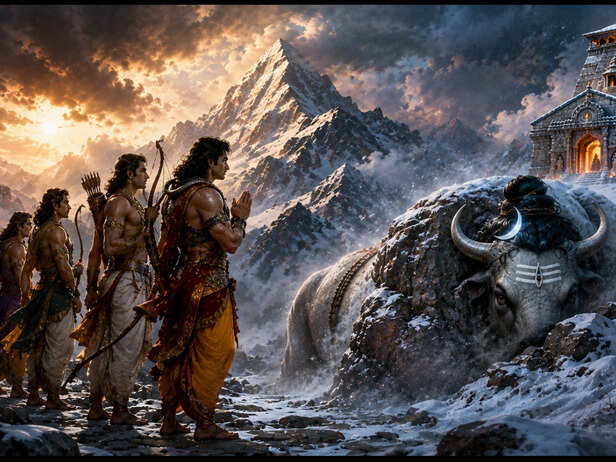
What if the story behind Kedarnath is not simply about a temple, a mountain or a pilgrimage?
According to a traditional account, its story begins much earlier, with the intense penance of Nara and Narayana and their devotion to Lord Shiva. Later, after the Kurukshetra war, the Pandavas came seeking relief from the burden of their actions. But Shiva did not immediately reveal himself.
Instead, the tradition says that Mahadev took the form of a bull and tried to disappear from their sight.
What followed was a remarkable encounter involving Bhima, a stubborn grip and a divine form that became associated with Kedarnath.
The Story Begins With Nara and Narayana
The traditional legend begins with Nara and Narayana, revered sages and associated with Lord Vishnu in Hindu tradition. They are believed to have performed intense penance in the Himalayan region. Their devotion was directed toward Lord Shiva, and their tapasya eventually pleased Mahadev. When Shiva appeared and offered them a boon, they made a remarkable request. They asked him to remain in the region so that devotees could seek his blessings and spiritual liberation. This tradition connects Shiva’s presence in the Himalayan landscape with the sacred significance later associated with Kedarnath.
Shiva’s Sacred Presence Became Kedareswar
According to the traditional account, Shiva accepted the devotion of Nara and Narayana and manifested as a sacred presence in the region. This form came to be associated with the name Kedareswar. The story gives the Himalayan landscape a deeper spiritual meaning, presenting it not merely as a place of natural beauty but as a space shaped by devotion and penance. Over time, the sacred tradition surrounding Shiva’s presence became closely connected with Kedarnath. For devotees, the story represents the idea that sincere spiritual practice can create a lasting connection between the divine and a sacred place.
Why Did the Pandavas Seek Shiva?
The Mahabharata war left the Pandavas victorious, but victory did not erase the consequences of war. Their actions had resulted in immense destruction, including the deaths of relatives, teachers and members of their own extended family. According to the traditional Kedarnath legend, the Pandavas wanted to seek Shiva’s blessings and relief from the burden of their actions. They were advised to approach the sacred form of Shiva at Kedareswar. But Mahadev did not make the meeting easy. The story presents an important spiritual idea: seeking forgiveness requires genuine humility and an honest confrontation with the consequences of one's actions.
Shiva Took the Form of a Bull
The traditional story says that Shiva did not want to appear before the Pandavas immediately. He took the form of a bull and mixed among other animals. The Pandavas became suspicious, and Bhima, known for his extraordinary strength, decided to stop the mysterious bull. He stood in its path and tried to prevent it from escaping. Shiva attempted to disappear into the earth, but Bhima refused to let go. According to the legend, he held on to the bull’s tail. This moment became one of the most memorable parts of the Kedarnath tradition.
Bhima’s Determination Changed Everything
Bhima’s actions are often interpreted as a symbol of determination. He did not simply demand that Shiva appear. He continued pursuing the mysterious bull until Mahadev finally accepted the Pandavas’ devotion. In the traditional account, Shiva eventually revealed his divine nature, and the Pandavas received his grace. The story does not suggest that actions can simply be erased through a request. Instead, it places repentance, devotion and sincere effort at the centre of the journey. Bhima’s grip becomes a powerful image of refusing to abandon the search for spiritual redemption.
The Sacred Form Became Kedarnath
The traditional narrative connects the place where the bull’s form appeared with Kedarnath and Shiva’s sacred presence there. Kedarnath is also one of the Jyotirlinga sites revered in Shaiva tradition and is part of the Himalayan pilgrimage known as the Char Dham of Uttarakhand. Devotees travel through challenging terrain to seek Mahadev’s darshan. The journey itself can become an act of devotion, patience and discipline. For many pilgrims, the mountains, silence and temple create an atmosphere that feels deeply spiritual. The legend gives this pilgrimage an additional layer of meaning rooted in ancient tradition.
The Real Lesson Is About Karma
The deepest message of the story is not simply that Shiva can forgive. It is that actions carry consequences, while sincere repentance can change the direction of a person’s life. The Pandavas did not simply walk away from the war and forget what had happened. They sought Shiva and confronted the spiritual weight of their actions. This makes the story relevant even today. When we make mistakes, running away rarely solves anything. A better path is to accept responsibility, learn from our actions and sincerely work toward becoming better. That is where devotion becomes more than ritual.
Unlock insightful tips and inspiration on personal growth, productivity, and well-being. Stay motivated and updated with the latest at My Life XP