Why Did Shiva Wander Naked After Sati’s Death? The Truth
Noopur Kumari | Sept 28, 2026, 11:00 IST
After Sati’s death, Shiva’s grief became so intense that he moved beyond ordinary social boundaries. But this story goes deeper than grief alone. Shiva’s fierce forms, Bhairava traditions and tantric symbolism explore powerful ideas about attachment, destruction, detachment and consciousness. Behind the frightening imagery lies a deeper question: what happens when grief transforms the way we see ourselves?

Shiva Wander Naked After Sati’s Death
Image credit : ChatGPT(ai)
What happened to Lord Shiva after Sati’s death is one of the most intense episodes in Hindu mythology. Tradition describes Shiva consumed by grief, carrying Sati’s body and wandering in a state of profound detachment. Stories and tantric traditions also describe fierce forms of Shiva connected with this period, including Unmatta Bhairava, one of the eight Bhairava forms.
But there is a deeper question behind this mysterious imagery: Was Shiva’s fierce form really about madness, or does it represent something far more symbolic?
![Goddess Sati and Lord Shiva in the Himalayas]()
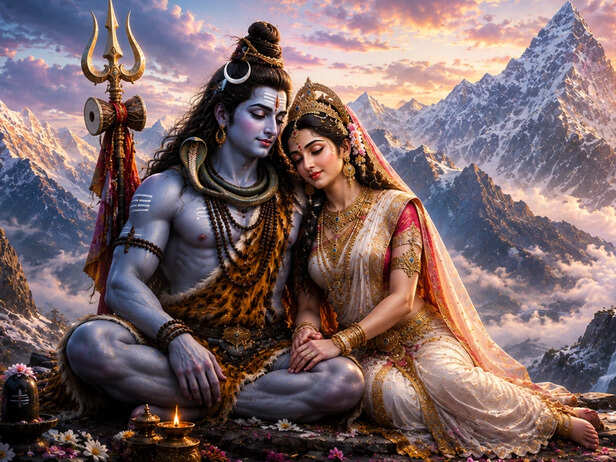
After Sati’s death, traditional accounts describe Shiva entering an intense state of grief. He carried her body and wandered, unable to accept the loss. In popular retellings, this moment is often presented as Shiva losing awareness of the ordinary world around him. Vishnu eventually intervenes in the larger cosmic sequence, and the story of Sati’s body becoming associated with the Shakti Peethas follows from this tradition. The image of Shiva wandering in grief is therefore more than a dramatic scene. It represents a moment when even the detached Mahadeva is shown confronting overwhelming attachment and loss.
![Shiva in His Unadorned Form]()
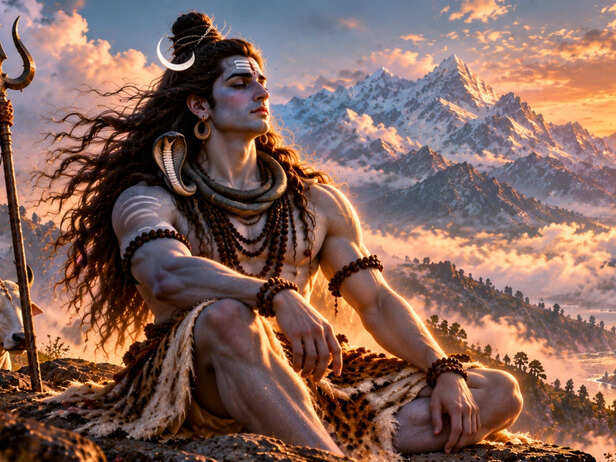
The idea of a naked or unadorned Shiva appears in Shaiva and tantric symbolism, but it should not be treated as one simple story found identically in every scripture. The Sanskrit idea of nagna can describe being unadorned, and Bhairava traditions also use imagery that moves beyond ordinary social conventions. In symbolic terms, such imagery can point toward Shiva existing beyond attachment, status and social identity. This makes the image far more complex than simply saying that Shiva was physically wandering without clothes because he had “lost his mind.”
One of the most intriguing names connected with fierce Shiva traditions is Unmatta Bhairava. He is traditionally counted among the eight Bhairavas, alongside forms such as Asitanga, Ruru, Chanda, Krodha, Kapala, Bhishana and Samhara. The word unmatta is associated with a state beyond ordinary restraint or conventional consciousness. In tantric interpretation, the symbolism is not simply about uncontrolled madness. It can represent confronting the limits of ordinary identity and transforming intense states rather than being controlled by them.
The unusual appearance of Bhairava can be startling because it deliberately moves away from familiar peaceful images of Shiva. Ashes, skulls, fierce expressions and unconventional forms appear across Bhairava iconography. These images are often connected with mortality, fear, ego and the boundaries of ordinary life. That is why the story can be read on more than one level. Shiva’s extreme imagery is not merely designed to frighten. It can also represent a consciousness that confronts everything people normally avoid: grief, death, attachment, fear and the loss of control.
The connection between Shiva and Tantra is especially important when discussing fierce forms such as Unmatta Bhairava. Different tantric traditions have their own texts, practices and interpretations, so it would be misleading to claim that every tradition teaches the same ritual method. Unmatta Bhairava is recognised in Shaiva tantric cycles as one of the eight Bhairavas. The emphasis is often on transforming fear, attachment and fixed ideas rather than simply performing dramatic rituals. This is also why tantric practices should not be reduced to viral claims about “dangerous powers” or supernatural experiences.
Claims that a particular Bhairava sadhana will automatically cause dangerous supernatural effects are not something that can be established as a universal fact. However, specialised tantric practices do belong to specific traditions and lineages, where initiation, ritual rules and guidance can matter. Some modern teachers discussing Unmatta Bhairava also emphasise understanding the symbolic and disciplined nature of the practice rather than treating it as an experiment. For readers, the safest approach is simple: do not attempt specialised tantric rituals from an unverified social-media script or without understanding the tradition behind them.
The most powerful part of this story may not be the frightening imagery at all. Shiva’s journey after Sati’s death can be understood as a story about what happens when grief and attachment overwhelm ordinary identity. Unmatta Bhairava then adds another layer, representing a fierce Shiva form that challenges conventional ideas of order and consciousness. Rather than calling the form simply “dangerous,” it is more meaningful to ask what the symbolism is trying to express. Shiva’s fierce forms remind us that Hindu traditions often portray the divine through both serene and terrifying imagery.
Unlock insightful tips and inspiration on personal growth, productivity, and well-being. Stay motivated and updated with the latest at My Life XP
But there is a deeper question behind this mysterious imagery: Was Shiva’s fierce form really about madness, or does it represent something far more symbolic?
Shiva Was Consumed by Grief
Goddess Sati and Lord Shiva in the Himalayas
Image credit : chatgpt(ai)
After Sati’s death, traditional accounts describe Shiva entering an intense state of grief. He carried her body and wandered, unable to accept the loss. In popular retellings, this moment is often presented as Shiva losing awareness of the ordinary world around him. Vishnu eventually intervenes in the larger cosmic sequence, and the story of Sati’s body becoming associated with the Shakti Peethas follows from this tradition. The image of Shiva wandering in grief is therefore more than a dramatic scene. It represents a moment when even the detached Mahadeva is shown confronting overwhelming attachment and loss.
The “Naked Shiva” Needs Context
Shiva in His Unadorned Form
Image credit : ChatGPT(ai)
The idea of a naked or unadorned Shiva appears in Shaiva and tantric symbolism, but it should not be treated as one simple story found identically in every scripture. The Sanskrit idea of nagna can describe being unadorned, and Bhairava traditions also use imagery that moves beyond ordinary social conventions. In symbolic terms, such imagery can point toward Shiva existing beyond attachment, status and social identity. This makes the image far more complex than simply saying that Shiva was physically wandering without clothes because he had “lost his mind.”
Why Unmatta Bhairava Appears
The Fierce Form Has a Deeper Meaning
This Is Where Tantra Enters
Why These Practices Need Guidance
The Real Secret Behind Shiva’s Form
Unlock insightful tips and inspiration on personal growth, productivity, and well-being. Stay motivated and updated with the latest at My Life XP