
Why Did Shri Ram Use a Grass Brahmastra on a Crow?
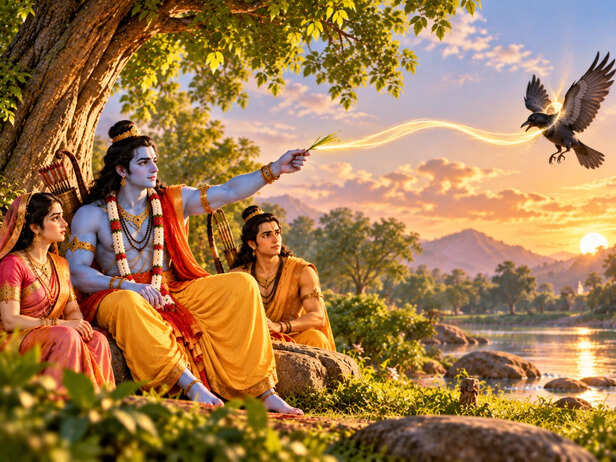
Can a simple blade of grass become a weapon so powerful that even the gods cannot protect someone from it? In the Ramayana, a remarkable incident from Chitrakoot reveals why Shri Ram used the Brahmastra against a crow with nothing more than a blade of kusha grass. The crow was no ordinary bird. He was Jayanta, the son of Indra, who disturbed Sita while she was with Ram. But the real mystery is not just how the grass became a divine weapon. It is why Ram pursued the crow and what happened when the frightened bird finally sought his protection.
The Crow That Disturbed Sita
During their forest exile, Shri Ram and Sita spent time in Chitrakoot, surrounded by nature. According to the episode narrated in the Ramayana's Sundara Kanda, a crow repeatedly attacked Sita with its beak and claws, causing her pain. Ram had been resting beside her, but he awoke when he noticed her injuries. What appeared to be an ordinary bird's disturbance soon became a divine encounter. The crow was Jayanta, the son of Indra, king of the gods. His actions would lead to one of the most memorable episodes involving Shri Ram's divine power.
Why Ram Chose a Blade of Grass
When Ram saw Sita hurt, he decided to stop the crow. Instead of reaching for an ordinary weapon, he picked up a blade of grass and invoked the Brahmastra, a powerful celestial weapon associated with Brahma. This detail makes the story especially striking: the power did not come from the grass itself but from the divine force invoked through it. The episode highlights Ram's extraordinary ability to turn even an ordinary object into an instrument of divine power. It also shows that a weapon's significance in Hindu mythology depends on its spiritual force, not merely its physical appearance.
Jayanta Could Not Escape the Brahmastra
Once released, the Brahmastra pursued Jayanta wherever he fled. The crow sought help from powerful beings, including his father, Indra, but no one could provide a safe escape from the weapon. The episode shows that Jayanta's divine family connections could not shield him from the consequences of his actions. His flight across the three worlds also builds the story's central suspense: if even the gods could not stop the weapon, where could he turn? The answer would come only when Jayanta stopped running and returned to the one whose protection he needed.
Why No God Could Save Him
Jayanta's inability to find shelter is an important part of this Ramayana story. Being Indra's son did not place him above the consequences of harming Sita. The gods could not simply cancel the force of the Brahmastra after it had been invoked. The story is often understood as a reminder that power, status, and family connections cannot always protect someone from the results of their choices. Jayanta eventually understood that escape was impossible. His only remaining option was to return to Shri Ram, acknowledge his helplessness, and seek forgiveness.
How Jayanta Saved His Life
Jayanta finally surrendered to Shri Ram and asked for mercy. Ram accepted his surrender, but the power of the Brahmastra could not simply be left without a consequence. In the traditional account, Jayanta lost the sight of one eye, while his life was spared. This moment brings the story to its turning point: Ram did not ignore what had happened to Sita, but he also did not refuse mercy when Jayanta surrendered. The episode balances accountability with compassion, showing that forgiveness does not necessarily mean pretending that wrongdoing never occurred.
Why Sita Told Hanuman This Secret
Later, when Hanuman reached Lanka to find Sita, she needed a way to send Ram a message that would prove their meeting was genuine. She recalled the Chitrakoot crow incident, a personal memory shared with Ram. This was not just a random story from their past. It was a private experience that Hanuman could repeat to Ram as evidence that he had truly met Sita. The episode therefore connects two important moments in the Ramayana: Ram's response to Sita's suffering in the forest and Hanuman's mission to find her in Lanka.
The Deeper Lesson of Ram's Brahmastra
Why did Shri Ram use a grass Brahmastra on a crow? The traditional story presents Jayanta's actions as a serious offence against Sita, while the pursuit demonstrates the power of Ram's divine weapon. Yet the ending matters just as much as the punishment. When Jayanta surrendered, Ram spared his life while ensuring that the incident had a consequence. For readers today, the story offers a lasting lesson: respect others, take responsibility when you cause harm, and have the courage to seek forgiveness. True strength is not only the ability to act, but also the wisdom to show mercy.
Unlock insightful tips and inspiration on personal growth, productivity, and well-being. Stay motivated and updated with the latest at My Life XP.