
Why Did Shukracharya Curse His Own Asuras?The Hidden Story
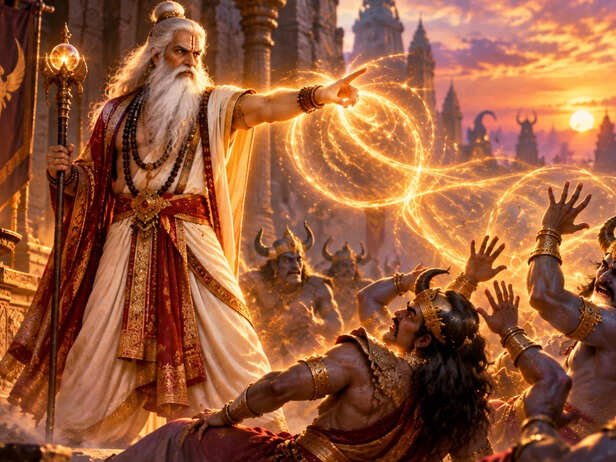
Imagine a guru becoming so angry with his own disciples that he curses them to be defeated. That is exactly what makes this ancient story so intriguing. Shukracharya, the revered guru of the Asuras, returned to find that his disciples had accepted someone else as their teacher. But there was a shocking twist: the person they trusted was actually Brihaspati in disguise. Furious at being deceived, Shukracharya cursed the Asuras. Even after they realised their mistake and begged for forgiveness, he could not simply take the curse back. But there is one question that makes this story even more fascinating: who led the Asuras to Shukracharya to ask for forgiveness?
Brihaspati’s Clever Disguise
The story begins when Brihaspati, the guru of the Devas, takes on the appearance of Shukracharya. The Asuras fail to recognise the deception and accept him as their spiritual teacher. For them, the mistake is not merely about recognising the wrong person. Their faith and loyalty are placed in someone who is secretly working against them. When the real Shukracharya eventually returns, he sees that his disciples have accepted another person in his place. Feeling betrayed and insulted, he becomes furious. What happens next is far more serious than a simple disagreement between a guru and his disciples.
Shukracharya’s Anger Becomes a Curse
Shukracharya becomes enraged when he discovers what has happened. According to the traditional narrative, he curses the Asuras, declaring that they will become devoid of wisdom and be defeated by the Devas. The Asuras soon understand their mistake. They realise that the person they had accepted as their guru was actually Brihaspati. They approach Shukracharya and sincerely ask for forgiveness. His anger eventually subsides, but there is a problem: a guru's curse cannot simply be treated as meaningless words. Shukracharya therefore tells them that although he forgives them, the consequence of his curse cannot be avoided.
The Curse Could Not Be Taken Back
This is where the story takes an important turn. Shukracharya's decision to forgive the Asuras does not erase the curse. In the traditional telling, he explains that his words cannot become false. The Asuras may have made an honest mistake, but the consequences have already been set in motion. Shukracharya then gives them another instruction. After the coming battle, they must retreat and take shelter in Patala Loka. The episode creates a striking lesson within the story: forgiveness does not always mean that every consequence disappears immediately. Sometimes a mistake can be forgiven while its effects still have to unfold.
The Battle Ends in Defeat
The war eventually takes place, and the Asuras are defeated. Those who survive follow Shukracharya's instructions and retreat to Patala Loka. The defeat becomes the fulfilment of the curse he had pronounced earlier. Meanwhile, Shukracharya turns away from the battlefield and begins deep meditation and penance. The story portrays him as someone trying to understand the deeper movement of time, destiny and ultimate truth. His role therefore changes from an angry guru to a spiritual seeker. The battle may have ended, but the larger questions raised by the episode are only beginning.
Who Went to Shukracharya?
And now comes the question hidden at the heart of the story: who went to Shukracharya to ask for forgiveness while representing the Asuras? In versions of the story, the Asuras themselves realise their mistake and approach their guru, acknowledging that they had been deceived. Their act of seeking forgiveness shows that they understood where they had gone wrong. The episode is not simply about a curse. It is also about recognising one's mistake before it becomes impossible to correct. Their humility cannot stop the curse from taking effect, but it does restore their relationship with their guru.
The Deeper Lesson of the Story
The story carries a powerful message about discernment, loyalty and consequences. The Asuras trusted someone because he appeared to be their guru, but they failed to recognise the truth behind the appearance. Their mistake ultimately contributed to their defeat. Shukracharya's reaction also adds another layer. Even after forgiving them, he could not make his spoken curse untrue. For a modern reader, the story can be seen as a reminder to question appearances, think carefully before placing trust and accept responsibility when a mistake is discovered. Ancient stories often survive because their questions remain relevant long after the original setting has disappeared.
Unlock insightful tips and inspiration on personal growth, productivity, and well-being. Stay motivated and updated with the latest at My Life XP