
Why Did Vaishno Devi Wait for Kali Yuga? The Truth
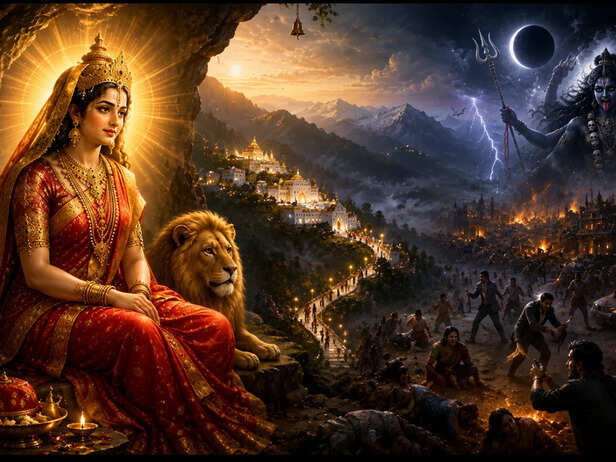
What if a meeting between Lord Rama and Mata Vaishno Devi was connected to a promise stretching across different ages?
According to a popular traditional account associated with the Vaishno Devi pilgrimage, Mata Vaishnavi performed intense penance with devotion toward Lord Vishnu. During the Treta Yuga, she encountered Lord Rama while he was searching for Mata Sita.
The meeting took an unexpected turn. Vaishnavi wished to be united with Rama, but Rama could not accept her request because he had committed himself to his one-wife vow and remained devoted to Sita.
Yet the story did not end with his refusal.
Rama Meets Vaishnavi in Treta Yuga
According to the traditional legend, Vaishnavi was deeply devoted to Lord Vishnu and had undertaken severe penance. During Rama's search for Sita, she encountered him and recognised his divine nature. She expressed her desire to be united with him. Rama, however, was bound by his commitment to Sita and his ideal of ekapatni vrata, or devotion to one wife. He therefore could not accept her request. His response was not portrayed as a rejection of her devotion, but as an expression of his unwavering commitment to his dharma and promise.
The Promise That Changed Everything
The most intriguing part of the story is the promise attributed to Rama. According to the legend, he told Vaishnavi that her spiritual journey would continue and that their destined connection would be fulfilled in another age. Some popular versions connect this promise with the Kalki avatar, the future incarnation of Vishnu associated with the end of Kali Yuga. This detail gives the story its unusual sense of timelessness. A meeting that could not lead to marriage in Treta Yuga was instead transformed into a promise extending far beyond that era.
Why Vaishnavi Went to Trikuta
Rama is traditionally said to have directed Vaishnavi toward the Trikuta Mountains, where she could continue her spiritual practice and serve humanity. This became an important part of the legend associated with the Vaishno Devi shrine in Jammu and Kashmir. The mountain setting adds another layer to the story. Vaishnavi is not simply portrayed as someone waiting for a promise to be fulfilled. She becomes a powerful spiritual figure who dedicates herself to penance, devotion and the welfare of others.
Then Came Bhairavnath
The story takes a dramatic turn when Bhairavnath, a tantric associated with the tradition, becomes determined to follow Vaishnavi. According to the popular legend, he pursued her toward the mountains despite warnings and refused to respect her boundaries. Vaishnavi eventually revealed her divine power. What appeared to be a simple spiritual journey suddenly became a confrontation between divine strength and uncontrolled desire. This part of the story is often remembered as a reminder that devotion without discipline can become destructive.
Vaishnavi Reveals Her Fierce Form
When Bhairavnath continued his pursuit, Vaishnavi is said to have manifested her fierce Mahakali form and defeated him. The transformation is one of the most powerful moments in the legend because it shows two aspects of the divine feminine together: compassion and strength. Vaishnavi is portrayed as peaceful when approached with devotion, yet immensely powerful when confronted with disrespect or wrongdoing. Her victory is therefore not simply a battle scene. It represents the idea that divine power can protect righteousness when boundaries are repeatedly violated.
Why Bhairavnath Was Forgiven
The story does not end with Bhairavnath's defeat. According to the popular tradition, Vaishnavi granted him forgiveness after he recognised the divine nature of the Mother. She also gave him a significant place in the pilgrimage. Devotees visiting the Vaishno Devi shrine traditionally continue onward to Bhairavnath Temple, making his story part of the pilgrimage itself. This ending changes the meaning of the legend. Punishment is followed by forgiveness, suggesting that recognising one's mistake and turning toward the divine can open the way to redemption.
The Deeper Meaning of Rama's Promise
The deeper message of the Rama and Vaishnavi story is not simply about a future marriage. It is about dharma, devotion and patience. Rama remains faithful to his commitment to Sita, while Vaishnavi continues her spiritual path instead of abandoning her purpose. The story also reflects a recurring theme in Hindu mythology: divine events may unfold across different ages, with their meaning becoming clear only much later. For devotees, the legend can therefore be understood as a story of faith that survives time without losing its purpose.
Unlock insightful tips and inspiration on personal growth, productivity, and well-being. Stay motivated and updated with the latest at My Life XP.