
Why Didn't Draupadi Fight in the Mahabharata War?
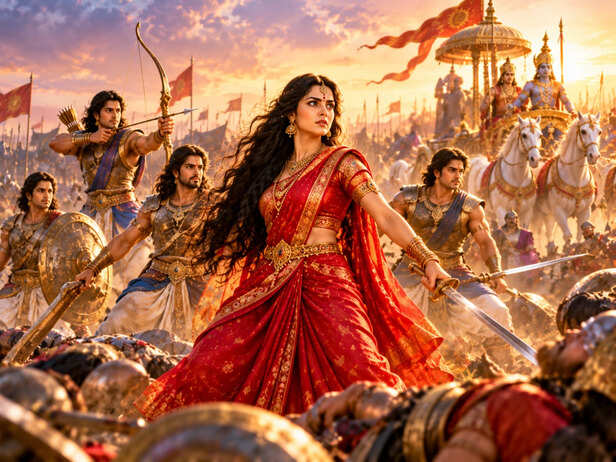
Thousands of warriors gathered on the battlefield of Kurukshetra, but where were the women? Did not a single woman fight in the Mahabharata war, or has their role been overlooked because they were not carrying weapons? The answer is more complicated than a simple count of zero. The epic describes women who remained away from the battlefield, yet their decisions, vows, grief, and political influence helped shape the events that led to the war. From Draupadi's presence at the centre of the conflict to Shikhandi's role in Bhishma's fall, the story raises a deeper question about what it means to hold power.
Did No Women Fight at Kurukshetra?
The Mahabharata describes an enormous war involving kings, princes, charioteers, archers, and warriors from different kingdoms. Yet its familiar accounts of the eighteen-day battle focus overwhelmingly on male combatants. This raises an intriguing question: did any women actually fight in the Kurukshetra war? The epic does not provide a complete census of every fighter based on gender, so claiming with certainty that the number was zero goes beyond what the text establishes. However, the absence of prominent female battlefield warriors in the main battle narrative makes the question worth exploring.
Why Is Shikhandi Different?
Shikhandi is central to this debate because the Mahabharata recounts that Shikhandi was born female and later became male. The epic identifies Shikhandi as a warrior who received military training and fought in the Kurukshetra war. Bhishma refused to fight Shikhandi because of Shikhandi's birth and earlier identity, a decision that the Pandavas used in their battle strategy. On the tenth day, Arjuna attacked Bhishma while Shikhandi stood before him. The episode shows how Shikhandi's identity and Bhishma's vow shaped the course of the war.
Why Would Bhishma Not Fight Shikhandi?
Bhishma had declared that he would not raise his weapons against a woman, someone who had previously been a woman, or someone he considered to have a feminine identity. His refusal was connected to his personal principles and understanding of warfare. The Pandavas knew this and used Shikhandi's presence to create an opening for Arjuna. Bhishma lowered his resistance to Shikhandi, allowing Arjuna's arrows to bring the mighty warrior down. This episode is more than a story of battlefield strategy; it also shows how vows, personal convictions, and individual choices could influence the outcome of a war.
Where Was Draupadi During the War?
Draupadi is one of the most influential women in the Mahabharata, but she is not portrayed as a combatant in the main Kurukshetra battle. The narrative of the Pandavas' preparations describes women remaining away from the fighting, and the account associated with their departure refers to Draupadi staying at Upaplavya with other women. Her absence from the battlefield did not make her role insignificant. The humiliation she suffered in the Kaurava court became a major part of the conflict's moral and emotional background. Her story reminds us that a person can shape the course of a war without personally wielding a weapon.
Were Women Considered Weak in the Mahabharata?
The absence of women from the main battlefield narrative should not be confused with a lack of strength or influence. Kunti's decisions shaped the lives of her sons, Gandhari's position connected her to the Kaurava family and its downfall, and Draupadi's experience became inseparable from the conflict between the two sides. Their influence worked through family relationships, political choices, vows, and moral arguments rather than battlefield command. The epic also reflects the social expectations of its world, where warfare and formal military leadership were largely associated with men. Its women nevertheless remain essential to understanding why the war happened and what it cost.
The Power Women Held Beyond the Battlefield
The Mahabharata's women influenced succession, marriage alliances, family loyalties, and the moral questions that surrounded the war. Their stories show that power did not always mean holding a bow or leading an army. Sometimes it meant making a decision that changed a royal family, speaking against injustice, or carrying the consequences of choices made by others. At the same time, their influence should not be used to romanticise the restrictions they faced. Their stories contain grief, unequal treatment, resilience, and agency. Reading them together gives a fuller understanding of the epic than focusing only on its famous male warriors.
A Place Beyond the Sword
The Mahabharata does not give us a definitive numerical answer to how many women fought in the Kurukshetra war. Its central battle narrative focuses mainly on male warriors, while Shikhandi's distinctive story challenges simple assumptions about gender and warfare.
Draupadi, Kunti, and Gandhari were not battlefield combatants in the familiar account, yet their lives were deeply connected to the war's causes and consequences.
The real lesson is not that women needed no weapons to prove their worth. It is that the Mahabharata cannot be understood through its warriors alone. Its women were central to the choices, injustices, loyalties, and losses that shaped the epic.
Unlock insightful tips and inspiration on personal growth, productivity, and well-being. Stay motivated and updated with the latest at My Life XP