
Why Do Bengali Women Make This Strange Sound During Durga Puja?
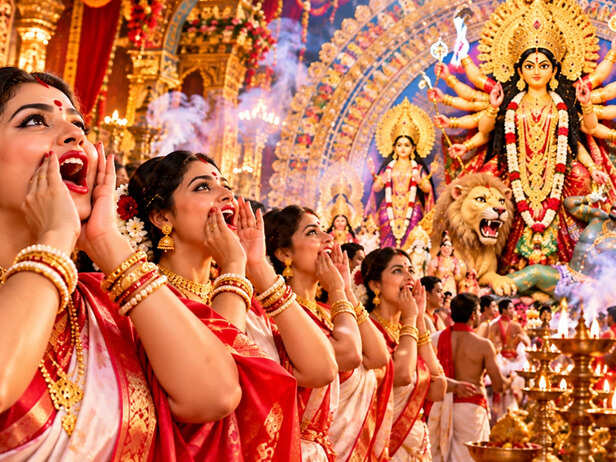
Have you ever heard women suddenly make a high-pitched, rolling sound during Durga Puja and wondered what it means? In Bengal, this traditional sound is known as Ulu Dhwani or Uludhvani. It is commonly heard during religious celebrations, weddings and other auspicious occasions. The sound is a form of ululation, a vocal practice found in many cultures around the world. Traditional explanations sometimes connect it with victory, celebration and the driving away of negativity. But some popular stories go much further, claiming a direct connection between Bengal, the Middle East and ancient Egypt. The real history is more interesting when folklore and evidence are kept separate.
The Sound Has a Name
The sound is commonly called Ulu Dhwani or Uludhvani in Bengal. It is produced through a rapid movement of the tongue while creating a sharp, rolling vocal sound. During Durga Puja and Kali Puja, women may perform it as an expression of celebration and auspiciousness. Similar traditions exist elsewhere in India under different names. In Assam, it is known as Uruli, while Odisha has forms called Hulahuli or Huluhuli. These traditions show that the sound is not limited to Bengal. It belongs to a much wider family of ceremonial vocal practices known as ululation.
Why Is It Heard at Durga Puja?
For many Bengali families, Ulu Dhwani during Durga Puja is almost inseparable from the atmosphere of the festival. It can be heard during rituals, celebrations and moments of religious excitement. Traditional interpretations often treat the sound as an expression of joy, victory and auspiciousness. Some modern retellings also say that it drives away negative forces. However, that spiritual interpretation should be understood as a cultural or religious belief, not as a scientifically established effect. What can be clearly observed is its social role: the sound brings people together and instantly marks a moment as festive, sacred or emotionally significant.
The Kali Connection Is a Folk Tradition
One popular story connects this sound with Goddess Kali and the battle against demons. In devotional retellings, the terrifying energy of the goddess is accompanied by powerful sounds and celebrations after the defeat of evil. Some versions connect the sound specifically with the 64 Yoginis and describe their tongues producing a frightening noise that overwhelmed demonic forces. This makes for a powerful story, but it should not be presented as a universally established scriptural account. The better way to understand it is as part of the rich folklore surrounding Kali, Durga, Yoginis and the victory of divine power over evil.
It Exists Beyond Bengal
The surprising part is that Ulu Dhwani is not unique to Bengal. Similar forms of ululation are found across India. Assamese traditions use the term Uruli, while Odisha has Hulahuli or Huluhuli. Other regional names include Bombalane in Maharashtra and Kulavai in Tamil Nadu. The sound may appear during weddings, religious festivals and other celebrations, although the exact customs differ from one community to another. This makes it difficult to claim that every version has the same origin or meaning. What they clearly share is a powerful vocal expression used to mark important communal moments.
The Ancient Egyptian Connection Is Real, But Different
Here the story becomes genuinely fascinating. Ululation is documented in ancient Egyptian Pyramid Texts, including passages associated with King Unas. One translation explicitly uses the word “ululation” in a passage describing the king's ascent to the sky. This proves that a form of ululation was known in ancient Egypt. But it does not prove that Egyptian ululation and Bengali Ulu Dhwani came from the same tradition or that one influenced the other. Ancient cultures could independently develop similar vocal practices. The Egyptian evidence is therefore fascinating on its own, without needing an unproven historical connection to Bengal.
What About the Arab Connection?
A similar sound is also found across the Arab world, where it is commonly known as zaghareet or zaghrouta. It is particularly associated with weddings and celebrations. Historical descriptions of Egyptian celebrations also record women making these joyful cries. Again, the resemblance is real, but resemblance does not automatically establish a shared origin. The safest conclusion is that ululation is a widespread human cultural practice that has developed different meanings in different societies. In one place it may mark a wedding, in another a religious festival, and elsewhere a moment of victory or collective joy.
The Sound That Still Lives On
That is what makes Ulu Dhwani so fascinating. It is not simply a strange sound made during a festival. It carries memory, emotion and community identity. Its Indian forms have survived across generations, while related forms of ululation appear in cultures far beyond South Asia. The ancient Egyptian evidence adds another layer to its long history, but it should not be used to claim an unproven common origin. For Bengali devotees, however, the sound remains deeply familiar: when Ulu Dhwani rises during Durga Puja, it can instantly turn a ritual into a celebration and make the atmosphere feel alive.
Unlock insightful tips and inspiration on personal growth, productivity, and well-being. Stay motivated and updated with the latest at My Life XP