
Why Do Devotees Insult This Goddess During Kerala’s Festival?
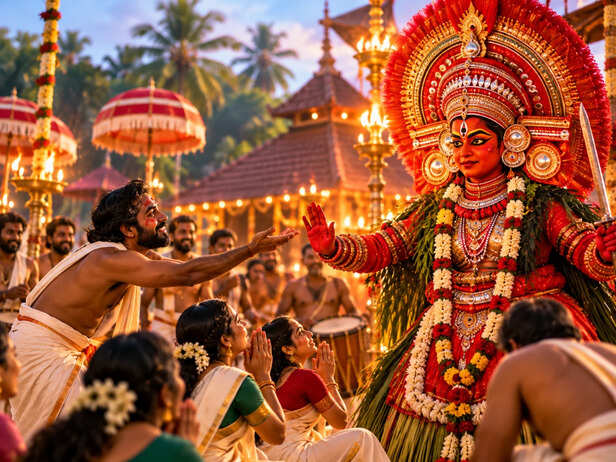
Imagine entering a temple where devotees shout provocative words, red flags signal the start of a festival, and rituals that seem unusual elsewhere are treated as expressions of devotion. This is the world of the Kodungallur Bharani festivalin Kerala, associated with Goddess Bhadrakali. Behind its striking customs lies a story of divine power, an ancient battle and a form of worship that challenges conventional ideas of how devotion should look.
The Goddess at the Centre of the Festival
The temple at the heart of this unusual celebration is the Sree Kurumba Bhagavathy Temple in Kodungallur, in Kerala’s Thrissur region. Its presiding deity is associated with Bhadrakali, a fierce form of the Divine Mother. Unlike festivals known mainly for peaceful processions and conventional offerings, Kodungallur Bharani is famous for its intense atmosphere and distinctive folk traditions. The celebration is rooted in local religious history, and its rituals make more sense when viewed through the community’s beliefs about the goddess, her power and her victory over evil.
The Legend of Goddess Bhadrakali
According to Hindu mythology, the asura Daruka received a powerful boon and became arrogant, using his strength to trouble the world. In the popular legend associated with the festival, Lord Shiva’s divine energy gave rise to Goddess Bhadrakali, who confronted Daruka and defeated him. The goddess’s fierce form represents the power that protects the world when injustice grows unchecked. The legend of Daruka is central to understanding the festival: the energetic rituals are interpreted through the memory of the goddess’s victory, rather than as ordinary temple customs.
Red Flags Signal the Beginning
The festival unfolds through a series of rituals spread across the Malayalam months of Kumbham and Meenam. Ceremonial signals and preparations announce the arrival of the festival period, building anticipation among devotees. The red colour seen during Kodungallur Bharani festival is closely associated with its intense devotional atmosphere. The sequence of events is more complex than a single day of celebration, with different observances taking place at different stages. These traditions are part of a distinctive local religious culture that has been passed down through generations.
Why Devotees Shout at the Goddess
One of the festival’s most discussed customs is Bharanippattu, a tradition of songs containing provocative and abusive language directed towards the goddess. To an outsider, this may seem incompatible with worship. Within the local tradition, however, the words form part of an established ritual expression, and devotees believe the goddess accepts them. Some cultural interpretations connect the practice with uninhibited devotion and the expression of emotions that ordinary social rules usually restrain. It is important to understand this custom in its specific cultural setting rather than assume that it represents how Hindus worship goddesses everywhere.
When Devotion Takes Over the Temple
The festival’s most striking event is Kavutheendal, when groups of Velichappadus, oracles associated with the goddess, gather in red attire and move around the temple in an intense devotional procession. They carry traditional ceremonial objects and perform ritual actions connected with the festival’s mythology. Historical accounts also describe devotees throwing objects and turmeric into parts of the temple complex as part of a symbolic act of ritual impurity. This deliberate departure from ordinary temple practice is one reason Kodungallur Bharani attracts so much attention. The ritual is followed by purification observances.
Why the Goddess Receives Sandalwood Paste
Another distinctive observance is Chandanapoti Charthal, also known as a sandalwood-paste ritual. Sandalwood paste is applied to the goddess’s image during this special ceremony. In popular explanations, the ritual is linked to the idea of soothing the goddess after her fierce encounter with Daruka. This imagery gives the festival an interesting contrast: the same deity celebrated for formidable power is also approached through an act associated with cooling and care. The observance forms an important part of the wider Bhadrakali temple festival and reflects the layered symbolism found in local worship traditions.
The Meaning Behind the Controversy
The unusual customs of Kodungallur Bharani can be difficult to understand when viewed only through the lens of conventional temple etiquette. For devotees, the festival is connected to the goddess’s power and a living tradition shaped by local history. For observers, it raises questions about how religious practices develop and how communities express faith in different ways. Not every ritual should be reduced to one simple explanation, and interpretations can vary. Looking at the legend, the songs, the oracles and the sandalwood ritual together offers a richer understanding of why this Kerala festival remains so distinctive.
Unlock insightful tips and inspiration on personal growth, productivity, and well-being. Stay motivated and updated with the latest at My Life XP.