
Why Do Hindu Texts Call India a Land of Karma?
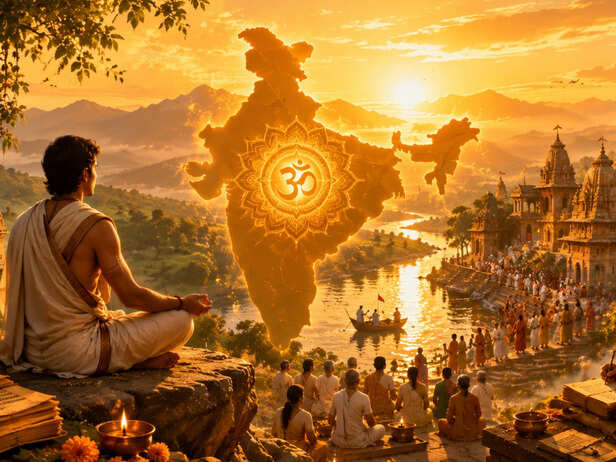
Ask why India is considered spiritually important, and the answers often sound familiar: it is Pavitra Bhoomi, the land of great rishis, or the home of ancient gurukuls. But these answers only describe India. They do not explain the deeper idea found in Hindu sacred literature.
The more intriguing answer lies in the concept of karma-bhumi, a land where human actions carry consequences and where life becomes an opportunity for spiritual progress. In Puranic cosmology, different realms are described with different conditions. But Bharatavarsha is repeatedly presented as a particularly important place for performing karma and pursuing liberation.
The Answer Begins With Karma
The key word is karma. In Hindu philosophy, karma is not simply punishment or reward. It refers broadly to intentional action and its consequences. The Puranic tradition gives Bharatavarsha a special place because human beings here are described as having the opportunity to perform actions that influence their future. This makes earthly life spiritually significant. Being born in a comfortable place is not necessarily the highest achievement in this worldview. What matters is what a person does with the opportunity of life. That changes the question completely: India’s importance is connected not only with where people live, but with what they can accomplish through their actions.
Heaven Is Not the Final Goal
Here comes the surprising twist. Hindu scriptures do describe heavenly realms filled with extraordinary pleasures, but heaven is generally not presented as the final destination. In the Bhagavad Gita, Krishna explains that those who seek heavenly enjoyment may eventually return to the mortal world when the merit supporting that experience is exhausted. The lesson is striking: even paradise can be temporary. Hindu spiritual thought therefore places enormous importance on liberation, or moksha, rather than simply obtaining a pleasurable afterlife. A beautiful existence may still leave the deeper question unanswered: Have you become free?
Why Human Life Matters
Human life occupies a fascinating position in Hindu philosophy. Unlike a life focused entirely on pleasure, human existence contains struggle, responsibility, choice and uncertainty. These conditions can become opportunities for spiritual growth. The Bhagavata Purana and other Hindu texts repeatedly connect human birth with the possibility of pursuing higher knowledge and liberation. This does not mean suffering is automatically good or that people should seek hardship. The deeper idea is that limitations can create awareness. When everything is effortless, there may be little reason to question life. When choices have consequences, the search for meaning becomes much more urgent.
Bharatavarsha Has a Special Role
Several Puranic passages describe Bharatavarsha as a particularly significant region within the larger cosmic geography of Jambudvipa. Its importance is connected with performing religious and moral actions and seeking liberation. This is where the popular idea of karma-bhumi becomes meaningful. It does not simply mean that India is geographically sacred in every possible sense. Rather, the texts use Bharatavarsha to express a spiritual condition in which action, responsibility and liberation become central. That is a much deeper explanation than simply calling India holy. The land becomes important because of the opportunities associated with human action.
The Real Prize Is Liberation
The ultimate destination in many Hindu philosophical traditions is not an endless supply of pleasure. It is moksha, liberation from samsara, the cycle of birth and death. This changes how the Puranic idea should be understood. If a person receives comfort, pleasure and long life but remains bound to samsara, the journey is not complete. Human life becomes valuable because it can be used for knowledge, devotion, disciplined action and spiritual practice. The goal is therefore not to escape every difficulty. It is to understand life deeply enough that one is no longer completely controlled by desire, attachment and the consequences of ignorance.
The Choice Makes the Difference
Imagine two lives. One is filled with comfort, pleasure and almost no reason to question existence. The other contains uncertainty, responsibility and difficult choices. From an ordinary perspective, the first life sounds better. But the Puranic worldview asks a different question: Which life gives you the opportunity to grow spiritually? That is the heart of the karma-bhumi idea. India’s spiritual importance is therefore not simply presented as a reward. It is also a responsibility. If human actions matter, then every choice becomes meaningful. A small act of kindness, discipline, devotion or self-control can become part of a much larger spiritual journey.
The Ancient Question Still Matters
So why does the Puranic tradition give Bharatavarsha such importance? The answer is more profound than “because India is sacred.” It is the idea that human life is a field of action. Pleasure may be temporary. Heaven may be temporary. Even extraordinary worldly achievements may eventually pass. But the choices made through human life can become part of the journey toward liberation.
That is why the ancient idea remains powerful today. It asks us to stop measuring life only by comfort and success. Instead, it asks a harder question: What are you doing with the life you have been given?
The Deeper Meaning of India as Karma-Bhumi
Perhaps this is the answer hidden behind the familiar phrase Pavitra Bhoomi.
India's spiritual significance in Hindu tradition is not merely about being an ancient land of temples, sages and sacred rivers. The deeper Puranic idea is about opportunity and responsibility.
Bharatavarsha is presented as a place where actions matter, where human beings can pursue dharma, devotion, knowledge and ultimately moksha.
And that creates a fascinating paradox.
The greatest gift is not necessarily a life without suffering.
It may be a life in which your choices actually matter.
That is the deeper mystery behind the idea of India as a Karma-Bhumi.
Unlock insightful tips and inspiration on personal growth, productivity, and well-being. Stay motivated and updated with the latest at My Life XP.