
Why Do Navagrahas Turn Their Backs to Each Other?
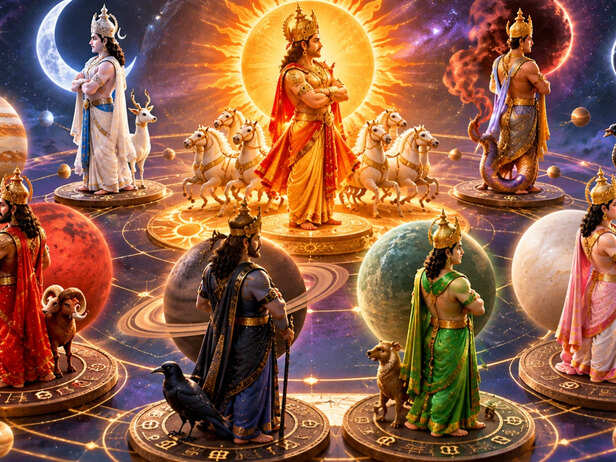
Have you ever noticed the unusual arrangement of the Navagrahas in some Hindu temples? Instead of facing one another, the nine planetary deities are traditionally shown facing outward or turned away from each other, with Surya Dev placed at the centre. At first glance, the arrangement may look like a simple temple design. But traditional explanations connect it with an important idea from Jyotisha Shastra: the relationship between planets, their aspects and their influences. There is also a fascinating belief about planetary friendship and enmity that offers another possible explanation.
Why Surya Dev Stands at the Centre
Surya Dev holds a special position in the Navagraha tradition. The Sun is treated as the central luminary among the nine planetary deities, while the other grahas are arranged around him in temple representations. This is not necessarily a literal model of the solar system. Instead, it carries religious and astrological symbolism. The central placement of Surya reflects the importance given to the Sun in Indian traditions of Jyotisha and worship. The exact layout can vary from one temple to another, so the arrangement should not be treated as a single universal architectural rule followed everywhere.
The Idea of Planetary Aspects
One explanation connects the outward-facing arrangement with graha drishti, or planetary aspects. In Jyotisha, planets are traditionally understood to cast influences through specific aspects. Because planetary aspects are considered meaningful in interpreting a birth chart, some traditions extend this symbolism to the physical arrangement of Navagraha shrines. The idea is that if the planetary deities faced one another, their symbolic “drishti” could be directed at each other. However, this should be understood as a traditional interpretation rather than a scientifically established mechanism. Classical Jyotisha explains planetary aspects in the context of astrology, not as a confirmed reason for temple architecture.
Planetary Friendship Adds Another Layer
There is another popular explanation that focuses on planetary friendship and enmity. Traditional Jyotisha assigns relationships such as friend, enemy and neutral to different planets. For example, the Sun, Moon, Mars, Mercury, Jupiter, Venus and Saturn are described through different combinations of these relationships. This has led to the belief that keeping the planetary deities from directly facing one another symbolically avoids conflict. It is an intriguing interpretation, especially because the Navagrahas are treated as distinct cosmic forces. But again, the connection between these relationships and the physical temple arrangement is better described as traditional symbolism than as a clearly documented scriptural rule.
Is This Actually Written in Jyotisha?
Here comes the part many people miss. Classical Jyotisha texts do discuss planetary aspects, dignity and relationships, but that does not automatically mean they prescribe a temple layout where every graha must turn its back on another. Temple architecture and ritual traditions developed through different textual and regional traditions. As a result, there is no simple basis for saying that Jyotisha definitively commands all Navagrahas to face away from each other. The popular explanation may preserve a symbolic understanding that developed around the shrine's design, but it should not be presented as an unquestionable scriptural fact without a specific textual source.
Every Temple May Follow a Different Layout
Another important detail is that Navagraha arrangements are not identical everywhere. Some temples place the nine deities around Surya, while others follow regional architectural or ritual conventions. Their orientation, positioning and surrounding structure can therefore differ. This variation matters because it shows why one explanation cannot necessarily be applied to every Navagraha shrine. Temple traditions often combine scripture, local customs, symbolism and architectural practice. So when you see the planets facing outward, it is better to understand the design within that particular temple's tradition rather than assuming that every shrine follows exactly the same ancient instruction.
The Arrangement Carries Symbolic Meaning
Whether the explanation comes from planetary aspects, relationships or regional temple tradition, the arrangement encourages devotees to think about the Navagrahas as interconnected forces within a larger sacred system. Surya at the centre gives the shrine a clear symbolic focus, while the surrounding grahas represent different planetary principles recognised in Jyotisha. The outward-facing arrangement can therefore be viewed as a visual expression of balance and separation rather than a literal instruction about planets fighting with one another. This symbolic reading also explains why the design can remain meaningful even when different temples interpret or arrange the Navagrahas differently.
The Mystery Has More Than One Answer
The next time you see the Navagrahas turned away from one another, there is more to notice than the unusual design. Traditional explanations connect it with graha drishti, planetary relationships and the desire for balance, while temple practices themselves can vary by region and tradition. The most accurate approach is to respect these explanations as part of Hindu religious and astrological traditions without turning them into proven scientific facts. Perhaps that is what makes the arrangement so fascinating. A simple circle of nine deities opens the door to questions about astrology, symbolism, architecture and centuries of evolving worship traditions.
Unlock insightful tips and inspiration on personal growth, productivity, and well-being. Stay motivated and updated with the latest at My Life XP.