
Why Does Lord Vishnu Have 4 Arms? The Hidden Meaning
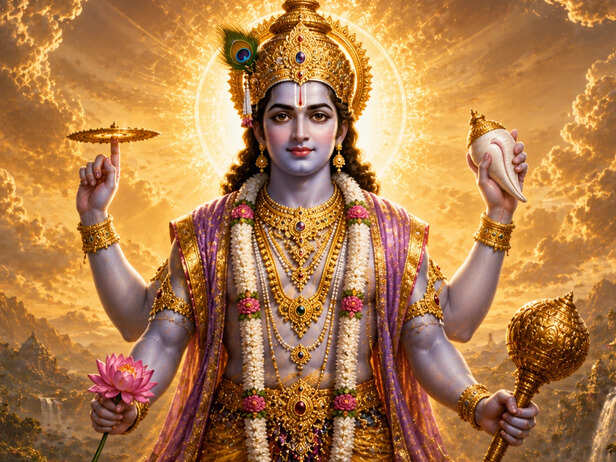
Have you ever wondered why Lord Vishnu is almost always shown with four arms? At first glance, the image looks familiar. One hand carries a conch, another holds the Sudarshan Chakra, a third carries the Kaumodaki mace, and the fourth holds a lotus. But these objects are not simply decorative symbols. Each one represents a deeper idea connected with dharma, time, knowledge, strength and spiritual awareness. Together, they tell a story about how life should be lived and how balance can be maintained even when the world around us becomes uncertain. The more closely you look at Vishnu's form, the more meaningful every detail becomes.
Why Vishnu Has Four Arms
The four-armed form of Lord Vishnu is one of the most recognisable images in Hindu tradition. Rather than representing physical power alone, the four arms allow different sacred attributes to be shown together. Each object communicates a particular spiritual principle. Vishnu's form therefore becomes almost like a visual teaching. His conch, Chakra, mace and lotus remind devotees that protecting dharma requires more than strength. It requires awareness, discipline, purity and the ability to act at the right moment. His four arms symbolically bring these qualities together, creating an image of complete and balanced divine responsibility.
The Conch Carries a Sacred Sound
The conch in Vishnu's hand is traditionally known as Panchajanya. Its sound is considered sacred and is associated with spiritual awakening. In Hindu worship, the blowing of a conch often marks an auspicious beginning and creates a sense of purification and reverence. The conch can therefore be understood as a reminder to become aware before taking action. Its connection with sacred sound also brings the mind toward the idea of Om, one of the most important sacred syllables in Hindu traditions. The message is simple: before acting in the outer world, first awaken and listen within.
The Sudarshan Chakra Means More
The Sudarshan Chakra is perhaps the most visually striking of Vishnu's attributes. It is traditionally associated with divine protection and the destruction of forces that threaten dharma. The circular form also naturally evokes the idea of time and cycles. Time never stops moving, and every action eventually produces consequences. This makes the Chakra more than a weapon in symbolic interpretation. It can serve as a reminder that life keeps moving and that our choices matter. When the moment to act arrives, hesitation can also have consequences. Vishnu's Chakra therefore represents both protection and the disciplined use of power.
The Mace Represents Inner Strength
The mace carried by Lord Vishnu is traditionally called Kaumodaki. It represents strength, but its meaning can be understood beyond physical power. True strength also requires discipline, courage and control over one's own impulses. A person may possess great ability, but without self-control that ability can become destructive. Vishnu's mace reminds devotees that strength should be used to protect what is right rather than to dominate others. It represents the firmness required to face difficulties without abandoning one's principles. In everyday life, that same strength can appear as patience, self-control and the courage to stand by the right decision.
The Lotus Holds a Deeper Lesson
The lotus is one of the most powerful spiritual symbols in Hinduism. It grows from muddy water but rises above the surface with remarkable beauty. This makes it a natural symbol of purity, detachment and spiritual growth. When Vishnu is shown holding a lotus, it can remind devotees that living in the world does not mean becoming consumed by every difficulty around us. We can face problems, responsibilities and uncertainty while still protecting our inner values. The lotus quietly teaches an important lesson: your surroundings may influence your journey, but they do not have to define your character.
Vishnu's Form Tells One Story
When all four symbols are viewed together, Vishnu's form becomes even more meaningful. The conch represents sacred awareness, the Chakra reminds us of time and righteous action, the mace represents strength and discipline, and the lotus points toward purity and spiritual growth. None of these qualities works perfectly in isolation. Wisdom without courage may remain inactive. Strength without discipline can become dangerous. Action without purity can lose its purpose. Vishnu's four arms therefore present a complete picture of balanced living. His form reminds us that preserving dharma requires the right combination of awareness, strength, action and inner purity.
The Message Vishnu Leaves Us
The next time you see an image of Lord Vishnu, do not look at his four arms as simply a divine artistic form. Look at them as a reminder of four powerful qualities. Awaken before you act. Remember that time keeps moving. Build strength without losing discipline. And remain pure despite difficult surroundings.
That is what makes Vishnu's iconography so powerful. Every object has a purpose, and every detail invites reflection.
Perhaps the hidden lesson is this: protecting your world begins with protecting the balance within yourself.
Unlock insightful tips and inspiration on personal growth, productivity, and well-being. Stay motivated and updated with the latest at My Life XP.