
Why Does Maa Kushmanda Reside at the Sun’s Centre? The Hidden Navratri Story
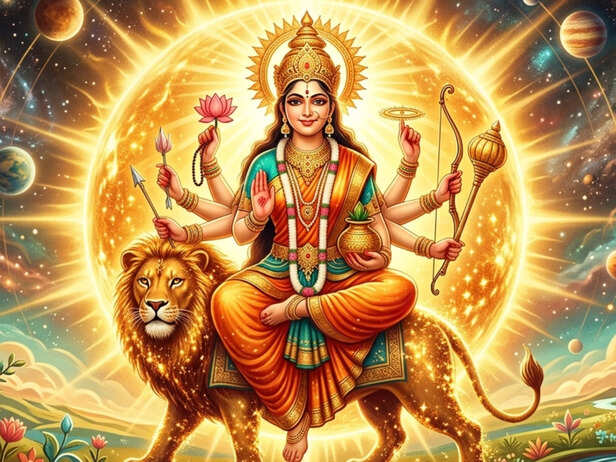
What if the Sun represented more than light and warmth? In Hindu devotional tradition, it also serves as a powerful symbol of divine energy, creation, and the force that sustains life.
This is where the story of Maa Kushmanda becomes particularly fascinating.
Among the nine forms of Goddess Durga worshipped during Navratri, Maa Kushmanda is traditionally associated with the Sun. Devotional descriptions portray her as residing at its centre, radiating energy and illumination throughout the universe.
But why is she connected to the heart of such a powerful celestial body? Is there a deeper meaning behind this belief?
The answer lies in her association with cosmic creation and the spiritual symbolism of light. To understand it, we must look beyond her radiant appearance and explore the mythology behind Navratri Day 4.
3. Who Is Maa Kushmanda? The Goddess Behind the Legend
Maa Kushmanda is the fourth manifestation of Navadurga, the nine forms of Goddess Durga worshipped during the nine days of Navratri.
Her name is commonly interpreted in popular devotional explanations through the idea of a divine smile associated with the creation of the universe. This connection has made her a symbol of creative power, vitality, and the illumination of darkness.
She is often depicted with eight arms holding sacred objects, including a lotus, rosary, bow, arrow, and discus. This form is also known as Ashtabhuja Devi, meaning the goddess with eight arms.
Her radiant appearance reflects the qualities associated with her worship: energy, strength, and the power of creation.
However, one detail makes her particularly distinctive. Unlike the familiar imagery of the Sun as a celestial source of light, Maa Kushmanda's association with its centre gives the solar connection a distinctly divine meaning.
4. Why Does Maa Kushmanda Reside at the Sun’s Centre?
The belief that Maa Kushmanda resides at the centre of the Sun is rooted in popular Hindu devotional descriptions of her divine radiance.
The Sun occupies an essential place in Hindu religious symbolism. It represents light, vitality, knowledge, and the energy that supports life. Maa Kushmanda's association with it reflects her connection with cosmic power and the sustaining force of creation.
Think about the Sun's role in our everyday existence. Its energy supports plant growth, influences Earth's climate, and helps sustain the natural cycles on which life depends.
In devotional imagery, the Sun becomes a fitting symbol for a goddess associated with creation and limitless energy.
Her presence at its centre is therefore understood spiritually, rather than as a scientific claim about a physical being living inside the Sun. It conveys the idea that her divine power is connected with the source of illumination and vitality.
This is also why her radiant form is significant. The imagery presents her not simply as a goddess surrounded by light, but as a divine presence associated with the very force that makes light possible.
The mystery, then, is not merely about where Maa Kushmanda is believed to reside. It is about what the Sun represents in her story: the power to illuminate, nourish, and sustain creation.
5. The Hidden Connection Between Maa Kushmanda and the Creation of the Universe
One of the most fascinating elements of Maa Kushmanda's mythology is the popular devotional story connecting her divine smile with the creation of the universe.
According to this traditional narrative, the cosmos was once enveloped in darkness. Maa Kushmanda's divine smile brought light into that darkness and set creation in motion.
This imagery offers a striking explanation for her association with cosmic energy.
If her smile represents the emergence of light, her connection with the Sun becomes even more meaningful. The Sun embodies illumination and vitality, while the goddess represents the creative power associated with their presence.
Together, these ideas form a story about the movement from darkness towards existence, from emptiness towards creation.
It is important to remember that Hindu traditions contain multiple accounts of how the universe originated. The creation narrative associated with Maa Kushmanda should be understood within its devotional context, rather than treated as the only explanation found across Hindu scriptures.
Yet its central idea remains compelling. The universe, in this devotional telling, is connected with divine creative energy, and the light of the Sun becomes a powerful expression of that energy.
6. What Does the Sun Symbolise in Maa Kushmanda’s Story?
Maa Kushmanda's solar connection can be understood through three important symbolic ideas.
Light That Overcomes Darkness
Light is frequently associated with knowledge, understanding, and awareness in spiritual traditions. Darkness, by contrast, can represent ignorance, uncertainty, or confusion.
Maa Kushmanda's radiant form reflects the idea of illumination overcoming darkness. Her story encourages devotees to seek clarity and understanding when faced with uncertainty.
Energy That Sustains Creation
The Sun provides energy essential to life on Earth. In devotional symbolism, this makes it a powerful representation of vitality and creation.
Maa Kushmanda's association with the Sun reflects her role as a divine figure connected with cosmic energy and the sustaining power of existence.
Hope and New Beginnings
Sunlight also carries a simple but meaningful association with fresh beginnings. Every sunrise marks the arrival of another day and another opportunity to move forward.
Through this symbolism, Maa Kushmanda's story can inspire hope, courage, and renewed determination.
These interpretations are spiritual reflections on her imagery, rather than promises that worship will automatically change a person's circumstances.
7. Why Is Maa Kushmanda Worshipped on Navratri Day 4?
Navratri celebrates the nine forms of Goddess Durga, with each day dedicated to a particular manifestation.
The fourth day is devoted to Maa Kushmanda. Her association with creation and solar energy gives this day its distinctive devotional significance.
Devotees offer prayers according to their religious and regional traditions, seeking divine blessings and reflecting on qualities such as strength, vitality, and positivity.
Her worship also offers an opportunity to consider the importance of creative energy in everyday life. Whether understood through faith, symbolism, or personal reflection, her radiant form represents the possibility of moving forward with renewed purpose.
For many devotees, Navratri is not only a time of ritual observance but also a period of reflection, devotion, and spiritual renewal.
8. What Can Maa Kushmanda’s Story Teach Us Today?
The story of Maa Kushmanda carries a message that extends beyond its mythological setting.
Life often brings moments when the path ahead seems uncertain. We may struggle to find direction, regain confidence, or take the first step towards something new.
The symbolism of Maa Kushmanda's divine radiance offers a way to reflect on these experiences.
Her association with light reminds us of the value of knowledge and clarity. Her connection with creation encourages us to recognise that new beginnings often require courage and effort. And the imagery of the Sun reminds us that growth depends on sustained energy rather than a single moment of inspiration.
These lessons do not diminish the religious meaning of her story. Instead, they show how devotional symbolism can continue to hold personal significance in modern life.
Sometimes, the most meaningful change begins when we find the clarity to see a situation differently and the courage to act.
The Deeper Meaning Behind Maa Kushmanda’s Solar Connection
Why does Maa Kushmanda reside at the Sun's centre?
In popular Hindu devotional tradition, this belief represents her association with cosmic creation, divine radiance, and the energy that sustains life. The Sun serves as a symbol of illumination and vitality, reflecting the creative power attributed to the goddess.
Her story also gives Navratri Day 4 a deeper significance. Beyond prayers and celebrations, it invites devotees to reflect on the relationship between creation, light, and hope.
Perhaps the most fascinating part of Maa Kushmanda's solar connection is not simply the image of a goddess surrounded by extraordinary radiance. It is the idea that light can represent the beginning of something entirely new.
And sometimes, that is precisely the reminder we need: even after the darkest moments, there is always room to seek clarity and begin again.
Unlock insightful tips and inspiration on personal growth, productivity, and well-being. Stay motivated and updated with the latest at My Life XP.