
Why Does Uttarakhand Celebrate Diwali 11 Days After the Rest of India?
Have you ever wondered why some parts of Uttarakhand celebrate Diwali almost two weeks after the rest of the country?
The answer lies in a unique mountain tradition called Igas Bagwal, also known as Budhi Diwali. Celebrated on the 11th day after Diwali, this festival brings villages together with traditional sweets, folk songs, dancing and burning pinewood torches.But why do people celebrate Diwali again, and what does the festival have to do with Lord Rama and a Garhwali warrior? There are two popular stories behind this unusual celebration.
The Story of Lord Rama's Return Reaching the Hills 11 Days Late
One popular folk belief connects Igas Bagwal with the return of Lord Rama to Ayodhya after defeating Ravana.According to the Ramayana tradition, people of Ayodhya welcomed Lord Rama by lighting rows of earthen lamps. This celebration is associated with Diwali, which falls on Kartik Amavasya.
However, local folklore in Uttarakhand says that the news of Rama's return reached the remote hill villages 11 days later because of the difficult mountain terrain and limited communication facilities.By the time people heard the news, the festival date had passed. They therefore celebrated the occasion on Ekadashi, 11 days after Diwali.This is one of the most widely shared explanations for Igas Bagwal. However, it is important to understand that it is a regional folk belief, not an event established by the Ramayana itself.
Did a Garhwali Warrior's Return Give Birth to Igas Bagwal?
There is another fascinating story, particularly popular in the Garhwal region. It revolves around a warrior named Madho Singh Bhandari, who is remembered in local history and folklore.According to this account, Madho Singh Bhandari was a military commander serving under the Garhwal ruler Mahipati Shah. He and his soldiers were sent on a military campaign towards Tibet.The expedition reportedly took place around the time of Diwali. Since the soldiers did not return home for the festival, their families and villagers became worried. Some believed that the army might have lost the battle and that the soldiers would never return.Consequently, the community did not celebrate Diwali with its usual enthusiasm.
Then, according to the popular story, Madho Singh Bhandari and his soldiers returned victorious 11 days later, on Ekadashi. Their safe return brought immense happiness to the villages, and people celebrated by lighting lamps, singing folk songs and dancing.This celebration is believed to be another explanation behind the tradition of Igas Bagwal.There is no universally established historical proof that this particular event created the festival. It is best understood as a local account passed down through generations.
What Is Bhailo, the Unusual Fire Tradition of Igas Bagwal?
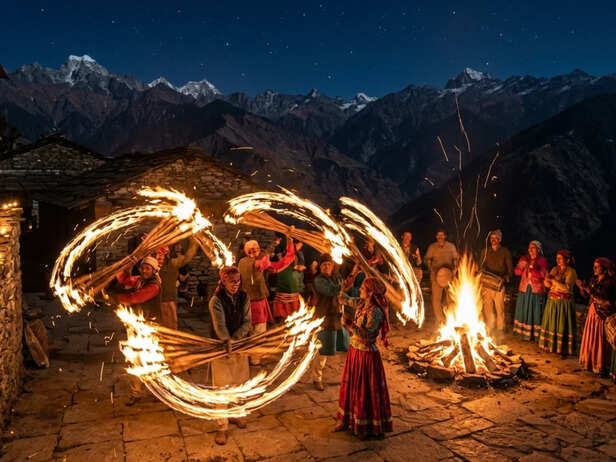
One of the most fascinating parts of Igas Bagwal is Bhailo, a traditional fire ritual that makes the celebration visually different from the usual Diwali festivities.During the festival, people traditionally gather bundles of pinewood or pine bark and tie them together to create large torches. These are lit and swung in the air, creating beautiful circles of fire against the dark mountain sky.
People gather in groups, sing traditional Garhwali folk songs and dance around the bonfire. The celebration brings entire villages together.The sight of burning torches, glowing diyas and people dancing to traditional music makes Igas Bagwal a memorable celebration of Uttarakhand's folk culture.The exact way Bhailo is performed can vary between villages.
Why Are Cows and Oxen Worshipped During Igas Bagwal?
Igas Bagwal is not just about lighting lamps and celebrating the return of happiness. It also reflects the close relationship between mountain communities and their livestock.In several villages, cows and oxen are given special attention during the festival. They may be washed, decorated and offered special food.
For farming families, cattle have traditionally been important for agriculture, transportation and everyday life. Honouring them reflects gratitude for their contribution to the household and the community.This also gives Igas Bagwal an agricultural and cultural significance beyond its connection with Diwali.
Why Is Igas Bagwal Also Called Budhi Diwali?
Igas Bagwal is also popularly known as Budhi Diwali, which translates to Old Diwali.The word Igas is associated with Ekadashi, the eleventh lunar day, while Bagwal is a local term used for the Diwali celebration in parts of Uttarakhand.
The festival is generally observed on Kartik Shukla Ekadashi, also known as Devuthani or Prabodhini Ekadashi.This day has a separate religious significance in Hindu tradition. It is believed to mark the end of Lord Vishnu's four-month period of cosmic rest, known as Chaturmas. Many Hindu communities consider it an auspicious time for weddings and other religious ceremonies to resume.However, the local Igas Bagwal celebration has its own regional identity and should not be confused with the wider observance of Devuthani Ekadashi.
A Festival That Keeps Uttarakhand's Mountain Traditions Alive
Igas Bagwal is more than a second Diwali. It represents the stories, memories and community traditions that have shaped life in Uttarakhand's mountain villages.Whether people celebrate it because of the folk story of Lord Rama's delayed homecoming or the tale of Madho Singh Bhandari's victorious return, the festival carries a shared message of happiness, hope and togetherness.
Today, efforts to celebrate Igas Bagwal in cities and encourage people to return to their ancestral villages are also helping keep this regional tradition alive.The festival reminds us that India's celebrations are not limited to one date or one way of observing a tradition. Sometimes, a festival becomes even more meaningful because of the stories a community has preserved for generations.