
Why Durga Maa’s Idol Needs Soil From a Courtesan’s Home
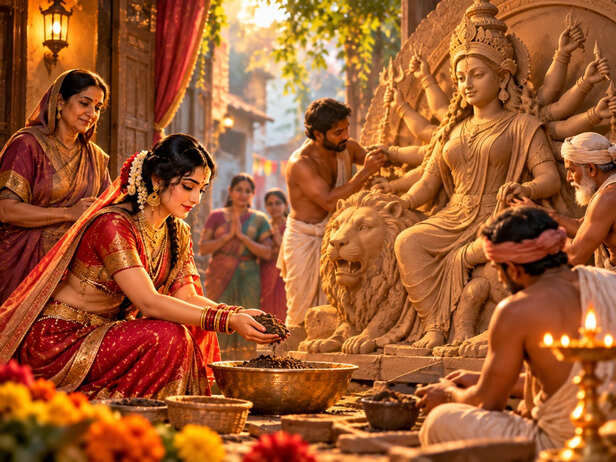
Every year, artisans in Bengal create magnificent idols of Goddess Durga. But one traditional ingredient used in some idol-making practices raises a powerful question: why is soil from the entrance of a courtesan’s home considered sacred? The custom, often associated with Nishiddho Pallisoil, is surrounded by religious interpretations and cultural stories. Some explanations connect it with the belief that a person leaves their purity outside before entering such a home. Yet the tradition carries a deeper question for society: if this soil is worthy of being part of the Goddess’s idol, why should the women associated with it be denied respect?
Four Ingredients Behind a Durga Idol
The making of a Goddess Durga idol is more than an artistic process. In some traditional accounts, four materials are associated with its preparation: cow urine, cow dung, soil from the Ganga riverbank and soil collected from the entrance of a courtesan’s home. These ingredients carry different ritual meanings, although practices vary among artisans and communities. Clay remains central to the idol-making process, while the other materials are connected with particular customs and beliefs. Among them, the soil from a courtesan’s home has attracted special attention because it raises questions about purity, tradition and the way society treats women.
Why Is This Soil Considered Sacred?
The custom is commonly linked to the Bengali tradition of collecting Nishiddho Palli soil, a term associated with a socially marginalised neighbourhood. One popular explanation says that visitors leave their purity outside before entering such a home, making the soil at its entrance symbolically significant. This is a traditional belief, not a scientifically established fact, and interpretations differ. The practice is often discussed as a reminder that sacredness cannot always be understood through society’s labels. The Durga Puja sacred soil tradition therefore invites people to look beyond appearances and consider how beliefs about purity shape their attitudes towards others.
A Ritual That Calls for Respect
Popular retellings of this custom describe the soil being requested with respect, sometimes alongside offerings, new clothes, prayers or a traditional Bengali meal. The details are not uniform across every community, so these accounts should not be treated as a universal ritual rule. Still, the idea of approaching someone with dignity is significant. The practice challenges the assumption that a person's social position determines their worth. In a festival centred on the power of Goddess Durga, this aspect of the tradition encourages reflection on whether respect should be reserved for certain people or offered to everyone.
Durga Puja Celebrates the Divine Feminine
Durga Puja in Bengal celebrates Goddess Durga as a symbol of strength, protection and the victory of good over evil. The festival also honours the divine feminine, reminding devotees that feminine power can take many forms. In some traditions, the worship of women and the recognition of feminine energy are important parts of religious observance. However, the specific rituals and their meanings vary. This makes the soil custom especially thought-provoking: a tradition connected with the Goddess can prompt a conversation about the dignity of women in everyday life, not just during a few days of celebration.
The Nine Forms of Feminine Power
The nine forms of Goddess Durga, collectively known as Navadurga, are worshipped especially during Navratri. Each form carries distinct symbolism, from courage and devotion to wisdom and compassion. The idea of honouring feminine power makes the soil tradition an opportunity to reflect on a wider question: how can people celebrate the Goddess while overlooking the dignity of women in their own communities? The rituals associated with Durga Puja are not all the same, but the broader message of reverence can inspire people to treat others with fairness and humanity beyond the festival.
The Contradiction Society Must Confront
Here lies the most striking question behind the Durga idol soil tradition. If soil connected with a courtesan’s home can be included in a sacred idol according to a traditional belief, why do social prejudices still influence how people view the women associated with those homes? The ritual alone does not prove that every community interprets the custom as a statement about equality. Yet it offers a meaningful starting point for discussion. A person's dignity should not depend on their background, occupation or social standing. Respect becomes meaningful when it extends beyond religious ceremonies into everyday behaviour.
Take the Message Beyond the Festival
The story behind Durga Puja’s sacred soil is not only about how an idol is made. It also encourages us to question the labels society places on people. Traditions can carry layers of meaning, and their interpretations may differ, but the values of compassion and dignity remain relevant. This Durga Puja, the lesson could be simple: worshipping the Goddess should also inspire us to respect women in real life, especially those who face social exclusion. After all, devotion is not measured only by the rituals we perform. It is also reflected in how we treat people whose lives are different from our own.
Unlock insightful tips and inspiration on personal growth, productivity, and well-being. Stay motivated and updated with the latest at My Life XP.