
Why Every Life Gives You Two Paths, Just Like Krishna
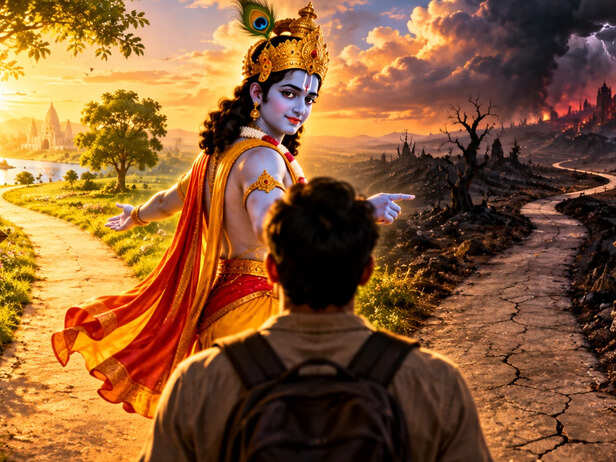
Life rarely tells us clearly which decision is right.
A difficult situation can put two choices directly in front of us. One may look attractive because it protects our comfort, ego or immediate interests. The other may be harder, but it can lead us toward responsibility, wisdom and peace.
This is one of the deeper lessons people find in the Mahabharata.
Traditional accounts describe Krishna going to Hastinapur to seek peace before the great war. But the deeper spiritual interpretation goes beyond simply asking whether Krishna entered the royal court.
It asks something far more personal: What did the people of Hastinapur choose when they were given a chance to choose differently?
Krishna’s Visit Was More Than a Mission
In the Mahabharata tradition, Krishna went to Hastinapur as a messenger of peace before the Kurukshetra war. His purpose was to prevent conflict and seek a settlement. Yet the deeper lesson lies in how people responded to that opportunity. Krishna’s presence can be viewed symbolically as a moment when wisdom stood before power. Hastinapur had an opportunity to choose peace, responsibility and compromise. But powerful interests and attachment to the throne made that choice difficult. The story reminds us that having the right answer in front of us does not guarantee that we will choose it.
Hastinapur Faced Two Different Paths
The conflict in Hastinapur can also be seen as a choice between two directions. One path represented fairness, restraint and the possibility of peace. The other was driven by pride, attachment and personal interest. This does not mean every difficult decision is simply good versus evil. Real life is usually more complicated. Yet the Mahabharata repeatedly shows how small choices can slowly create larger consequences. A person may ignore one warning, justify one selfish decision and compromise once more. Eventually, those choices can create a situation that becomes almost impossible to reverse. That is where the real danger begins.
Self-Interest Can Make Wisdom Invisible
One of the most striking lessons from the story is how personal interest can affect judgment. When people become deeply attached to power, status or ego, they may stop seeing consequences clearly. The problem is not always a lack of knowledge. Sometimes people know what is right but still choose what benefits them immediately. This happens even today. Someone may know they should apologise but protect their ego instead. A person may know a decision is unfair but remain silent because speaking up feels risky. The Mahabharata shows how such choices can grow over time until the consequences become much bigger than the original decision.
Two People Can Choose Opposite Roads
The Mahabharata also reminds us that people facing similar circumstances can make completely different choices. Even within the same family, individuals may develop different values, ambitions and ideas of right and wrong. This is why simply blaming circumstances is not always enough. Our environment influences us, but our decisions still matter. A person can choose patience when another chooses anger. One can choose truth while another chooses convenience. These choices gradually shape character. The story therefore shifts attention away from destiny alone and toward personal responsibility. What happens next is often influenced by what we repeatedly decide to do.
Every Choice Leaves a Consequence
We often judge decisions by what they give us immediately. But the Mahabharata encourages a longer view. A choice that feels comfortable today may create suffering tomorrow, while a difficult decision may protect something far more valuable in the future. This is why dharma is not simply about choosing what feels good. In traditional Indian thought, dharma is connected with duty, righteousness and living according to what is right in a given situation. Understanding it requires wisdom and reflection. Before making an important decision, ask yourself one question: Will this choice still feel right when the immediate emotion has disappeared?
How to Recognise Your Better Path
When life puts two choices before you, pause before reacting. Ask whether your decision is being controlled by anger, fear, greed, pride or pressure. Then ask what remains if those emotions are removed. Consider who could be affected by your choice and whether you would be comfortable explaining your decision later. You do not need to make every decision perfectly. What matters is developing the habit of thinking beyond immediate comfort. Sometimes the better path is the harder one because it requires honesty, patience or courage. That difficulty does not necessarily make it wrong.
The Final Choice Is Always Yours
The greatest lesson is not that life will always give us an easy answer. It is that we will repeatedly face moments when our values are tested. The Mahabharata presents a world where decisions made from pride and attachment eventually carry enormous consequences. Its spiritual message can still feel relevant today. You may not control every situation around you, but you can question the intention behind your choices. When two paths appear, one may serve your ego while another may demand courage and responsibility. The path you choose may quietly shape the person you become. That choice is yours.
Unlock insightful tips and inspiration on personal growth, productivity, and well-being. Stay motivated and updated with the latest at My Life XP