
Why Is a Cat Worshipped With Goddess Shasti in Bengal?
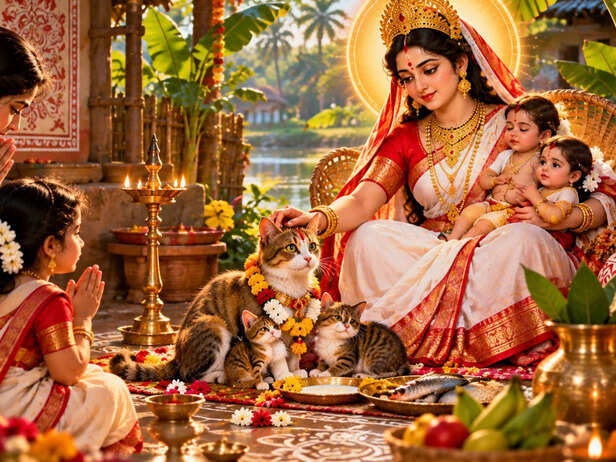
A cat enters a Bengali household, and suddenly children begin disappearing one after another. At first, nobody understands what is happening. But behind this mysterious folk tale is Goddess Shasti, a deity traditionally associated with childbirth, fertility and the protection of children. Her vahana, the cat, plays a central role in Bengali traditions connected with Shasti Puja. The story carries a powerful warning about disrespect, false accusations and the consequences of harming an innocent creature.
The Cat Was Blamed for Everything
The story begins inside a prosperous Bengali household where the youngest daughter-in-law secretly takes food from the kitchen. Whenever someone notices food missing, she blames the family’s cat. The family believes her story and punishes the animal repeatedly. But the cat is not an ordinary creature in this legend. It is regarded as the vahana of Goddess Shasti, the deity traditionally connected with children and motherhood. The woman does not realise that her false accusations and cruel treatment of the cat will soon become the centre of a much darker lesson.
Shasti’s Cat Was No Ordinary Animal
When the injured cat finally reaches Goddess Shasti, the story takes an unexpected turn. The goddess learns how the animal was treated and why it was repeatedly punished. In Bengali religious tradition, Shasti Devi is associated with protecting children and supporting mothers. Her connection with the cat is especially important in regional folklore and Shasti worship. The cat therefore becomes more than an animal in the story. It represents the goddess’s presence and turns the woman’s careless behaviour into a spiritual lesson about honesty, compassion and respect for creatures associated with the divine.
Her Children Began Disappearing
Months later, the woman gives birth to a son. But instead of celebrating peacefully, the family faces a terrifying mystery. The newborn disappears. The same thing happens after her next children are born. One after another, six children vanish, leaving the mother heartbroken and confused. Nobody knows where they have gone, and whispers begin spreading through the village. The woman starts wondering whether she has been cursed. But she still does not understand the connection between her missing children and the cat she once blamed for every missing piece of food.
The Seventh Child Revealed the Truth
When the seventh child is born, the mother refuses to fall asleep. She stays awake through the night, determined to discover what is happening. At midnight, she sees the cat carrying her baby away. Instead of staying behind, she follows it into the darkness. The trail finally leads her to a Goddess Shasti temple. What she sees there leaves her stunned. Her six missing children are alive, playing happily at the goddess’s feet. The mystery that had haunted the household is finally beginning to make sense.
Shasti Revealed Her Greatest Lesson
Inside the temple, Goddess Shasti confronts the woman and reveals what she had done wrong. The woman had stolen food and repeatedly blamed the innocent cat, leading the family to punish it. According to the legend, the goddess makes her understand that the suffering she experienced was connected to her own actions. The woman finally realises that her mistake was not simply stealing food. It was falsely accusing another creature and allowing it to be harmed. She falls at the cat’s feet and asks for forgiveness, accepting responsibility for what she had done.
The Cat Finally Forgave Her
The turning point comes when the woman sincerely apologises. Her pride disappears, and she accepts that the cat was innocent. The cat forgives her, and Goddess Shasti returns the children. The story ends with the family understanding the importance of respecting the goddess and her sacred vahana. In Bengali tradition, Shasti is remembered particularly in connection with children, motherhood and family well-being. The legend therefore transforms a frightening mystery into a story about repentance: admitting a wrong, seeking forgiveness and changing one’s behaviour can restore what was lost.
Why Bengal Remembers Shasti’s Cat
The story explains why the cat of Goddess Shasti holds such a distinctive place in Bengali folklore. Shasti worship has traditionally been associated with mothers praying for the well-being and longevity of their children. The cat is closely connected with the goddess in regional traditions, making it an important symbol rather than simply a household animal. The legend also carries a message that remains easy to understand: do not accuse someone without proof, do not hurt an innocent creature and do not mistake kindness for weakness. Its mystery may be ancient, but its moral remains surprisingly relevant.
Unlock insightful tips and inspiration on personal growth, productivity, and well-being. Stay motivated and updated with the latest at My Life XP.