
Why Is Shaligram Worshipped With Tulsi Leaves?
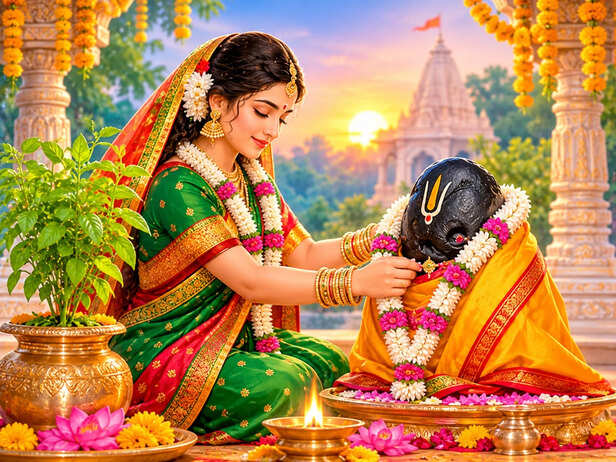
Why is a sacred plant married to a black stone every year, and why is this wedding celebrated with the same rituals as a traditional Hindu marriage? The answer lies in a fascinating story involving a devoted woman, a powerful demon king, Lord Vishnu and a curse that changed their lives forever. Tulsi Vivah, celebrated around Dev Uthani Ekadashi, is not just a symbolic wedding. It carries a deep connection with devotion, sacrifice and the belief that Tulsi became inseparable from Lord Vishnu.
Who Was Vrinda Before Becoming Tulsi?
According to a popular Hindu legend, Tulsi was once a woman named Vrinda, the devoted wife of the demon king Jalandhar. She was known for her deep faith in Lord Vishnu and her unwavering loyalty to her husband. Her devotion was believed to be the source of Jalandhar's extraordinary strength. As long as Vrinda's chastity remained unbroken, Jalandhar could not be defeated. This made her devotion central to the battle between the gods and Jalandhar. Her story eventually became the foundation of the Tulsi Vivah tradition.
Why Could Nobody Defeat Jalandhar?
Jalandhar became so powerful that even the gods struggled to defeat him. According to the legend, his strength was connected to Vrinda's unwavering devotion and chastity. Every attempt to defeat him failed because Vrinda's spiritual power continued to protect him. Worried about the growing threat, the gods approached Lord Vishnu for help. They believed that defeating Jalandhar was necessary to restore balance. However, the situation created a difficult dilemma because Vrinda's devotion had become the greatest protection for her husband.
Why Did Lord Vishnu Take Jalandhar's Form?
In the popular version of the story, Lord Vishnu decided to take Jalandhar's appearance while the demon king was away fighting the gods. Vrinda believed that her husband had returned and welcomed him. When she realised the truth, her spiritual protection over Jalandhar was broken. The gods were then able to defeat him. However, when Vrinda discovered that Lord Vishnu had deceived her, she was heartbroken and furious. She felt that the very deity she worshipped had betrayed her trust.
The Curse That Changed Lord Vishnu Forever
Unable to accept what had happened, Vrinda cursed Lord Vishnu to turn into stone. Lord Vishnu accepted her curse, and according to the legend, this became the origin of the sacred Shaligram stone associated with his worship. The story takes an emotional turn here because Vrinda's curse did not come from hatred alone but from the pain of being deceived by the deity she trusted. Her words changed the course of the legend and created a lasting connection between Lord Vishnu, Shaligram and Tulsi.
How Did Vrinda Become the Sacred Tulsi Plant?
After Vrinda's curse, Lord Vishnu blessed her and gave her a special place in his worship. According to the popular legend, Vrinda's earthly form became the Tulsi plant. Lord Vishnu also declared that Tulsi leaves would be essential in his worship. This is why Tulsi holds a special position in many Hindu households and temples. Devotees consider the plant sacred and offer its leaves to Lord Vishnu and Krishna. The transformation of Vrinda into Tulsi is remembered as a story of devotion, sacrifice and divine connection.
Why Is Tulsi Married to Shaligram?
This is where the tradition of Tulsi Vivah begins. Shaligram is a sacred black stone form of Lord Vishnu, traditionally worshipped by devotees. Since Vrinda became Tulsi and Lord Vishnu took the Shaligram form after accepting her curse, their symbolic marriage represents their eternal connection. Every year, devotees perform Tulsi Vivah with wedding rituals, flowers, decorations, mantras and offerings. The ceremony is not simply about marrying a plant to a stone; it celebrates the sacred bond between Tulsi and Lord Vishnu.
Why Is Tulsi Vivah Celebrated on Dev Uthani Ekadashi?
According to Hindu tradition, Lord Vishnu enters a period of cosmic sleep on Dev Shayani Ekadashi and awakens on Dev Uthani Ekadashi, also called Prabodhini Ekadashi. His awakening marks the beginning of the auspicious wedding season after the Chaturmas period. Tulsi Vivah is celebrated on Dev Uthani Ekadashi or on one of the following days, depending on regional traditions and family customs. Devotees perform the wedding with great devotion, believing that the ceremony brings blessings, harmony and happiness into the household.
Unlock insightful tips and inspiration on personal growth, productivity, and well-being. Stay motivated and updated with the latest at My Life XP.