
Why King Janaka Took a 12-Year-Old Seriously
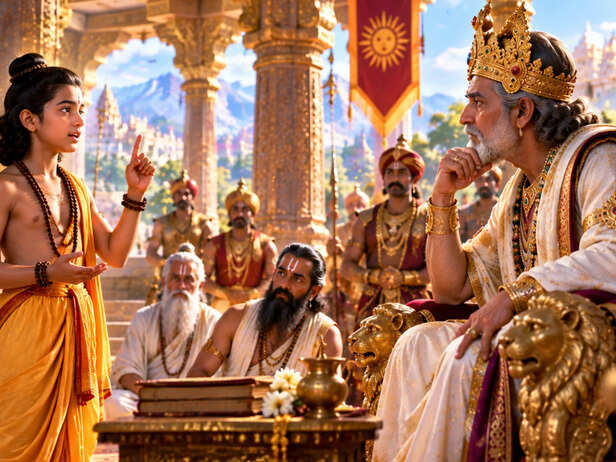
Imagine walking into a room filled with the greatest scholars of your time.
Now imagine being just twelve years old.
Before anyone hears what you have to say, they look at your age and decide that you do not belong there.
That is what makes the traditional story of Ashtavakra so striking.
According to the story, a young Ashtavakra arrived at King Janaka’s great gathering of scholars. The gatekeeper questioned why a child should enter a place meant for learned men.
But Ashtavakra did not become intimidated.
Instead, he asked a question that completely changed the conversation:
Does age decide who is wise, or does knowledge?
What followed became one of the most memorable lessons about judging human potential.
The Boy Who Entered Janaka’s Court
The traditional account places Ashtavakra in the court of King Janaka in Mithila during a great gathering of scholars. He was still a child, and his physical form was noticeably different. The name Ashtavakra is traditionally explained as referring to his body being bent in eight places. When the gatekeeper saw him, he questioned his right to enter a gathering meant for learned men. But Ashtavakra did not argue about his appearance. He questioned the assumption behind the rejection itself. Why should a person’s age determine whether they have something meaningful to say?
He Questioned the Meaning of Wisdom
Ashtavakra’s response was simple but powerful. If knowledge is the reason people are respected, then why should age be used as the measure of wisdom? Grey hair may show that someone has lived longer, but it cannot automatically prove that they understand more. His argument challenged a common human habit: judging people before listening to them. We still do this today. We may dismiss a young person's opinion because they are inexperienced, or assume an older person must always be right. Ashtavakra’s story asks us to pause and consider the person’s understanding rather than judging them by appearance alone.
King Janaka Asked Him to Enter
When the gatekeeper could not defeat Ashtavakra’s reasoning, the matter reached King Janaka. The king then allowed the young boy to enter the assembly. This moment is important because Ashtavakra did not demand respect merely because he was confident. He earned attention through the strength of his reasoning. The story presents Janaka as someone willing to listen rather than dismiss a person based on age. That quality remains relevant today. A good teacher, parent or leader does not simply ask, “How old are you?” They also ask, “What have you understood, and how clearly can you explain it?”
The Debate Became the Real Test
The story then takes a dramatic turn. Ashtavakra challenged Vandin, a highly respected scholar in Janaka’s court. Traditional versions describe the stakes of these scholarly debates as extremely serious. Ashtavakra was not intimidated by reputation or age. He entered the debate based on knowledge and reasoning. The important lesson is not simply that a child defeated an accomplished scholar. It is that Ashtavakra was willing to question someone everyone else treated as unquestionable. Sometimes confidence means speaking up when everyone around you has already decided who is right.
His Age Did Not Limit His Questions
Children are often told to listen, follow instructions and wait until they are older to understand difficult subjects. Respecting experience is valuable, but curiosity should not be discouraged. Ashtavakra represents the opposite approach. He questioned assumptions instead of accepting them simply because an older person had made them. That does not mean children automatically know more than adults. It means age should not become a reason to silence genuine curiosity. A child who asks difficult questions may be showing the beginning of deep thinking. Instead of immediately saying, “You are too young to understand,” sometimes the better response is, “Tell me why you think that.”
His Story Still Matters for Children
The lesson becomes especially meaningful for parents and teachers. Children are constantly learning how to think, but they also learn from how adults respond to their questions. If every difficult question is dismissed, curiosity can slowly disappear. Stories such as Ashtavakra’s can encourage children to value reasoning rather than simply memorising answers. Ask them why they believe something. Let them explain their ideas. Correct mistakes without humiliating them. Encourage respectful disagreement. These simple habits can help develop confidence and critical thinking. The goal is not to make children believe they are always right, but to teach them that thoughtful questions are worth asking.
Never Measure Potential by Age
The deepest lesson from Ashtavakra’s story is not about defeating a scholar. It is about refusing to let other people decide your potential before you have even spoken. Age, appearance, wealth and social position can influence how people perceive us, but they do not tell the whole story. A young person may have extraordinary curiosity. An older person may still have much to learn. What matters is the willingness to question, understand and grow. Ashtavakra entered the court as a child, but he left behind a lesson that still speaks to parents, teachers and every person who has ever been underestimated.
Unlock insightful tips and inspiration on personal growth, productivity, and well-being. Stay motivated and updated with the latest atMy Life XP