
Why Mahabharata Has Stories Inside Other Stories
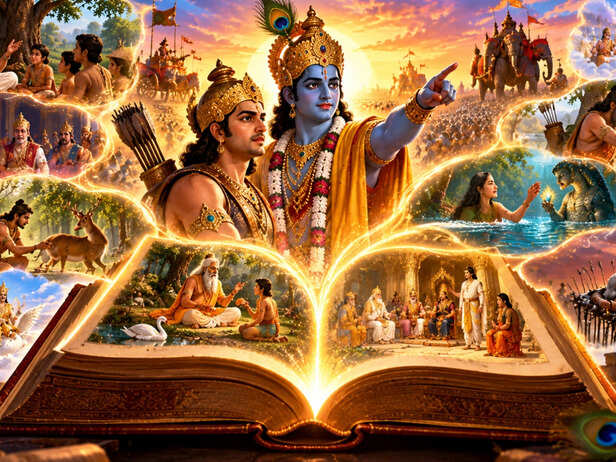
What if the Mahabharata is not just one enormous story?
Imagine drawing a circle. Inside it, draw another circle. Then another, and another. Now imagine that every circle contains a different storyteller, a different conversation and sometimes an entirely different story.
This is one of the most fascinating features of the Mahabharata. Its narrative repeatedly moves from one storyteller to another, creating layers within layers. A story begins, another story appears inside it, and sometimes that story contains yet another tale. This unusual structure makes the epic feel almost endless, with every new layer opening another door.
The First Circle Begins
The first layer begins in Naimisha forest, where the sage Shaunaka and other sages are gathered during a long sacrificial session. Ugrashrava Sauti arrives there and is asked about the great stories he has heard. Sauti explains that he has recently witnessed King Janamejaya's snake sacrifice, where Vaishampayana recited the Mahabharata. The sages then ask Sauti to narrate what he heard. This creates the outer frame of the epic. We are already listening to one storyteller who is about to repeat the story told by another storyteller.
A Story Inside the Sacrifice
Now the narrative moves one level deeper. Sauti tells the sages about Janamejaya's snake sacrifice, a dramatic event connected with the death of his father, King Parikshit. During this sacrifice, snakes are drawn toward the fire, until the sage Astika intervenes and brings the ritual to an end. This episode becomes part of the larger frame through which the Mahabharata reaches its audience. The fascinating part is that Sauti is not presenting the epic as a story happening directly before him. He is remembering and retelling something he heard at an earlier gathering.
Vaishampayana Opens Another Layer
Inside Janamejaya's gathering comes another important narrator, Vaishampayana, a disciple of Vyasa. At Vyasa's direction, Vaishampayana narrates the history of the Bharata dynasty to Janamejaya. This is where the stories of the Kauravas, Pandavas and the great conflict become central to the narration. The structure now becomes clear: Vyasa's composition is transmitted through Vaishampayana, heard by Sauti and later retold to Shaunaka and the assembled sages. It is almost like passing a flame from one person to another, with each storyteller carrying the enormous narrative forward.
One Tale Opens Another
The pattern does not stop with the main story. Throughout the Mahabharata, characters frequently become storytellers themselves. A king may ask a question, a sage may answer with an ancient example, and that example may introduce another character and another episode. This technique allows the epic to explore ideas such as duty, anger, wisdom, ambition and truth without simply explaining them directly. Instead, the lesson becomes a story. The reader enters one narrative expecting an answer, only to discover another tale waiting inside it. That is what gives the Mahabharata its remarkable depth and variety.
Vidura Turns Advice Into Story
One of the clearest examples appears in the Udyoga Parva. Vidura advises the troubled Dhritarashtra, but instead of giving only direct instructions, he repeatedly uses older stories to make his point. One such story involves Prahlada and his son Virochana. Virochana becomes involved in a dispute with Sudhanwan, and Prahlada is forced to judge between them. The difficult part is that truth stands against his own son's interest. Prahlada chooses truth and declares Sudhanwan superior. Vidura uses this story to teach Dhritarashtra about the danger of allowing attachment to overcome righteousness.
Why This Structure Feels Endless
This layered design explains why the Mahabharata can feel much larger than a single war story. The main narrative can pause for a question, which opens an older tale. That tale may introduce another conversation, which leads to another example. Instead of moving only forward in time, the epic moves backward, sideways and inward. The result is a vast narrative world where characters become listeners and storytellers at different moments. It also allows the epic to preserve many different traditions, teachings and memories inside one enormous framework. The story becomes a collection of stories connected by human questions.
The Storytelling Secret Still Works
The real genius of this structure is that every new story has a reason to exist. Someone asks a question, someone remembers an event, and another narrator responds with a story. That makes the transitions feel natural rather than random. It also keeps curiosity alive because the reader never knows what the next layer will reveal. The Mahabharata therefore becomes more than the story of the Pandavas and Kauravas. It becomes a huge conversation about human life, where stories explain other stories. Perhaps that is why, even after centuries, its narrative structure still feels surprisingly powerful.
The Epic Inside the Epic
The Mahabharata's greatest storytelling secret may be hiding in plain sight.
It does not simply tell us what happened. It shows us how stories travel.
Vyasa, Vaishampayana, Sauti, sages, kings and other characters become links in a long chain of narration. One story creates the space for another, and another opens the door to something deeper.
That is why reading the Mahabharata can feel like walking through a building filled with hidden rooms. You enter one room expecting an answer, but inside it, you discover another story.
And perhaps that is the most fascinating secret of all: the Mahabharata is not just one story. It is a world made from stories within stories.
Unlock insightful tips and inspiration on personal growth, productivity, and well-being. Stay motivated and updated with the latest at My Life XP