
Why Mahabharata Starts with King Janamejaya, Not Bhishma
Ask anyone where the Mahabharata begins, and most people will mention King Shantanu, Bhishma Pitamah, or the rivalry between the Kauravas and Pandavas. But what if the epic actually begins somewhere entirely different? Long before the Kurukshetra war unfolds, a forgotten king, a deadly serpent sacrifice, and a powerful narration set the stage for one of the world's greatest epics. This little-known beginning changes the way we understand the Mahabharata and reveals why it is much more than the story of a war.
The Story Begins with a Forgotten King
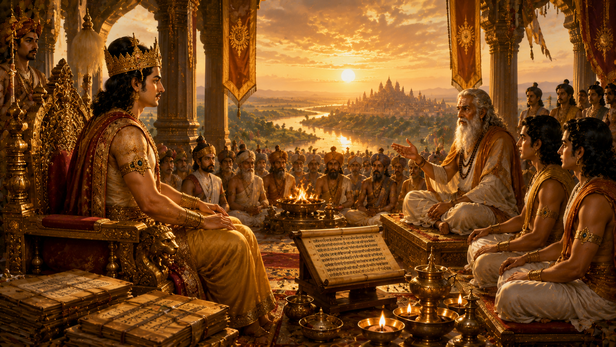
Contrary to popular belief, the Mahabharata does not begin with Bhishma, King Shantanu, or the Pandavas. The epic opens with King Janamejaya, the great-grandson of Arjuna and the son of King Parikshit. Filled with grief after his father's death from the bite of Takshaka, Janamejaya organized the famous Sarpa Satra, a massive snake sacrifice meant to destroy every serpent. It was during this historic event that the Mahabharata was narrated for the very first time.
Vyasa Had Already Completed the Epic
Before Janamejaya's sacrifice took place, Sage Vyasa had already composed the Mahabharata. According to tradition, Lord Ganesha agreed to write the epic on one condition: Vyasa must narrate it without stopping. In return, Vyasa requested that Ganesha understand every verse before writing it down. This remarkable partnership produced one of the longest and most profound works of literature ever created, preserving its wisdom for future generations.
The First Public Narration
Following Vyasa's instructions, his disciple Sage Vaishampayana narrated the complete Mahabharata to King Janamejaya during the Sarpa Satra. This was not simply storytelling. It was a lesson in dharma, justice, leadership, and the consequences of human choices. As the king listened, he learned that revenge alone could never bring lasting peace, making the narration deeply connected to his own life.
How the Epic Reached the World
Among those present at the sacrifice was Sage Ugrashrava Sauti, who carefully listened to the entire narration. Later, he travelled to the sacred forest of Naimisharanya, where many sages had gathered in the ashram of Sage Shaunaka. There, he narrated the Mahabharata once again. This chain of oral tradition ensured that the epic spread across generations before it became widely preserved in written form.
More Than the Story of a War
Many people think the Mahabharata is simply about the battle between the Kauravas and the Pandavas. In reality, the war is only one part of a much larger journey. The epic explores truth, duty, forgiveness, leadership, family relationships, sacrifice, and the difficult choices every person faces. Every character reflects a different aspect of human nature, making the Mahabharata as relevant today as it was thousands of years ago.
Why the Sages Recommended Reading It
According to the Mahabharata's traditional narrative, Sage Vaishampayana told King Janamejaya that those who study or listen to this sacred history with sincerity gain wisdom, reputation, and a better understanding of righteous living. While these are devotional beliefs rather than guaranteed outcomes, the epic's lessons on decision-making, self-control, and compassion continue to inspire readers across cultures and generations.
A Timeless Guide for Every Generation
Imagine growing up with the Mahabharata as a companion instead of reading it only later in life. Every chapter offers practical lessons about courage, patience, honesty, humility, and responsibility. Although the complete epic contains more than 100,000 verses, even reading a small portion regularly can open new perspectives on everyday challenges. Perhaps that is why the Mahabharata has survived for centuries, not merely as an ancient story, but as a timeless guide for understanding life itself.
Unlock insightful tips and inspiration on personal growth, productivity, and well-being. Stay motivated and updated with the latest at My Life XP.