
Why Rivers Are Seen as Living Goddesses Beside Hindu Temples?
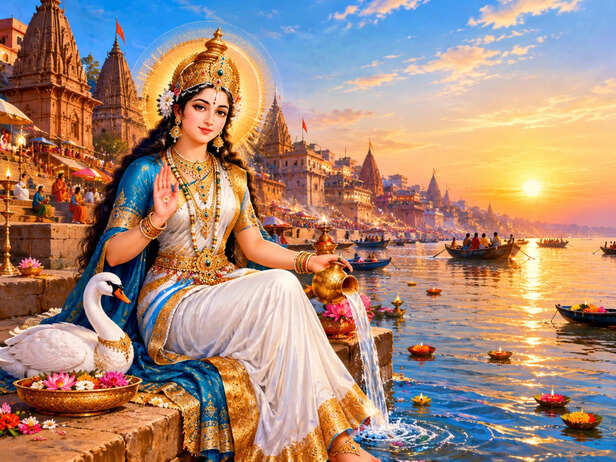
There is something almost familiar about an old temple beside a river. You see people entering the temple with flowers in their hands, while others are sitting quietly near the water. Some take a holy dip, some offer prayers and some simply spend a few peaceful minutes by the river. This scene can be found in many parts of India. The connection between rivers and Hindu temples is not just a coincidence. Rivers have always been important in Indian life, and Hindu tradition gives many of them a sacred place. Over time, rivers became closely linked with temples, pilgrimage and daily rituals. So, why did this happen?
Rivers Are Worshipped As Goddesses
In Hindu tradition, several rivers are treated as divine beings and are often represented as goddesses. Ganga, Yamuna, Narmada, Godavari, Krishna, Kaveri and Sindhu are among the most respected sacred rivers. They are also commonly known together as the Saptanadi, meaning seven sacred rivers. For devotees, these rivers are much more than natural water sources. They are connected with purity, life and spiritual belief. That is why people may offer flowers, light lamps near the water or take a dip before visiting a temple. The river becomes part of the worship itself.
Why Is Ganga So Special?
Among all sacred rivers, Ganga has perhaps the strongest place in Hindu religious tradition. A famous story tells us that Ganga once flowed in the heavens. King Bhagiratha is believed to have performed deep penance to bring her down to earth so that his ancestors could be freed. But her descent was considered too powerful for the earth to bear. Lord Shiva is then said to have caught Ganga in his matted hair and released her gently. This is why Shiva is often shown with Ganga flowing from his hair. The story is also one reason places connected with the Ganga became important pilgrimage centres.
Why Are So Many Temples Near Rivers?
There was a practical reason as well. In the past, people naturally built settlements near rivers because they needed water for farming, drinking and everyday life. As these settlements grew, religious places also developed around them. But the connection soon became deeper. Water was already an important part of Hindu rituals, so having a sacred river near a temple made it possible for devotees to bathe and then offer prayers. In many temple towns, the river became part of the pilgrimage rather than simply being something nearby.
What Is Theertham?
The word theertham is often heard during temple visits. In simple terms, it means sacred water connected with a temple or deity. Devotees may receive a small amount of theertham after a prayer or ritual. For many people, it is a meaningful part of worship. The idea is not just about drinking water. Theertham is connected with purity, blessing and devotion. It also reflects a larger Hindu belief that outer cleanliness and inner purity should go together.
Famous Temple Towns Near Rivers
Some of India's most well-known pilgrimage places show this connection very clearly. Varanasi is a major example, where the Ganga and temples form an important part of the city's spiritual identity. Nashik is another example, with the Godavari closely connected with the pilgrimage traditions around Trimbakeshwar. There are many such places across India where people visit the temple and river as part of the same spiritual journey.
Why Has This Tradition Continued?
The relationship between rivers and worship is very old. Rivers supported early communities and made life possible in many regions. They provided water, helped agriculture and made travel easier. It is not surprising that people began to see these life-giving rivers as something special. Over generations, stories, rituals and festivals grew around them. The river became part of the cultural memory of entire communities.
Sacred Rivers Are Facing Modern Problems
Today, these rivers face a very different kind of challenge. Pollution, plastic waste, sewage and rapid urban growth have affected many sacred rivers. This creates a difficult contradiction. A river may be worshipped as sacred, but it can still be badly polluted. For many people, protecting these rivers is therefore more than an environmental issue. It is also about respecting a tradition that has continued for generations.
The reason so many Hindu temples are found near rivers is a mix of geography, history and faith. People settled near rivers because they needed water. Over time, those same rivers became sacred and deeply connected with worship. That is why the temple and river often feel like two parts of the same place. One brings people closer to the deity. The other gives them a quiet place to pray, reflect and feel connected to something bigger than themselves.
Unlock insightful tips and inspiration on personal growth, productivity, and well-being. Stay motivated and updated with the latest at My Life XP.