
Why Shiva Appeared After a Demon Attacked His Lingam
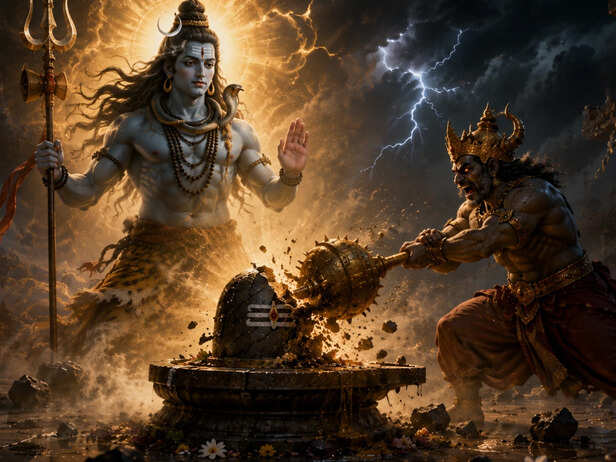
What would happen if someone raised a sword against a Shiva Lingam?
According to the traditional story of Bhimashankar Jyotirlinga, the answer was beyond anything the demon Bhima could have imagined. A powerful ruler, filled with anger and pride, believed that his strength could silence everyone who stood against him. But inside a prison, he encountered someone who refused to abandon his faith.
That devotee was King Sudakshina.
Even when imprisoned, Sudakshina continued worshipping Lord Shiva by creating a simple Shiva Lingam from clay. When Bhima saw this devotion, his anger reached its peak. He raised his sword and struck the Lingam.
And then, everything changed.
Bhima Was Born From A Dark Past
According to the traditional legend, Bhima was the son of Kumbhakarna, Ravana's brother, and Karkati. After learning about his father's death, Bhima became consumed by anger and revenge. He wanted extraordinary power so that nobody could challenge him. He performed severe penance to please Lord Brahma and eventually received a powerful boon. With his newfound strength, Bhima became increasingly arrogant and began creating fear across the three worlds. His power had grown, but so had his pride. And that pride would eventually bring him face to face with someone whose strength came from an entirely different source.
Bhima Turned Power Into Tyranny
The boon Bhima received did not make him wiser. Instead, it made him more confident in his own power. He began defeating opponents and troubling gods, sages and kings. Eventually, he captured King Sudakshina, a devoted worshipper of Lord Shiva. Bhima probably believed that imprisoning the king would also break his spirit. But he misunderstood something important. Sudakshina's strength did not come from his kingdom, army or position. Even inside a prison, he still had his devotion. Bhima could control the king's body, but he could not control what the king believed in.
The Prison Became A Temple
Instead of surrendering to fear, Sudakshina made a Parthiva Shiva Lingam, traditionally described as a Lingam made from earth or clay. He began worshipping Lord Shiva with complete devotion. The scene is striking because there was nothing grand about it. No temple. No royal ceremony. No army. Just a prisoner, a simple Lingam and unwavering faith. Sudakshina's circumstances had changed, but his devotion had not. That is the point where Bhima's physical power began to meet something he could not understand. When Bhima discovered what the king was doing, his anger exploded.
One Sword Strike Changed Everything
Bhima entered the prison and saw Sudakshina worshipping Shiva. Furious that the king continued to pray despite his captivity, Bhima decided to destroy the Lingam. He raised his sword and struck it. But according to the traditional account, the moment the weapon touched the sacred Lingam, the entire place was filled with divine radiance. What Bhima thought he could destroy became the very source of his greatest defeat. The Shiva Lingam was no longer merely an object of worship in the story. It became the point from which Mahadev manifested.
Mahadev Appeared In His Fierce Form
Lord Shiva appeared before Bhima to protect his devotee. The confrontation that followed was no ordinary battle. Bhima possessed immense power gained through years of penance, while Shiva represented the divine force that could not be overcome through arrogance. According to the legend, a fierce battle followed between Bhima and Shiva. Eventually, Bhima and his forces were defeated. The story creates a powerful contrast: Bhima spent years gaining external power, while Sudakshina remained protected through inner faith. In the end, it was not the strongest weapon that mattered. It was the devotion that could not be broken.
Shiva Stayed For His Devotees
After Bhima's defeat, the gods and devotees prayed to Lord Shiva to remain at the sacred place. According to the traditional account, Shiva accepted their prayers and manifested there as a Jyotirlinga, becoming known as Bhimashankar. The name itself remains connected with the legendary demon Bhima and the divine manifestation of Shiva. The sacred site traditionally associated with Bhimashankar is located in Maharashtra and is revered as one of the twelve Jyotirlingas. For devotees, the story is not simply about a battle. It represents the victory of devotion over arrogance and divine protection over oppression.
The Real Battle Was Between Pride And Faith
The most powerful part of this story may not be the sword, the demon or even the battle. It is the contrast between Bhima's pride and Sudakshina's faith. Bhima believed that power gave him control over everything. Sudakshina had almost nothing, yet he refused to give up his devotion. That difference changed the entire story. The traditional legend reminds devotees that external strength can be temporary, while faith can remain powerful even in the darkest circumstances. The prison could hold Sudakshina, but it could not imprison his devotion. And that is when the divine light appeared.
The Hidden Truth Behind Bhimashankar
Bhima thought he was striking a piece of clay.
But according to the traditional legend, he was actually standing before the very divine presence he had underestimated.
The story of Bhimashankar carries a simple but powerful message:
Power without humility can become destruction.
Devotion without fear can become strength.
Sudakshina did not defeat Bhima with a weapon. He simply refused to stop believing.
And when Bhima's sword finally touched the Shiva Lingam, the story says that Mahadev himself appeared.
That is why the legend of Bhimashankar Jyotirlinga continues to fascinate devotees.
Because sometimes the greatest strength is not the ability to fight back.
Unlock insightful tips and inspiration on personal growth, productivity, and well-being. Stay motivated and updated with the latest at My Life XP