
Why Two Puranas Name Different Goddesses to Kill Mahishasura
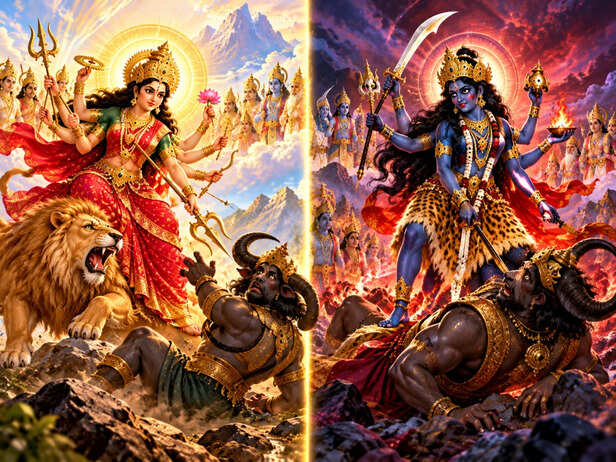
Most people know the story of Goddess Durga defeating Mahishasura after a fierce battle. But there is another detail that makes this ancient legend even more intriguing. Some Puranic accounts describe the emergence of a powerful goddess from the combined energies of the gods, while a version associated with the Narada Purana connects Mahishasura’s defeat with Goddess Lakshmi. Why do these accounts differ, and what does each story reveal about the divine feminine?
The Demon Who Defeated the Gods
According to the familiar Puranic account, Mahishasura gained immense power through a boon that made him believe he could not be defeated by a man. He used his strength to wage war against the gods and seize control of heaven. Unable to defeat him, the gods lost their celestial kingdom and sought help from Brahma, Vishnu and Shiva. Their defeat set the stage for the arrival of a power Mahishasura had failed to anticipate: a goddess whose strength would challenge his seemingly unstoppable rule.
The Gods' Anger Creates a Goddess
In the Devi Mahatmya, which forms part of the Markandeya Purana, the gods' combined energies come together to create a radiant female form. The brilliance of Brahma, Vishnu, Shiva and the other deities merges into a single, extraordinary power. This energy takes the form of the goddess who will confront Mahishasura. Her birth is not simply the arrival of another warrior; it represents the combined strength of the gods in a form the demon's boon cannot protect him against. She becomes the answer to a crisis that the gods could not solve individually.
The Gods Arm the Goddess
The newly manifested goddess receives weapons and sacred gifts from the gods. Shiva gives her his trident, Vishnu his discus, and other deities contribute their own weapons and symbols of power. The mountain god Himalaya is traditionally associated with gifting her a lion as her mount. Armed with these divine gifts, the goddess stands ready to face Mahishasura and his army. In this account, her strength comes from the combined power of the divine forces, yet she herself leads the battle. She is celebrated as Durga and Mahishasuramardini, the slayer of Mahishasura.
Durga Faces Mahishasura
Mahishasura does not surrender easily. The battle between the goddess and the demon becomes a fierce struggle, with Mahishasura changing forms and using his strength to resist her. Durga meets every challenge and finally defeats him. Her victory restores the gods' position and ends the demon's reign of terror. This is the best-known version of the story, especially in traditions associated with Durga Puja and Navratri. The image of Durga defeating Mahishasura has since become a powerful symbol of divine strength overcoming arrogance and destructive power.
The Other Account Names Lakshmi
The story takes a different turn in an account associated with the Narada Purana. Here, the divine response to Mahishasura's growing power is connected with Vishnu and the manifestation of Goddess Lakshmi. In this telling, Lakshmi appears in a fierce divine form and is associated with the demon's destruction. This version differs from the familiar account in which Durga emerges from the combined energies of the gods. The distinction is worth exploring, although summaries of Puranic stories can vary, so the exact passage and its wording should be checked before treating every detail as identical across editions.
Why Do the Stories Differ?
Hindu Puranic literature contains many stories that present the divine through different forms, names and roles. The best-known Mahishasura narrative appears in the Devi Mahatmya, where the goddess emerges from the combined energies of the gods and defeats the demon. Other accounts may frame divine intervention differently, including through the identity of Lakshmi. These traditions should be read in their own textual contexts rather than forced into a single version. To establish precisely what the Narada Purana says about Lakshmi and Mahishasura, readers should consult the relevant passage and a reliable translation.
The Deeper Meaning of the Goddess's Victory
Whether a particular tradition centres on Durga or describes Lakshmi in the role of the demon's slayer, the story turns on the power of the divine feminine. Mahishasura's confidence rests on the belief that his boon makes him invincible. His defeat exposes the limits of that confidence. The goddess represents a power he failed to understand and could not overcome. For devotees, the story is more than a battle between divine and demonic forces; it is also a reminder that arrogance cannot guarantee victory and that strength can appear in a form the powerful least expect.
Unlock insightful tips and inspiration on personal growth, productivity, and well-being. Stay motivated and updated with the latest at My Life XP