
Why Was Lord Ayyappa Called Manikandan? The Story Behind the Bell Around His Neck
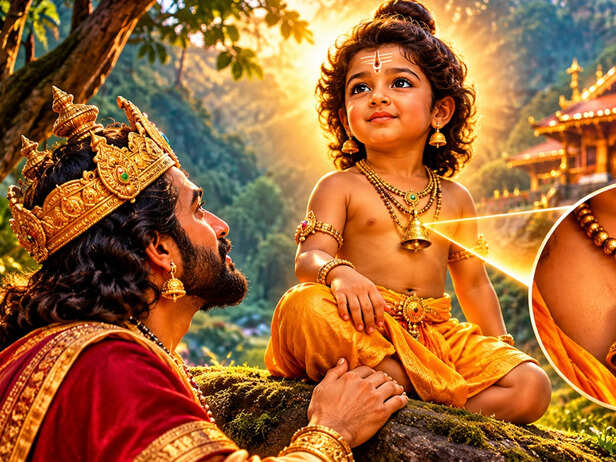
Lord Ayyappa is known by several names, including Manikandan, Hariharaputra and Dharma Sastha. Among these, Manikandan holds a special place because it is connected with the story of his discovery as a newborn child.
Why Is Lord Ayyappa Also Known as Manikandan?
According to a popular Sabarimala tradition, King Rajashekhara of Pandalam found a baby boy in the forest while hunting. What caught his attention was a small bell tied around the child's neck.
The king was surprised to find a baby alone in such a place. He took the child in his arms and decided to bring him to the palace.
Since the baby had a bell around his neck, he was named Manikandan. The name comes from two Sanskrit-derived words: 'Mani', meaning a jewel or precious object, and 'Kandan', referring to the neck. Together, the name is commonly understood as 'one who wears a bell or jewel around his neck'.
This is how the name Manikandan became closely associated with Lord Ayyappa.
How Did King Rajashekhara Find the Divine Child?
The story of Manikandan begins with King Rajashekhara, who ruled the kingdom of Pandalam in present-day Kerala.According to popular legend, the king and his queen were deeply devoted to Lord Shiva. Although they had wealth and a prosperous kingdom, they were unhappy because they had no children.They regularly prayed for a child who could continue their royal lineage. One day, while the king was travelling through the forest, he heard a baby's cry.
When he followed the sound, he discovered a beautiful infant lying near a riverbank. The baby had a small bell around his neck and appeared unusually radiant.The king understood this discovery as a blessing from the divine. He carried the child to his palace and presented him to the queen.The royal couple welcomed the baby with great happiness and decided to raise him as their own son.They named him Manikandan and treated him as the heir to the kingdom.
Why Is Manikandan Believed to Be the Son of Shiva and Mohini?
The story of Manikandan becomes more fascinating when his divine identity is revealed.According to Hindu mythology, Lord Ayyappa is believed to be the son of Lord Shiva and Lord Vishnu in his Mohini form.The connection goes back to the Samudra Manthan, the churning of the cosmic ocean, when Lord Vishnu assumed the enchanting form of Mohini.
In a later episode described in Hindu Puranic traditions, Lord Shiva became fascinated by Mohini's divine appearance. Their divine union is associated with the birth of Hariharaputra, another name for Lord Ayyappa.The name Hariharaputra also has a symbolic meaning. 'Hari' refers to Lord Vishnu, while 'Hara' refers to Lord Shiva. 'Putra' means son.Thus, Hariharaputra represents the divine union of Shiva and Vishnu.Manikandan is therefore worshipped as a deity who represents the combined spiritual qualities associated with both gods.
What Happened After Manikandan Grew Up?
Manikandan grew up in the Pandalam palace and soon became known for his intelligence, courage and kindness.Although he was raised as a prince, popular legends describe him as humble and deeply devoted to dharma.Meanwhile, the king's queen eventually gave birth to a biological son. This created tension within the royal family because Manikandan was already considered the heir to the throne.
According to the popular legend, the queen and a minister became concerned that Manikandan would inherit the kingdom instead of her biological son.They devised a plan to remove him from the royal succession. The queen pretended to suffer from a mysterious illness and claimed that only the milk of a tigress could cure her.Manikandan volunteered to enter the forest and bring the required milk.The king was worried about sending his young son into such a dangerous place, but Manikandan insisted on completing the task.What happened next became one of the most important episodes in the story of Lord Ayyappa.
Why Did Manikandan Return to the Palace Riding a Tiger?
When Manikandan entered the forest, he encountered Mahishi, a powerful demoness who had received a boon that made her difficult to defeat.According to popular Ayyappa traditions, Manikandan fought Mahishi and defeated her, restoring peace and protecting the world from her destructive power.
After completing this divine mission, he returned to the kingdom in a remarkable way.
Instead of bringing back only the milk of a tigress, Manikandan arrived riding a tiger, accompanied by several other tigers.
The sight shocked the people of Pandalam. The king finally understood that the child he had adopted was no ordinary prince.
He realised that Manikandan possessed divine powers and had been sent to fulfil a greater purpose.
The king sought forgiveness for not recognising his son's true identity earlier.
How Did Manikandan Become Lord Ayyappa of Sabarimala?
After revealing his divine nature, Manikandan explained that he had come to fulfil a sacred purpose.
According to the popular legend, he instructed King Rajashekhara to build a temple at Sabarimala, where devotees could worship him.
The king followed his instructions, and Manikandan became worshipped as Lord Ayyappa.
The Sabarimala temple in Kerala eventually became one of the most important pilgrimage centres for Ayyappa devotees.
Even today, the name Manikandan remains deeply connected with the deity's childhood story and his divine identity.
Why Does the Name Manikandan Still Matter to Devotees?
The name Manikandan is more than a reference to the bell around a newborn child's neck. For devotees, it represents the beginning of Lord Ayyappa's divine journey.His story also carries lessons about humility, courage, compassion and the importance of following dharma.
The legend reminds devotees that divine purpose can appear in unexpected forms. A child discovered in a forest eventually became a deity worshipped by millions.For those visiting Sabarimala, remembering Manikandan's story adds another layer of meaning to their pilgrimage. It connects the temple's traditions with the childhood of the deity and the faith of King Rajashekhara, who raised him with love without knowing his divine identity.