
Why Were So Many Ram Rings Found in One Place?
A small ring carries one of the most powerful messages in the Ramayana tradition.
Ram's ring was not simply a piece of jewellery. It became a symbol of identity, trust, hope and recognition at different moments of the story. When Hanuman crossed the ocean to find Sita, the ring became his proof that he had come on Ram's behalf.
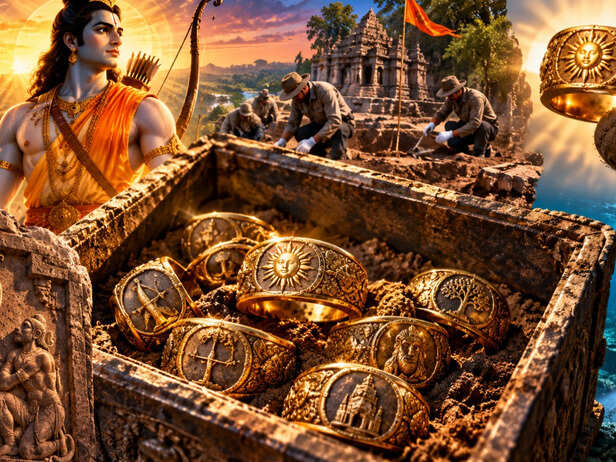
But another fascinating episode comes later. When Ram's ring falls into the earth, Hanuman follows it and discovers something deeply mysterious. There are countless rings, each bearing the name of Ram.
That moment turns a simple ring into a profound lesson about life, attachment and letting go.
The Ring Carried Ram's Identity
The ring first carries the feeling of identity and belonging. In the traditional story, Ram gives Hanuman his ring before the search for Sita. It serves as a sign that Hanuman has truly come as Ram's messenger. For Sita, seeing the ring brings recognition and reassurance during an extremely difficult time. A small object suddenly carries the emotional weight of an entire relationship. It tells her that Ram has not forgotten her and that help is coming. This is why the ring becomes much more than an ornament. It becomes a physical reminder of trust between Ram, Sita and Hanuman.
Hanuman Took It Across the Ocean
Hanuman's journey to Lanka was not simply about crossing an ocean. He was carrying Ram's message and the responsibility that came with it. When he finally reached Sita, the ring helped him establish his identity and convince her that Ram knew where she was. In that moment, something tiny became more powerful than words alone. Sita could recognise the connection immediately. Hanuman then delivered Ram's message of hope. The ring had travelled from Ram to Hanuman and finally reached Sita, connecting three people separated by distance and circumstances. Its journey reflected faith that could survive even the greatest separation.
The Ring Became a Promise
For Sita, the sight of Ram's ring was deeply emotional because it came from the person she was waiting for. Hanuman was not merely delivering an object. He was carrying a promise. The ring silently said that Ram remembered her and that the separation would not last forever. This is why symbols can sometimes carry emotions that ordinary words cannot. A familiar object can instantly bring back a person, a relationship or a promise. In the Ramayana tradition, Ram's ring therefore becomes closely connected with hope. It represents the assurance that even in darkness, a loved one's promise can remain alive.
Then Hanuman Found Something Strange
The most mysterious part comes later in a traditional story associated with the ring. When Ram's ring falls into the earth, Hanuman follows it and discovers something astonishing: countless rings that appear like Ram's ring. Each one bears the name of Ram. Hanuman is understandably confused. How could there be so many? The answer transforms the entire meaning of the object. In the traditional telling, the rings represent different cycles of existence and different manifestations of Ram's story. What looked like one unique ring suddenly becomes part of something much larger. The message is no longer about possession. It is about the passing of time.
Every Age Leaves Its Ring
The mysterious rings carry a deeper philosophical idea in the traditional narrative. The world moves through cycles, and stories of divine descent are understood within those cycles. Hanuman's discovery therefore teaches him that what appears unique from one person's perspective can belong to a much larger cosmic pattern. The ring that seemed precious and irreplaceable was only one among countless rings. This does not make it meaningless. Instead, it changes what the object represents. Its value comes from the love, duty and trust connected to it, not from possessing it forever. The lesson quietly shifts from holding on to understanding.
The Ring Teaches Us to Let Go
This is where the story becomes surprisingly relatable. We often attach our identity to things we have collected over time: relationships, achievements, possessions, memories and even old versions of ourselves. We fear that letting them go means losing who we are. But the ring's story offers another perspective. Some things complete their purpose and must eventually be released. Letting go does not erase what happened. It simply allows the next chapter to begin. Ram's ring had already carried identity, trust and hope. When its journey ended, another lesson began. Sometimes releasing what we hold tightly is exactly what prepares us for the road ahead.
What The Ring Really Leaves Behind
The deepest message of the ring is not about jewellery at all. It is about what remains when possessions, circumstances and identities change. The name of Ram remains at the centre of the story. We may carry many labels throughout life, but none of them stay unchanged forever. Relationships change, responsibilities change and even our understanding of ourselves changes. The wisdom is to value what we have without believing we can possess it permanently. Ram's ring reminds us that every journey has moments of receiving, carrying and finally releasing. What truly stays with us is the meaning we created along the way.
The Ring's Final Lesson
Perhaps that is why this small ring continues to feel so powerful.
It begins as a symbol of identity. It becomes a message of trust. It gives Sita hope, guides Hanuman's mission and eventually leads him toward a much larger truth.
The mysterious rings remind us that nothing we hold is permanent.
We may spend years building an identity around our relationships, achievements, possessions and memories. But life keeps moving. At some point, every person has to open their hand and let something go.
The lesson is not to stop caring.
It is to understand that what we release can become part of the next journey, while the values we learned from it can remain with us forever.
Unlock insightful tips and inspiration on personal growth, productivity, and well-being. Stay motivated and updated with the latest at My Life XP.