
Why Women Avoid Hanuman Ji’s Idol in Some Temples
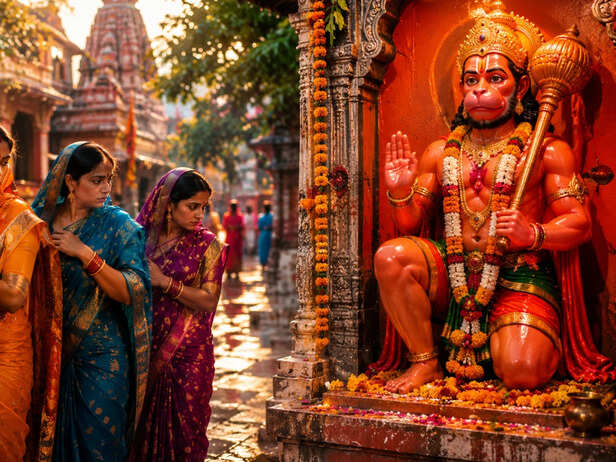
Hanuman Ji is worshipped across India as a symbol of strength, devotion, courage and self-control. Women also pray to him, recite the Hanuman Chalisa, observe fasts and offer prayers with deep faith. Yet, in some temples, you may notice a different practice: women are asked not to touch Hanuman Ji’s idol or feet.
At first, this can seem surprising. Why would a deity known as Sankat Mochan, the remover of troubles, have such a restriction?
The answer is rooted in a traditional understanding of Hanuman Ji’s brahmacharya, his complete dedication to Lord Rama and the belief that he viewed women with the same respect given to a mother.
But there is another side to this story that is equally important.
The Tradition Begins With Brahmacharya
Hanuman Ji is widely regarded in Hindu tradition as an ideal brahmachari, representing extraordinary self-control and complete devotion to Lord Rama. Based on this belief, some temple traditions avoid direct physical contact with his idol by women. The practice is understood not as a statement that women cannot worship Hanuman Ji, but as a way of respecting the form of spiritual discipline associated with him. Some modern religious explanations describe this as a customary practice rather than a universal prohibition.
Why Are His Feet Not Touched?
The commonly shared explanation is deeply symbolic. Hanuman Ji is traditionally believed to have regarded women as mother figures. Therefore, devotees following this custom believe that a woman should not touch his feet in the same way she would not traditionally touch the feet of her own son. This interpretation is repeated in several contemporary explanations of the practice. It is important, however, to understand that this is a traditional interpretation, not a practice followed uniformly across all Hanuman temples.
Women Can Still Worship Hanuman Ji
Here is the part that is often misunderstood. A restriction on touching the idol does not mean women cannot worship Hanuman Ji. In traditions that follow this practice, women can still fold their hands, light a diya, offer prayers, recite the Hanuman Chalisa and seek his blessings. Contemporary religious sources also note that women regularly worship Hanuman Ji in many parts of India. The emphasis is therefore on the manner of worship rather than denying women a place in Hanuman devotion.
Not Every Temple Follows This Rule
This is perhaps the most important fact to remember. There is no single practice followed by every Hanuman temple. Some temples maintain restrictions on touching the idol, while others do not make such a distinction. Regional traditions and individual temple customs can be very different. A 2026 discussion of the practice similarly notes that some families and temples follow the restriction while others permit women to perform complete worship. So, it would be inaccurate to say that women everywhere are forbidden from touching Hanuman Ji.
The Deeper Meaning Is Self-Control
Beyond the question of who can touch the idol, Hanuman Ji’s story carries a deeper spiritual message. His brahmacharya is traditionally associated with control over the mind, senses and desires. His entire life is remembered through his unwavering service to Lord Rama. The practice followed in some temples therefore becomes a symbolic reminder of that discipline. Rather than focusing only on the restriction, devotees can reflect on what Hanuman Ji represents: strength without arrogance, power with humility and devotion without distraction. This is one reason his worship continues to hold such a powerful place in Hindu spiritual traditions.
What Should Women Do in Such Temples?
If you visit a temple where women are traditionally asked not to touch Hanuman Ji’s idol, there is no need to feel that your devotion is incomplete. Join your hands, offer a heartfelt prayer, chant the Hanuman Chalisa or simply sit quietly before the deity. You can also offer devotion in the ways permitted by that temple. The simplest approach is to respect the temple’s established custom while remembering that devotion does not depend only on physical contact. As one contemporary explanation puts it, women continue to worship Hanuman Ji through prayer and other devotional practices even where direct touching is restricted.
The Real Lesson Is Bigger Than The Rule
The story behind this tradition ultimately points toward something deeper than a simple temple rule. Hanuman Ji represents a life devoted to seva, discipline and unwavering faith. Whether a devotee stands close to the idol or worships from a respectful distance, the spiritual intention remains important. And because customs differ, devotees should avoid judging another temple or family tradition simply because it follows a different practice. The most meaningful lesson may be this: true devotion is not measured by how closely you can touch a deity, but by how sincerely you carry that devotion into your life.
The Truth Behind the Tradition
So, why don't women touch Hanuman Ji's feet in some temples? The traditional answer is connected with his revered identity as a brahmachari and the belief that he regarded women as mother figures. But this practice varies, and it should not be presented as a universal rule for all Hanuman temples.
Hanuman Ji's devotion teaches something far more powerful than any single ritual: when faith becomes sincere, devotion does not need physical touch to reach the divine.