
6G vs 5G: What Will India's Next-Generation Internet Actually Change?
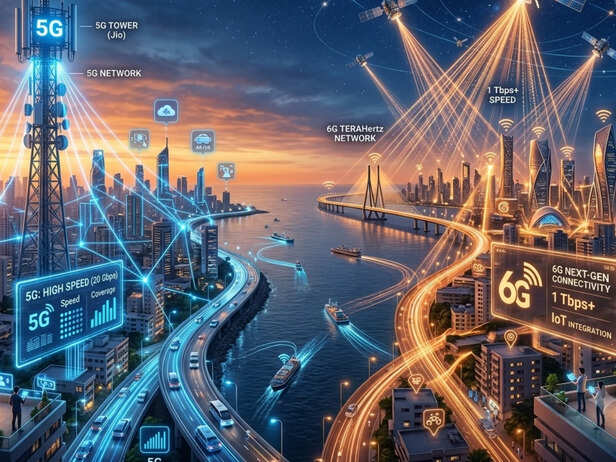
India has already entered the 5G era, bringing faster mobile internet and new possibilities for connected devices, businesses and digital services. Now, attention is gradually shifting towards 6G, the sixth generation of mobile network technology that could transform how people communicate, work and interact with the digital world.
Here is what you need to know about India's 6G ambitions, its potential benefits and when the technology could become available.
What Is 6G Technology?
6G is the sixth generation of wireless technology and the successor to 5G, designed to deliver faster connectivity, lower latency and smarter networks.The ITU’s IMT-2030 framework envisions AI-powered networks, immersive digital experiences, wider coverage and integrated sensing capabilities.However, 6G is still under development, and its final standards, features and performance will depend on ongoing research and international collaboration.
5G vs 6G: What Is the Difference?
The biggest difference between 5G and 6G is expected to extend beyond internet speed. While 5G focuses on improving mobile broadband and connecting more devices, 6G aims to support a more intelligent, responsive and interconnected digital environment.
Here is a simple comparison.
| Feature | 5G Technology | 6G Technology |
|---|---|---|
| Network generation | Fifth generation | Sixth generation |
| Main focus | Faster internet and connected devices | Intelligent, immersive and ubiquitous connectivity |
| Speed | Supports high-speed mobile broadband | Aims for substantially higher peak data rates |
| Latency | Low latency, depending on the network | Targets even lower latency for demanding applications |
| Artificial intelligence | AI can optimise network operations | AI is expected to be integrated more deeply into network design |
| Connectivity | Mobile devices, IoT and industrial applications | More extensive connections between people, machines and environments |
| Coverage | Expanding across cities, towns and rural areas | Aims for more seamless coverage, including underserved areas |
| Expected timeline | Commercially available in India | Broader commercial deployment targeted around 2030 |
These comparisons describe the intended direction of development, not guaranteed performance. Actual speed, latency and coverage will depend on network design, spectrum, infrastructure and local conditions.
1. Will 6G Make Internet Speeds Much Faster?
One of the most anticipated features of 6G is its potential to deliver significantly higher data speeds.
Future 6G research explores peak data rates that could reach tens or even hundreds of gigabits per second in suitable conditions. These are theoretical or research targets, not speeds that consumers can expect from an ordinary mobile connection today.If these capabilities become practical, downloading large files, transferring high-resolution video and working with data-intensive applications could become much faster.For most smartphone users, the real benefit will depend on whether these improvements make everyday tasks noticeably faster and more reliable.
2. How Could 6G Transform AI and Smart Devices?
Artificial intelligence is expected to make 6G networks smarter by managing traffic, predicting congestion and improving network efficiency.AI-powered 6G could support smart factories, connected transport systems, intelligent assistants and advanced connected devices through reliable, low-latency communication.However, better AI performance will still depend on computing power, software quality, data access and system design—not network speed alone.
3. Could 6G Improve Internet Connectivity in Rural India?
Reliable internet is essential for education, healthcare, agriculture and digital services across India. 6G could expand connectivity through terrestrial networks and satellite-based systems, potentially helping remote communities access online education, telemedicine, digital payments and agricultural information. However, affordable data, electricity and network infrastructure will remain crucial to bridging the digital divide.
4. Will 6G Make Virtual Reality and Augmented Reality More Realistic?
6G could enhance virtual reality (VR), augmented reality (AR) and mixed reality through faster data transfer and lower latency. These improvements may enable more immersive learning, remote collaboration, medical training and industrial simulations. However, widespread adoption will also depend on advances in devices, software and affordability.
5. What Role Will 6G Play in India's Technology Ambitions?
India aims to become a key player in 6G through its Bharat 6G Vision, launched in March 2023, which targets development and deployment by 2030. The Bharat 6G Alliance brings together industry, researchers and academic institutions to advance domestic innovation. In July 2026, it reportedly expanded to 90 member organisations. However, nationwide 6G availability will depend on further research, international standards, infrastructure investment and compatible devices.
6. When Will 6G Launch in India?
India's stated ambition is to contribute to the design, development and deployment of 6G technology by 2030.
The international standards process is progressing, with the ITU working towards evaluating candidate technologies and establishing the technical foundations for the next generation of mobile communications.
This makes the end of the decade an important target for 6G development and potential early deployments.However, a target year does not guarantee that 6G smartphones and commercial services will be widely available throughout India in 2030. Initial deployments, where they occur, may be limited to particular locations or use cases.A nationwide rollout would take additional time and depend on spectrum availability, infrastructure investment, equipment development and consumer demand.
For now, 5G remains the practical choice for people seeking modern mobile connectivity.
7. Will You Need a New Smartphone for 6G?
Yes, consumers will most likely need compatible hardware to access commercial 6G networks.Existing 5G smartphones are not expected to gain full 6G capabilities through an ordinary software update alone. Access to a new generation of mobile networks generally requires compatible radio hardware and support for the relevant standards and frequency bands.
Future 6G-compatible phones may also include more advanced processors, antennas and AI capabilities, depending on how the technology develops.However, there is no reason for most consumers to replace a working 5G smartphone simply because 6G is being developed.The sensible approach is to choose a phone based on current needs, including battery life, software support, camera quality, performance and network coverage.
As 6G standards and compatible devices mature, consumers will be able to assess whether upgrading offers meaningful benefits.
What Challenges Could Slow Down 6G?
Despite its potential, 6G faces several challenges before it can become a widely used technology.
- High infrastructure costs: New network equipment, antennas, fibre connections and supporting systems could require substantial investment.
- Spectrum availability: Regulators and international organisations must determine which frequency bands can support 6G services.
- Device affordability: Early compatible devices may be expensive, potentially limiting adoption.
- Coverage limitations: Higher-frequency signals can face greater propagation challenges, depending on the bands used and local conditions. Careful network planning will be essential.
- Security and privacy: More connected devices and AI-enabled systems could introduce new vulnerabilities that require stronger security measures.
- Energy consumption: Supporting more data-intensive applications while managing network power requirements will be an important engineering challenge.
- Addressing these issues will be necessary to ensure that 6G becomes practical, affordable and accessible rather than remaining a technology available only in limited environments.
Is 6G Worth the Wait?
6G could bring faster connectivity, smarter networks and new applications across healthcare, education, manufacturing and transport. For India, it offers opportunities to boost innovation and strengthen its global telecom presence.
However, 6G is still developing. Meanwhile, expanding 5G coverage, improving affordability and connecting underserved communities remain key priorities.
Unlock insightful tips and inspiration on personal growth, productivity, and well-being. Stay motivated and updated with the latest at My Life XP.