
How Kinderdijk's Windmills Keep a Country From Drowning
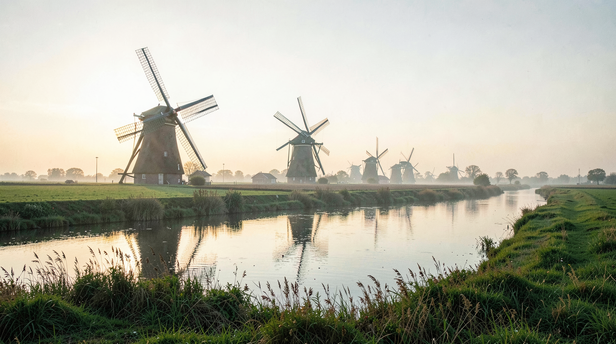
Stand at the edge of a Dutch polder on a still morning and the logic of the landscape takes a moment to settle. The fields are lower than the canal beside them. The canal is lower than the river beyond it. The river is lower than the sea. Everything about this arrangement should end in a flood, and for centuries it did, until engineers learned to harness the wind to run the water the other way.
The Land That Should Not Exist
A polder is a piece of land that has been claimed from water. The word is Dutch, and the Dutch have more reason than anyone to have invented it. Large stretches of the Netherlands lie between one and seven metres below mean sea level, sitting inside a bowl formed by river deltas and ancient peat bogs that compressed and sank over centuries as farmers drained them to grow crops. The more they drained, the more the peat shrank. The more it shrank, the lower the land fell. The problem is self-reinforcing, and it has no permanent solution, only continuous management.
Kinderdijk sits in the Alblasserwaard, a polder between the rivers Lek and Noord, southeast of Rotterdam. The name translates roughly as Children's Dike, and the legend behind it holds that after a catastrophic storm flood in 1421, a cradle was found floating against a dike with a cat balanced on its rim, keeping it stable, and a child sleeping dry inside. Whether the story is true matters less than what it tells you about the relationship between these people and the water that surrounds them. The flood was real. The Alblasserwaard was devastated. The rebuilding required a system, not just a wall.
What a Windmill Actually Does to Water
The windmill's role in this system is specific and mechanical. It does not pump water out of the ground. It lifts surface water from a lower level to a higher one, from the drainage ditches that cross the fields into a holding reservoir, and from there into the river. The device that does this lifting is called a scoop wheel, a large wooden paddle wheel mounted inside the mill's base, sitting partly submerged at the junction between the low-water inlet and the high-water outlet.
When the sails turn, they drive a shaft that runs vertically down through the mill's body. That shaft connects to a horizontal gear, which connects to the axle of the scoop wheel. The paddles dip into the low water, scoop it up in a continuous arc, and deposit it on the other side of a partition wall at the higher level. The height difference the wheel bridges is modest, typically between sixty centimetres and one and a half metres, but it is enough. Gravity does the rest, carrying the water along the upper canal toward the river outfall.
Kinderdijk's nineteen mills were built between 1722 and 1761, arranged along two parallel canals. They were not decorative and they were not isolated machines. They were a coordinated relay system, each mill handing water to the next level, the whole chain working together to drain a polder of roughly 4,500 hectares. Before the mills, this was done by hand and by horse, with buckets and scoops, and it was never quite enough. The windmills made it possible to keep pace with rainfall and seepage continuously, as long as the wind blew.
Reading the Mill From the Outside
The eight-sided smock mills at Kinderdijk, so called because the rotating cap and sails resemble a smock worn over a fixed body, are built to be read. The angle of the sails carries meaning that millers across the region once understood at a glance. Sails stopped just before vertical, in the shape of a plus sign, meant the miller had paused briefly and would return. Sails stopped just past vertical, in the shape of an X, meant a longer absence. Sails decorated with greenery or flags announced a birth or a celebration. The mill was a signalling system as well as a machine.
The cap rotates so the sails always face into the wind. A miller adjusted this manually using a long pole called a tail pole, walking the cap around on a circular track until the sails caught the wind squarely. Inside the cap, the brake wheel, a large gear with wooden teeth, meshes with the wallower, the first gear in the downward drive train. The sound of a working mill is the sound of those wooden teeth engaging, a rhythmic knock that carries across the water on a still day.
When the Wind Stopped
The windmill's limitation is obvious: it depends on the wind, and the wind is not reliable. A long calm in a wet autumn could mean flooding. Millers worked through the night when conditions were right, and the mills were sometimes run in relays to keep the water moving during critical periods. The system was always a negotiation with weather rather than a defeat of it.
Steam pumping stations began replacing the windmills in the nineteenth century, and diesel and electric pumps followed in the twentieth. The mills at Kinderdijk were decommissioned for drainage purposes in 1950, when a diesel pumping station took over the work of the whole system. The UNESCO designation came in 1997, recognising the site not as a curiosity but as the most complete surviving example of a water management system that once covered the entire Dutch delta. Two of the nineteen mills are kept operational and are run periodically, so the mechanics remain alive rather than merely preserved.
The Polder System as a Way of Thinking
What Kinderdijk represents extends beyond its nineteen mills. The polder model, the idea that water management is a collective problem requiring negotiated cooperation among everyone whose land drains into the same system, shaped Dutch political culture in ways that historians still trace. The water boards that managed polders were among the oldest democratic institutions in Europe, predating national governments. Every landowner had an interest in maintaining the dikes and keeping the pumps running. A farmer who neglected his section of the dike damaged his neighbour's fields as much as his own. The system enforced cooperation by making defection immediately visible and costly.
That logic is embedded in the landscape at Kinderdijk. The mills are evenly spaced. The canals are precisely levelled. The outfall to the river is engineered to drain at low tide and seal against the incoming tide. Every element depends on every other, and the whole depends on the river behaving predictably enough to accept the water when the gates open. It is a machine made of land and water and wind, and it has been running, in one form or another, for three centuries.
The windmill you see at Kinderdijk is the most visible part of a system whose real scale is underground and underwater, in the clay embankments, the sluice gates, the tidal outfalls, and the pumping stations that replaced the mills but follow the same logic. The sails turning in the wind are the part that catches the eye. The part that keeps the land dry is everything else.
Unlock insightful tips and inspiration on personal growth, productivity, and well-being. Stay motivated and updated with the latest at My Life XP.