
Above Tabo: Where the Last Tree Ends and the Air Begins to Thin
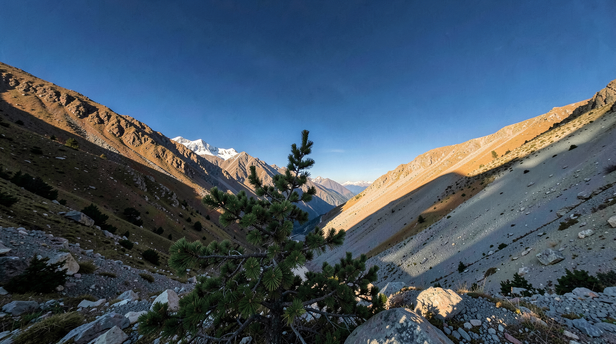
The road out of Tabo climbs before you are ready for it. The monastery sits at roughly 3,280 metres, which is high enough to slow your step on the first morning, but the valley still holds colour there, a strip of willows along the Spiti River, kitchen gardens behind mud walls, the occasional apricot tree gone silver in the cold months. You leave that behind faster than you expect.
The Last Tree Is a Juniper
It does not announce itself. You are walking or driving and then you notice, at some point after the fact, that the slope above you carries nothing with roots. The last tree on this side of the pass is almost always a juniper, low, wind-pressed, growing at an angle that records every prevailing gust across its entire life. It does not look like a tree making a last stand. It looks like a tree that made a decision long ago and has been entirely at peace with it.
Juniper is the climber of the high Himalaya. Birch gives out lower, willow stays close to water, pine stops well before the alpine zone. Juniper persists because it has learned to photosynthesize slowly and to lose almost no water through its needles, which are more like scales than leaves. At this altitude, the growing season is measured in weeks. The tree that stands above Tabo may be several hundred years old and still shorter than a person.
Past it, the ground changes texture. The soil, such as it is, gives way to scree, loose rock in shades of ochre, rust, and a grey so pale it reads as white in flat light. The Spiti valley is one of the driest places in India, sitting in the rain shadow of the main Himalayan range, and the landscape above the treeline makes that dryness legible. There is no organic matter softening the stone. What you walk on is essentially the exposed skeleton of a mountain.
What the Body Registers First
The thinning of the air is not a single event. It is a gradient, and the body reads it in stages that do not always correspond to how high the altimeter says you are.
The first thing most people notice is that they are breathing more than the effort seems to warrant. A gentle uphill slope produces the kind of breath that a steeper slope at lower altitude would require. This is the body's immediate response to reduced oxygen partial pressure, it increases the rate and depth of breathing to move more air across the lung surface. The mechanism is straightforward; the sensation is not. It feels, to many people, less like effort and more like mild surprise. The body is doing something without being asked.
The second register is the light. Above the treeline, there is nothing to filter or diffuse it. The UV index at this altitude is significantly higher than at sea level, and the dryness of the air means there is almost no atmospheric haze to scatter the shorter wavelengths. Colours look different, more saturated, less graduated. Shadows have hard edges. The sky, away from the sun, is a blue that does not exist at lower elevations, a blue that has had more of the spectrum removed from it.
The third thing, slower to arrive, is a kind of attentiveness that feels imposed from outside. The landscape above the treeline offers the eye almost nothing to rest on, no canopy, no middle distance of foliage, no softening of the horizon. The gaze keeps moving and finding only more stone, more sky. Some people find this clarifying. Some find it quietly unsettling. Both responses are honest.
The Silence Has a Texture
Sound behaves differently at altitude and in open terrain. There is no vegetation to absorb or scatter it, no ambient biological noise, no insects at this elevation, few birds, no rustling. Wind, when it comes, is the only moving thing, and it moves without obstruction across miles of open ground before it reaches you.
The silence between gusts is not the silence of a room or a forest. It has a quality that people who have spent time in high deserts and above treelines often describe the same way, independently: it presses slightly. The ear, deprived of the low-level acoustic texture it is accustomed to, becomes more sensitive to what remains. Your own footfall on loose rock is louder than it should be. Your own breathing is present in a way it rarely is at lower altitude.
The Spiti valley has been a transit corridor for centuries, traders, pilgrims, armies moving between the Tibetan plateau and the Indian plains. The people who crossed this ground regularly developed a relationship with this silence that is legible in the monastery at Tabo itself, in the practice of sitting with very little, of making the interior life do the work that the exterior landscape refuses to do.
Why the Threshold Matters
The treeline is not a line drawn on a map. It is the visible record of a negotiation between temperature, moisture, wind, and the slow biology of wood. In the Spiti valley, it sits lower than treelines in wetter Himalayan ranges because the aridity compounds the cold, a tree here must survive not just the freeze but the desiccation. The juniper that marks the upper boundary of the possible has solved a problem that no other species in this valley has managed to solve at this elevation.
Standing above it, you are in a place that life has assessed and largely declined. That is not a dramatic statement, it is a biological fact, and it is part of what the body and the mind are both responding to when they register the change. The increased breathing, the hard light, the textured silence: these are the body's instruments reading an environment that is genuinely different from the one it was calibrated for.
The altitude above Tabo where this threshold sits is not the highest point in Spiti, not even close. The passes above it go to five thousand metres and beyond. But the treeline is the last legible boundary before the landscape stops offering reference points that the human nervous system knows how to use. Everything above it requires the traveller to bring their own scale.
The juniper does not care about any of this. It has been solving the problem of survival at this altitude for longer than the monastery has stood below it. It will be there, wind-pressed and unhurried, long after the road is empty.
Unlock insightful tips and inspiration on personal growth, productivity, and well-being. Stay motivated and updated with the latest at My Life XP.