
Lonar Crater Lake: Why the Water Is Salty, Green, and Unlike Any Other in India
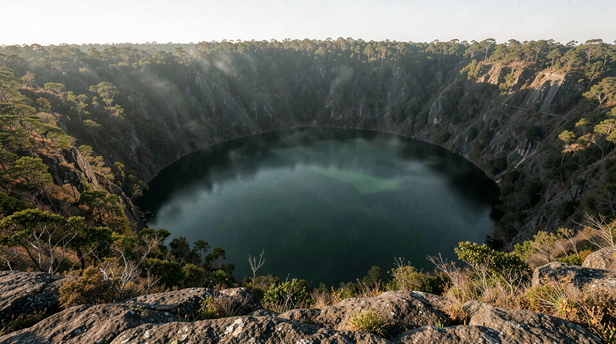
Lonar sits in Buldhana district in Maharashtra's Vidarbha region, roughly equidistant from Aurangabad and Nagpur. The crater was formed by a meteorite impact, not volcanic activity, which makes it one of only four confirmed impact craters in basaltic rock anywhere on the planet. The other three are geologically older and far less intact. Lonar is the youngest, the best preserved, and the only one with a permanent lake still sitting in it. That combination is why geologists, astrobiologists, and ecologists keep returning, and why a morning walk along the rim offers more than a view.
Why the Lake Is Both Saline and Alkaline
The chemistry of Lonar lake is the thing that surprises people most when they read about it properly. The water is saline, meaning it carries dissolved salts, and alkaline, meaning its pH sits well above neutral, typically between nine and eleven depending on the season and the sampling point. Most saline lakes on Earth are either one or the other. Lonar is both, and the reason is the rock it sits in.
Basalt, the volcanic rock of the Deccan plateau, weathers slowly when water moves through it. The impact that formed the crater shattered and fractured the rock across a wide area, and as rainwater has percolated through those fractured layers over tens of thousands of years, it has dissolved specific minerals, including sodium carbonate and sodium bicarbonate, into the lake. Because there is no outflow, those minerals concentrate rather than flush away. The lake has no river feeding it and no drain taking water out. What comes in, stays in. Evaporation removes the water but leaves the salts behind, and the concentration has been building since the crater filled.
The alkalinity comes from the same source. Sodium carbonate dissolved in water produces a strongly alkaline solution. The lake is, in chemical terms, a kind of natural soda lake, similar in its broad chemistry to the soda lakes of the East African Rift Valley, though formed by a completely different mechanism.
Why the Water Turns Green
The colour of the lake shifts with the season and the angle of light, but the green that visitors notice, particularly in the shallower margins, is biological rather than optical. The water supports dense populations of halophilic microorganisms, organisms that thrive in high-salt, high-alkalinity conditions that would kill most life. Among these are several species of cyanobacteria, the photosynthesising bacteria that produce the green pigment chlorophyll, and in the right conditions, flamingo-pink pigmented archaea that tip the water toward pink or red at the margins.
The microbial community at Lonar has attracted serious scientific attention because it offers a model for how life might persist in chemically extreme environments. The organisms here have adapted over a very long time to conditions that exclude almost everything else, and studying their biochemistry has implications for understanding life in analogous environments elsewhere. For a visitor, the practical consequence is that the water is not simply stagnant. It is densely alive, and the colour is the life showing itself.
The green is most vivid in the months after the monsoon, when the lake level is higher and the water is freshest relative to its salt load. By late summer, as evaporation concentrates the minerals further, the colour deepens and the margins can take on an almost metallic quality in direct afternoon light.
What the Rim Holds
The crater rim is roughly 1.8 kilometres in diameter, and a full walk around it takes between two and three hours depending on pace and how long you stop. The path is uneven in places and passes through mixed scrub forest. The forest itself is part of what makes the rim worth the walk: it is old secondary growth that has recovered from decades of disturbance, and it holds a bird population disproportionate to its size. The enclosed basin creates a microclimate that is noticeably cooler and more humid than the surrounding plateau, and the forest reflects that.
On the inner slope of the rim, descending toward the lake, there are several temples of significant age. The Kamalja Devi temple on the southern shore is the most visited. It sits close to the water and is built partly from stones that show the characteristic shatter-cone fracturing that impact events produce in rock. Shatter cones are one of the definitive geological signatures of a meteorite impact, and seeing them built into a temple wall, used as ordinary construction material by people who had no way of knowing what had made them, is one of those moments where geological time and human time press against each other in a way that is hard to describe but easy to feel.
The Daitya Sudan temple, dedicated to Vishnu, stands on the northern shore and is older in its core structure, with later additions. The inscriptions and carvings here have been studied by historians interested in the medieval period of the Vidarbha region. The temples are active places of worship, not ruins, and the correct approach is as a visitor in a functioning sacred space.
The Impact and Its Scale
The meteorite that struck here was roughly fifty to a hundred metres across, travelling at a speed that converted its kinetic energy almost entirely into heat and pressure on impact. The explosion would have been audible across a radius of several hundred kilometres. The crater it left is about 1.8 kilometres across and roughly 150 metres deep from rim to lake surface. The surrounding countryside shows a faint raised ring of ejecta, material thrown outward by the impact, that is visible in aerial imagery though not obvious on the ground.
The age of the impact has been revised several times as dating methods have improved. Current estimates place it between fifty and sixty thousand years ago, which means it occurred when anatomically modern humans were already present in South Asia. Whether anyone witnessed it is unknowable, but the timing puts it within the range of human memory, at least in principle.
Standing on the rim and looking down at the lake, the geometry of the impact becomes legible in a way that photographs do not convey. The crater walls drop steeply on the inside. The lake sits in the lowest point. The rim you are standing on is the compressed and uplifted edge of the original surface, pushed outward and upward by the pressure wave. The circularity is almost perfect, which is characteristic of a near-vertical impact. A meteorite coming in at a shallow angle would have left an oval scar. This one came almost straight down.
When to Go and How to Move Through It
The months between October and February offer the clearest air and the most comfortable temperatures for walking the rim. The lake level after the monsoon is higher, and the green of the water is at its most saturated. The forest on the rim is also at its most active in these months, and early morning is when the bird activity peaks.
The crater is accessible from the town of Lonar, which has basic accommodation. Most visitors arrive from Aurangabad, roughly four hours by road. The rim walk begins near the Maharashtra Tourism rest house and can be done in either direction. The inner slope path down to the lake shore is steeper and less maintained in places; footwear with grip matters. The lake water is not suitable for swimming or drinking. There is no formal entry fee for the rim walk, and the temples follow their own visiting hours.
The site is managed jointly by the Archaeological Survey of India and the state forest department, with the lake itself designated a wildlife sanctuary. Visitor numbers remain low relative to Maharashtra's more famous sites, which is part of what makes the rim walk feel like something you have found rather than something you have been sent to.
The salt and the green and the temples built from shatter-coned stone are each separately interesting. Together, on a quiet morning with the crater holding the mist, they add up to the rare experience of a place that has not yet been explained away.
Unlock insightful tips and inspiration on personal growth, productivity, and well-being. Stay motivated and updated with the latest at My Life XP.