
How Coorg Coffee Is Picked and Dried Under a Living Canopy
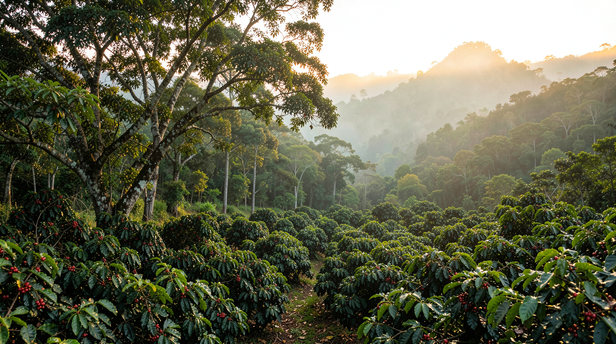
The first thing you notice walking into a Coorg estate is that it does not look like a farm. The light arrives in pieces. Silver oak and jackfruit and the occasional wild pepper vine close the sky into a patchwork, and the coffee grows underneath in something closer to a forest floor than a field. That arrangement is not decorative. It is the whole method.
Why the Canopy Was Never Cleared
Most of the world's commercial coffee grows in full sun, on slopes where the original forest was removed to make room for dense, high-yielding rows. Coorg's estates took a different path, partly by geography and partly by the farming culture of the Kodava people who settled these hills. The Western Ghats receive heavy monsoon rain and carry a native forest that regenerates quickly if left any opening. Clearing it completely would have meant fighting it back every season. Leaving it standing meant the estate worked with the hill rather than against it.
The canopy does several things at once. It slows the rate at which a coffee cherry ripens. A cherry that takes longer to ripen builds more of the sugars and acids that become flavour in the cup. The shade also keeps soil moisture more stable between rain and dry spells, which matters on slopes where water runs off quickly. The leaf litter from the canopy trees breaks down into the topsoil and feeds the coffee roots without the estate needing to add much from outside. The trees and the coffee have been in the same relationship long enough that the estate functions more like a managed ecosystem than a monoculture.
How the Cherry Is Picked
Coorg grows two main varieties: Arabica on the higher, cooler slopes and Robusta lower down where the air is warmer and the rain more consistent. Both are harvested by hand. The reason is the canopy itself. A machine harvester needs clear, even rows and uniform ripening. Under a shade canopy, cherries on the same branch ripen at different rates, and the trees above make mechanical access impractical. Every cherry is picked individually by workers who move through the estate over several passes during the harvest months.
The selection that happens at the moment of picking is the first quality filter the coffee passes through. A ripe cherry is a deep, even red, or yellow, on certain varieties. An under-ripe cherry is firm and pale. An over-ripe cherry has begun to ferment on the branch and will carry that ferment into the batch. A picker working by hand can feel the difference in the way a cherry releases from the stem. A ripe cherry comes away cleanly. One that resists is not ready.
What Happens in the Drying Yard
Once picked, the cherry goes through processing before it becomes the green bean that gets roasted. Coorg estates use both the wet method and the dry method, and the canopy influences which one a particular estate leans toward.
In the dry method, sometimes called natural processing, the whole cherry is spread on raised drying beds or on concrete drying yards and left to dry in the open air. The fruit dries around the seed over several weeks. The canopy matters here because it filters the light that reaches the drying yard. Direct, intense sun dries the outer skin faster than the inner fruit, which can crack the cherry and let unwanted fermentation in. Partial shade, or the diffuse light of early morning and late afternoon, dries the cherry more evenly. Workers rake the drying cherries several times a day to prevent mould and to expose different surfaces to the air.
In the wet method, the outer fruit is removed from the cherry within hours of picking, using a pulping machine and water. The seed, still coated in a layer of mucilage, is then fermented in water tanks for a day or two to loosen that coating, washed clean, and spread to dry. The drying stage here is shorter because most of the fruit has already been removed, but the same principle applies: slow, even drying in filtered or early-morning light produces a more stable bean than fast drying under harsh midday sun.
The Forest That Comes With the Cup
The canopy estates of Coorg are among the few coffee-growing regions in the world where the original forest cover has been largely maintained rather than replaced. The Western Ghats are one of the world's recognised biodiversity hotspots, and the shade estates function as a corridor for birds, insects, and small mammals that would otherwise have nowhere to move between the protected forest patches. A coffee estate with a full canopy supports a measurably different range of species than a sun-grown estate on the same hillside.
This is not a marketing claim attached to the coffee after the fact. It is a consequence of the method. The trees were left standing because they were useful to the farming system. The farming system produced a habitat as a side effect. The bird that eats the insects that would otherwise damage the cherry is part of the same chain as the picker who selects the ripe cherry by feel and the drying yard that slows the process down to let flavour develop.
The cup at the end of that chain carries the forest in it not as a metaphor but as a straightforward result of how the coffee was grown. The shade slowed the ripening. The slow ripening built the flavour. The flavour is the forest, expressed as something you can taste.
Unlock insightful tips and inspiration on personal growth, productivity, and well-being. Stay motivated and updated with the latest at My Life XP.