
What the Sam Sand Dunes Sound Like After the Wind Drops at Sundown
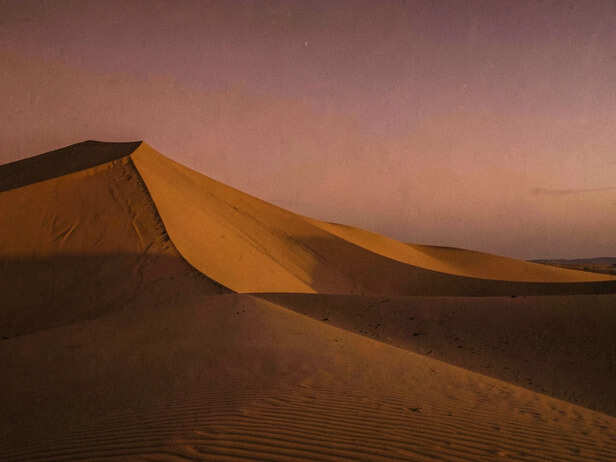
The wind at Sam drops fast. One moment the sand is moving in long horizontal sheets across the crest of the dune; the next, the air is still and the light has gone amber at the edges. Most people are already walking back toward the camp. The ones who stay find that the desert is not quiet. It is making a sound.
What the Sound Actually Is
The dunes at Sam are among the few places in India where you can hear what researchers of desert acoustics call booming sand, though the version at Sam is softer than the famous examples in the Gobi or the Sahara. It is a low, sustained hum, somewhere between a plucked cello string and the resonance of a large clay pot struck gently. It lasts a few seconds, fades, and sometimes returns. You feel it faintly in your chest before you are sure you are hearing it.
The sound comes from the sand grains themselves. When a dune face is steep enough and the grains are dry and uniform enough in size, the grains sliding down the slip face after the wind has disturbed them move in a kind of synchrony. They vibrate at nearly the same frequency. The dune amplifies that vibration the way a soundboard amplifies a string, and what reaches you is not the scratch of individual grains but the collective note of several million of them moving together.
Why Sam and Not Every Desert
Not all sand sings. The grain size has to fall within a narrow range, too fine and the grains float rather than slide; too coarse and they tumble without synchrony. The grains also have to be round rather than angular, polished by wind over a long time rather than recently broken from rock. The Thar's sand has been worked by wind for long enough that the grains at Sam are well-sorted and well-rounded in a way that younger desert sediments are not.
The shape of the dune matters too. Sam's barchan and transverse dunes have steep slip faces on their lee sides, the side the wind pushes sand over. When the wind drops, that face is loaded with grains that were being held in place by moving air. The stillness releases them all at once. A gentler, lower dune does not accumulate enough on its face to produce the same effect. The dunes at Sam are tall enough, and their faces steep enough, that the release is sudden and the sound carries.
The Role of the Moment Between Wind and Dark
The sound is most audible in the window between the wind's end and full dark, and that timing is not coincidental. During the day, the desert's thermal noise, the creak and pop of heated rock, the sound of moving air, the background of tourist activity, masks it. After the wind drops, the dune face is still releasing the grains that were loaded during the day's strongest gusts. The sand is at its driest, having shed whatever small amount of surface moisture the cooler late afternoon brought. Dry grains slide more freely and vibrate more cleanly than damp ones.
An hour later, the desert cools further, the sand settles fully, and the sound stops. The silence that follows is a different thing entirely, absolute in a way that is harder to describe and easier to feel. But the sound comes first, in that brief window, if you are standing still and not talking.
How to Actually Hear It
The practical obstacle is that the camps at Sam are positioned at the dune's base, and the base is where the sound is weakest. The slip face is where it originates. Walking up to the crest of the main dune at Sam takes roughly ten to fifteen minutes at a measured pace, and the footing is loose enough that most people abandon the attempt halfway and slide back down, which, incidentally, is itself a small demonstration of the mechanism. The grains you displace on the way down sometimes produce a faint version of the sound under your feet.
Reach the crest before the wind drops, sit down, and wait. Keep your weight still. The vibration travels through the sand as much as through the air, and a person sitting on the dune face feels it differently from a person standing at the base listening up. The sound is not loud. It does not announce itself. It asks for the kind of attention you have to decide to give.
The Sam dunes produce something that takes the desert years to build: a grain rounded enough, a face steep enough, and a moment quiet enough. The sound lasts a few seconds. The desert spent a long time making it.
Unlock insightful tips and inspiration on personal growth, productivity, and well-being. Stay motivated and updated with the latest at My Life XP.