
What a Ferry Crossing Does to You When There Is Nothing Left to Do
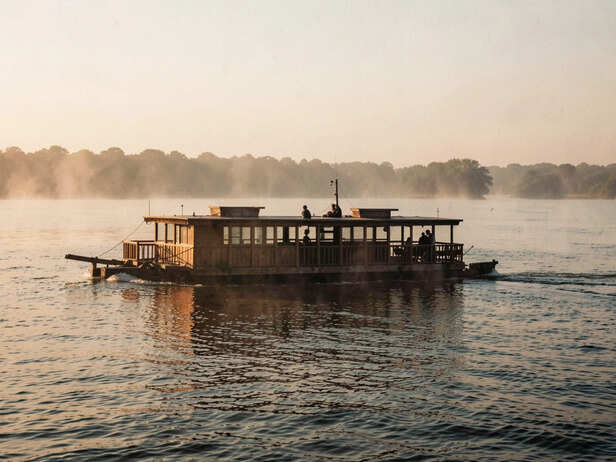
There is a moment, maybe ten minutes after a ferry leaves the dock, when the shore behind you has shrunk to a smudge and the shore ahead has not yet appeared. You are, for the first time in a long while, genuinely between places. No road, no signal worth trusting, no next turn. Just the water moving under you and the engine doing what engines do.
The Body Settles Before the Mind Does
The first thing that happens on a long ferry crossing is physical. The slight roll of the deck, not enough to unsettle most people, just enough to register, does something to the nervous system that sitting in a car or a train does not. The body is not gripping anything. It is not braced against a seat belt or a handle. It is simply standing or sitting on a surface that moves, and it adjusts, quietly, without being asked.
This is different from stillness. Stillness is the absence of movement. A ferry crossing is the presence of a very slow, very large movement that you cannot control and do not need to. The body recognises the difference. After a few minutes, something in the shoulders drops.
Water Makes Time Move Differently
Watch the water long enough and the usual sense of time, the kind measured in tasks completed and distance covered, stops working. Water has no landmarks. One stretch of river or sea looks like the last. There is nothing to mark progress against, and so the mind stops tracking it.
This is not boredom, though it can feel like boredom at first, especially if you are used to filling every gap. It is closer to the state a person reaches after twenty minutes of sitting quietly, the one most people never quite get to because something interrupts them. The ferry enforces it. You cannot leave. You cannot speed it up. The crossing takes as long as it takes.
Rivers feel different from open sea. A river crossing has banks, and the banks give the eye something to follow, a temple, a ghat, a line of trees, a heron standing very still. The eye moves between them and the mind moves with it, loosely, without agenda. Open sea crossings offer less and ask more. The horizon is the only line, and it does not change. Some people find this peaceful. Some find it vertiginous. Both responses are honest.
What You Notice When There Is Nothing to Do
A ferry crossing is one of the few places left where looking around is the only available activity. There is the water, obviously, its colour, which changes with depth and weather and the angle of the light. There are the other passengers, who arrange themselves on a boat in ways they would not arrange themselves anywhere else: strangers standing at the same railing, looking in the same direction, not speaking, not needing to.
There is the sound, which is layered in a way that takes a few minutes to hear properly. The engine underneath everything. Water against the hull, which is not one sound but several depending on the speed and the chop. Wind across an open deck. Occasionally a bird. These sounds do not compete with each other the way city sounds do. They sit at different distances and the ear learns to place them.
There is also the smell, which is one of the most specific things about any crossing and one of the hardest to describe afterward. River water smells of silt and vegetation and sometimes of the city it runs through. Sea air smells of salt and, underneath the salt, of something older and harder to name. Both smells are strong enough to stay with a person for hours after the crossing ends.
The Shore Appears and Something Shifts
The destination comes into view gradually. First a dark line that could be cloud. Then shape. Then colour. Then detail, a building, a jetty, a figure on the bank. The mind, which had been resting, starts up again. Where to go from the dock. What to do next. The list of things that were paused.
Most people do not notice the exact moment this happens, but there is one. The crossing ends before the boat reaches the shore. It ends when the destination becomes real enough to think about.
What remains, for a while, is the particular quality of having been nowhere for an hour. Not in transit in the way a flight feels like transit, sealed and pressurised and slightly unreal. In transit in the older sense, on the water, between two places, with nothing to do but be there.
The water does not care whether you used the time well. That is, unexpectedly, the best thing about it.
Unlock insightful tips and inspiration on personal growth, productivity, and well-being. Stay motivated and updated with the latest at My Life XP.