
How to Climb Badami's Four Cave Temples in Order
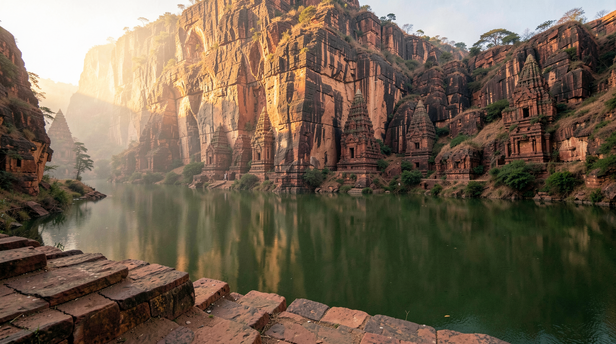
Badami sits in a sandstone gorge in northern Karnataka where the rock is the colour of dried turmeric and the cliff face holds four temples carved directly into it, not built against it. The caves were cut by the early Chalukya kings between roughly the sixth and seventh centuries, and they climb a single escarpment above Agastya Lake in a sequence that rewards walking in order. The path is one continuous staircase, and each cave is a chapter in the same sentence.
Start at the Base: Cave One and the Language of Shiva
The lowest cave is the oldest and the most austere. It is dedicated to Shiva, and the first thing you see before your eyes adjust to the shade is an eighteen-armed Nataraja carved into the wall to the right of the entrance. Count the arms if you like, each holds a different attribute, and the figure is large enough that the detail stays legible from the porch. The ceiling of the verandah carries a carved Shiva and Parvati, and the columns are plain enough that nothing competes with the sculpture.The floor here is worn smooth. People have been walking it for roughly fourteen centuries. Stand at the back of the shrine and look out at the tank below and the opposite cliff: the view is framed by the columns the way a painting is framed, and it seems unlikely to be accidental.
Cave Two: A Shorter Walk, a Different God
A short flight of steps brings you to the second cave, which is Vaishnava in dedication. Vishnu appears here in his Trivikrama form, the giant stride that measured the universe in three steps, carved on the left wall of the porch. The figure is dynamic in a way that the Shiva cave's sculpture is not: one leg raised, the body in motion, the scale deliberately exaggerated to make the cosmic act readable in stone.The dwarpalas, the guardian figures flanking the shrine entrance, are among the most carefully finished on the cliff. The cave is shallower than the first, and the light reaches further in, which makes the carving easier to read without a torch.
Cave Three: The Largest and the Most Elaborate
The third cave is the one most guides lead with, and for good reason. It is the largest of the four, the most completely carved, and the one with the inscription that gives the clearest dating, a Kannada and Sanskrit record that places its completion in the late sixth century.The ceiling of the verandah here carries a carved Anantashayana Vishnu, the god resting on the cosmic serpent, and the detail in the surrounding panels is dense enough that a careful look takes twenty minutes. Narasimha, the man-lion avatar, occupies one wall. Varaha, the boar avatar lifting the earth goddess, occupies another. The columns have bracket figures that art historians have spent considerable time with.This is also where the view down to Agastya Lake is most dramatic. The tank below is green in most seasons, and the opposite cliff, which holds a Buddhist cave and a fort, closes the gorge on the far side.
Cave Four: The Jain Shrine at the Top
The fourth cave is Jain, and it sits at the highest point of the climb. The ascent from cave three involves more steps and a turn in the path, and by the time you arrive the town below has shrunk and the gorge has opened. The cave is dedicated to Mahavira, who is carved in the main shrine in the dhyana posture, seated, composed, entirely still.The Jain cave is quieter in tone than the three below it. The ornamentation is restrained, and the figures of the Tirthankaras in the niches along the walls share that quality of absolute stillness. It is a different register from the kinetic Chalukya sculpture lower on the cliff, and that contrast is part of what makes the sequence worth walking in order rather than choosing one cave and stopping.
The Practical Shape of the Climb
The staircase connecting all four caves is carved stone and is uneven in places. Footwear that can be removed and carried is practical, shoes are left at the entrance to each shrine. The climb from the base to cave four takes between forty minutes and an hour at a comfortable pace that allows time inside each cave, longer if the light is good and the carvings are holding your attention.Morning light falls on the cliff face from the east, which makes the first two hours after sunrise the best time for reading the sculpture. By midday the sandstone radiates heat. The town of Badami at the base of the gorge has tea and food close to the tank, and the Archaeological Survey of India office near the entrance has a small display that gives context before the climb.Badami is also the base for Aihole and Pattadakal, two other Chalukya sites within an hour's drive, and the three together form the clearest picture available in stone of how early medieval Karnataka built its temples. The cave temples are the beginning of that story, and the cliff they are cut into is the reason the story started here.The sandstone that made Badami possible is also what makes it legible: it is soft enough to carve with precision, hard enough to hold detail across fourteen centuries. Walking the four caves in sequence is less a religious circuit than a lesson in what a dynasty chose to say when it had a cliff face and the tools to speak with it.