
Why Kyoto's Nishiki Market Still Sells So Many Kinds of Pickle
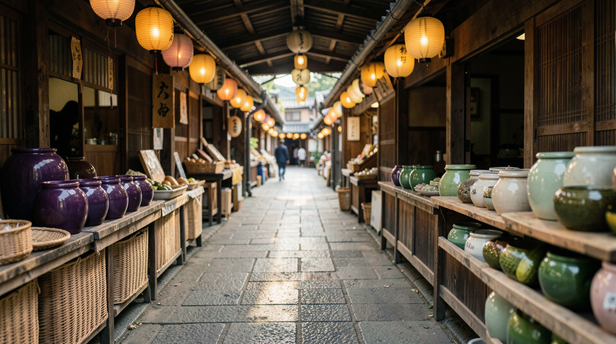
Kyoto sits in a basin. Mountains close it on three sides, the sea is far away, and for most of its history the city had no reliable source of fresh fish. What it did have was an abundance of root vegetables, leafy greens, and the cold, clean water running off those surrounding hills, and a population of monks, imperial cooks, and townspeople who needed to eat through winter on what the autumn harvest could provide. Pickling was not a preference. It was the answer to a specific geographical problem, and Nishiki Market, which has occupied a narrow covered lane in the centre of the city for several centuries, became the place where that answer was sold.
The Geography That Made Pickling Necessary
Kyoto's basin geography does two things to its food culture simultaneously. It creates a microclimate warm enough in summer to grow an unusual range of vegetables, and it cuts the city off from coastal supply lines that other Japanese cities relied on. Osaka, an hour away, built its food culture around fish. Kyoto built its around what grew in the fields immediately outside the city gates and what could be preserved from one season to the next.
The vegetables that came to define Kyoto pickling, kamo eggplant, shogoin turnip, kujo green onion, mibuna leaf, are not found in quite this form anywhere else. They were cultivated over generations specifically for the Kyoto kitchen, selected for flavour, texture after pickling, and the way they held colour in brine. The market still sells them because the farms that grow them are still there, still supplying the same stalls that have occupied the same lane for generations.
What Buddhist Temple Cooking Added
Kyoto was the seat of imperial power for over a millennium and home to hundreds of Buddhist temples whose kitchens operated under shojin ryori, a vegetarian cooking discipline that prohibited meat, fish, and the five pungent roots. In a kitchen with those constraints, the question of how to build flavour and variety from vegetables alone becomes urgent.
Pickling answered it. A raw turnip and a turnip that has spent three days in rice bran, salt, and kombu are different ingredients with different uses. Temple cooks developed an extraordinary range of fermentation and brining techniques not because they were experimenting for pleasure but because they needed each preparation to do a different job on the plate. The variety of pickle at Nishiki today, some sour, some sweet, some barely fermented, some aged for months, maps almost directly onto the range of techniques that temple kitchens refined over centuries of meatless cooking.
The Rice Bran Bed and the Logic of Nukadoko
The most distinctively Kyoto preparation is nukazuke, vegetables buried in a fermented rice bran bed called a nukadoko. The bran bed is alive in a literal sense: it carries lactic acid bacteria that ferment the vegetables slowly, producing a flavour that is sour, earthy, and complex in a way that a simple salt brine cannot replicate.
A nukadoko requires daily attention. It is turned by hand, kept at a consistent temperature, and fed occasionally with fresh bran and salt. A well-maintained bed improves over years; some family and shop beds in Kyoto have been kept continuously for decades. The flavour of a nukazuke pickle from a bed with that kind of history is genuinely different from one made in a new bed, and experienced buyers can taste the difference. This is why the stalls at Nishiki do not all sell the same thing even when they are selling the same vegetable: the bran bed behind each one is different.
Why the Market Kept Its Character When Others Did Not
Nishiki is sometimes called Kyoto's kitchen, and the name is older than tourism. The lane was a wholesale fish and vegetable market for the city's restaurants and temple kitchens long before it became a place visitors walked through. Its character as a specialist food market was established before the logic of that specialisation became interesting to outsiders.
When refrigeration arrived and preservation became less urgent, Nishiki did not pivot away from pickle. It stayed because the demand from Kyoto's restaurant culture, kaiseki restaurants that use tsukemono as a palate-cleanser and a course in their own right, kept the stalls viable. A kaiseki meal treats pickle not as a condiment but as a considered element of a sequence, which means the restaurants need variety, precision, and consistency. The market supplies that. The tourist trade that now fills the lane is real, but it is layered on top of a supply relationship that was already there.
What the Variety Actually Represents
The range of pickle at Nishiki is not decorative. Each preparation style solves a different problem or serves a different moment in a meal. A quick-pickled cucumber, barely an hour in salt, is a palate reset. A deeply fermented turnip, months in the bran bed, is a flavour in itself. A shibazuke, eggplant and cucumber pickled with red shiso, carries a colour that signals the season it was made in and a sourness that comes from the shiso's natural acidity reacting with the salt over weeks.
The stalls lay these out together because a Kyoto kitchen needs all of them, and has needed all of them for as long as the city has had a cuisine worth naming. The variety is a record of every constraint, geographic, religious, seasonal, that Kyoto's cooks worked within and eventually turned into a preference so deep it became identity.
The jars in Nishiki are not souvenirs of a pickling tradition. They are the tradition, still in use, still being replenished from the same fields and the same bran beds, still serving the same restaurants that have been ordering from the same stalls for longer than most food cultures have existed. The mountain basin that made preservation necessary is still there. So is the market it produced.
Unlock insightful tips and inspiration on personal growth, productivity, and well-being. Stay motivated and updated with the latest at My Life XP.