
Why Hampi's Boulders Are Round: What Granite Does Over Millions of Years
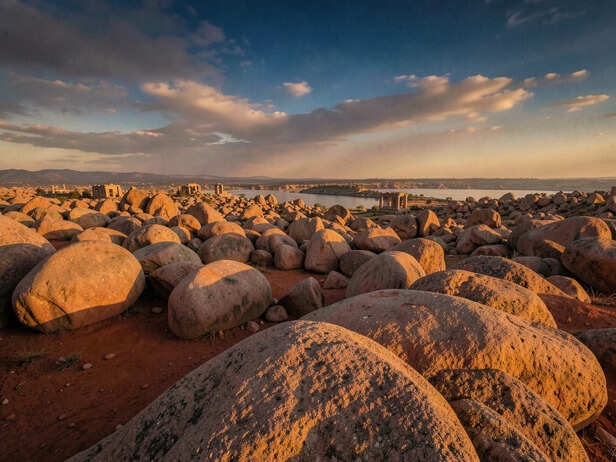
Stand anywhere on the Tungabhadra's bank at Hampi and the first question the landscape asks is a simple one: why are all the rocks round? Not cracked into slabs, not jagged like a cliff face, not flat like river stones worn by water. Round, and enormous, and stacked as if someone placed them there with intention. The answer is in the rock itself, and it goes back further than any dynasty that built here.
Granite Starts Its Life Underground
Granite forms when magma cools slowly, deep inside the earth, under enormous pressure. The slow cooling is what gives it its coarse grain, the interlocking crystals of quartz, feldspar, and mica that you can see with the naked eye if you look at a Hampi boulder up close. The rock at Hampi belongs to one of the oldest geological formations in India, part of the Dharwar craton, a stable block of ancient crust that has not been significantly deformed for roughly two and a half billion years. The magma that became these boulders intruded into older rock, cooled, and solidified kilometres below the surface.
How Joints in the Rock Set the Shape
As granite cools, it contracts. Contraction creates cracks, called joints, and these joints run in roughly three directions: horizontal, and two sets of vertical. Together they divide the rock into approximate cubes and rectangular blocks. This is the raw material. A freshly exposed granite mass, before weathering touches it, looks blocky, corners, edges, flat faces. The rounding comes later, and it comes from a process called spheroidal weathering.
What Spheroidal Weathering Actually Does
Water, carrying weak acids from soil and organic matter, enters the joints. It attacks the corners and edges of each block first, because corners have three exposed faces and edges have two, while flat faces have only one. The corners lose material fastest. Over time, and in granite, time is measured in millions of years, the corners round off, then the edges soften, then the flat faces begin to curve. The block becomes a boulder. The outer layers of the rock, chemically altered by water and heat cycling through wet and dry seasons, peel away like the skin of an onion. Geologists call these peeling layers exfoliation. Each layer that falls away reveals a slightly more rounded surface beneath. The boulder is not being carved from outside in. It is shedding its own altered skin, one layer at a time, until what remains is the dense, unweathered core, smooth, round, and almost impervious.
Why They Stack the Way They Do
The stacking is not random, though it looks it. The original joint pattern determined where blocks formed relative to one another. As the surrounding rock and soil eroded away over millions of years, the Deccan Plateau has been slowly stripped of its upper layers by rain and river, the boulders were exhumed. They emerged from the ground in roughly the positions and orientations the original jointing set. Gravity did the rest: a rounded boulder sitting on another rounded boulder finds a stable resting point. The stacks at Hampi are not precarious in the way they appear. Many have been sitting in exactly that configuration for longer than the human species has existed.
What the Tungabhadra Added
The river cut through this landscape over an immense span of time, exposing more rock, carrying away the weathered debris, and leaving the rounded cores behind on its banks and across its flood plain. The boulders you walk between at Hampi are the survivors of a process that dissolved and removed everything softer around them. The red soil between the rocks is partly the ghost of those dissolved outer layers, iron-rich minerals left behind when the feldspar and other soluble components were carried away by water. The landscape is, in a literal sense, what granite leaves behind when everything it once was has been slowly taken apart.
Why the Temples Sit Where They Do
The Vijayanagara builders did not fight the boulders. They built around them, between them, and sometimes into them. Several structures at Hampi use natural rock faces as walls. The boulders provided both the building material, granite blocks quarried from the same formation, and the defensive logic of the city's layout. A city surrounded by rounded granite hills is a city that is difficult to approach unseen and difficult to breach quickly. The geology was not incidental to the empire. It was one of the reasons the site was chosen.
The boulders at Hampi are not a backdrop to history. They are older than any category history uses. The temples, the bazaar street, the elephant stables, all of it sits on rock that was already ancient when the first stone was cut. What the landscape communicates, if you sit with it long enough, is that the rounding is still happening. Every monsoon adds another increment. The boulders will be here, slightly smoother, long after the next set of names for this place has been forgotten.
Unlock insightful tips and inspiration on personal growth, productivity, and well-being. Stay motivated and updated with the latest at My Life XP.