
Why Venice Stands on Millions of Wooden Piles Driven Into Lagoon Mud
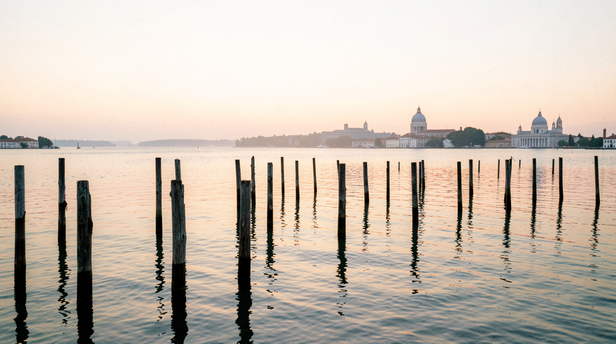
The first thing to understand about Venice is that it does not float and it is not built on water. It is built on land, land that was carried there, pile by pile, across a shallow lagoon, and then pinned in place with a forest's worth of timber driven straight down into the mud.
That distinction matters because it explains everything: why the city has lasted, why it is slowly sinking, and why the engineering underneath it is stranger and more deliberate than anything visible above the waterline.
The Lagoon Before the City
Venice sits in a brackish lagoon on the northeastern edge of the Italian peninsula, separated from the Adriatic by long, narrow barrier islands. Before the city existed, the lagoon held a scattering of low muddy islands, barely above the tide, unstable, and uninhabited except by fishermen and people fleeing the mainland during successive waves of invasion in the early medieval centuries.
The settlers who arrived from the fifth century onward were not engineers looking for an ideal site. They were refugees looking for defensible ground. Water was the wall. The difficulty of building there was, at first, less a problem to solve than a feature to exploit. A cavalry army could not cross a lagoon. That strategic advantage bought the early inhabitants time to figure out how to stay.
What the Ground Actually Is
The lagoon floor is not solid. It is layers of sediment deposited over millennia by rivers draining the Alps, sand, silt, clay, compressed organic material. The uppermost layers are soft and compressible. Drive a post into them and it sinks. Build a wall on them and it tilts.
But the sediment is not uniform all the way down. Beneath the soft upper layers lies a stratum of dense, consolidated clay called caranto, a Venetian dialect word for a material that behaves more like weak rock than soil. It does not compress easily. It holds a load. The builders of Venice had no geological survey, no bore samples, no laboratory analysis. They found the caranto by feel, by experience, and by watching what happened to structures that did not reach it.
How the Piles Work
The technique is straightforward in principle and brutal in execution. Wooden piles, typically alder, oak, or larch, cut from forests in the Alps and floated down rivers to the lagoon, were driven vertically into the lagoon bed using large wooden mallets and, later, mechanical pile drivers. The piles were driven close together, in dense grids, until their tips reached the caranto layer.
A platform of horizontal planks was then laid across the tops of the piles, and on top of that, a layer of Istrian limestone, a dense, water-resistant stone quarried from the coast of what is now Croatia. The limestone distributed the load and formed the actual foundation on which walls were built.
The result is a structure that transfers the weight of the building downward through the piles, past the soft sediment, and into the firm clay below. The piles do not float the building. They anchor it.
Why the Wood Has Not Rotted
This is the part that surprises almost everyone. Wood submerged in water for a thousand years should have decayed long ago. In most conditions, it would have. The reason it has not comes down to oxygen.
Wood rots because of fungi and bacteria that require oxygen to break down organic material. Below the lagoon sediment, in the anaerobic environment around the pile tips, there is almost no dissolved oxygen. The microorganisms that cause decay cannot survive there. The wood, deprived of the conditions that would destroy it, instead petrifies gradually, it mineralises, taking on the hardness and density of stone while retaining its structural form.
Cores drilled from Venetian piles have shown wood that is, in some cases, harder than the original timber. The lagoon mud, which looked like the worst possible building medium, turned out to be a preservative.
The Scale of What Was Built
The numbers attached to individual buildings give a sense of the overall effort. The Basilica di Santa Maria della Salute, built in the seventeenth century to mark the end of a plague, rests on more than a million wooden piles. The Rialto Bridge stands on around twelve thousand. The Doge's Palace, the Ca' d'Oro, the Frari church, each one sits on a dense mat of timber that was assembled by hand, over years, before a single stone was laid above ground.
Across the entire city, estimates of the total number of piles run into the tens of millions. The forests of the Cadore region in the Dolomites were systematically harvested over centuries to supply them. The relationship between Venice and its mountain hinterland was, in part, a relationship between a city and the timber it needed to stay upright.
Why the City Is Still Sinking
The piles hold. The problem is the sediment around them. Venice sinks for two reasons that operate at different speeds. The first is natural: the sediment of the lagoon compresses slowly under the weight of the city, and the tectonic plate beneath the northern Adriatic tilts gradually downward toward the northeast. Both processes were underway long before the city existed.
The second reason was human and acute. Through much of the twentieth century, industrial pumping of groundwater from the aquifers beneath the lagoon caused rapid subsidence, the ground compressing as water was withdrawn from the spaces between sediment particles. That pumping was stopped in the 1970s, and the rate of sinking slowed significantly, but the centimetres lost during those decades were not recovered.
The city now sits lower relative to the Adriatic than it did a century ago, which is why high tides flood the ground floors of buildings that were dry for most of their history. The piles are not the vulnerability. The relationship between the city and its water is.
The wooden piles beneath Venice are not a workaround or a compromise, they are a precise solution to a specific problem, arrived at by people who had no engineering tradition to draw on and no margin for failure. The lagoon that looked like an obstacle turned out to be the condition that made the solution work. Strip away the water, and the wood rots. Keep the water, and the city stands.
Unlock insightful tips and inspiration on personal growth, productivity, and well-being. Stay motivated and updated with the latest at My Life XP.