
How an Ajrakh Print Takes Sixteen Passes Before It Becomes Itself
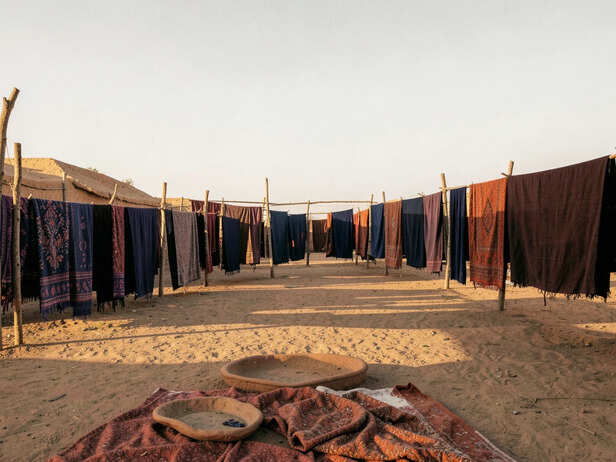
A piece of Ajrakh cloth does not arrive at its pattern. It is built toward it, layer by layer, over days that are governed as much by weather and water as by the craftsman's hand. The process has a name for each stage, a reason for its order, and a consequence if any step is skipped. What looks, at the end, like a single confident print is actually the residue of sixteen separate decisions made in sequence.
The Cloth Comes First, and It Takes Work Before It Takes Dye
Before a block touches fabric, the cloth, usually a tightly woven cotton, goes through a preparation called saaj. It is soaked, beaten, and dried repeatedly over several days to open the fibres and remove the sizing that mills apply. Then it is treated with a solution of castor oil and soda ash, a step called chikna, which conditions the cloth so that natural dyes will bond to it rather than sit on the surface and wash away. A piece that skips saaj will take dye unevenly. The craftsman can see this in the first resist pass, but by then it is too late to correct.
Resist Is Laid Down Twice Before the First Dye Bath
The resist paste, called dabu, is made from a mixture of lime, gum, and clay, and it is applied cold by hand-carved wooden blocks. The block is pressed into a tray of dabu and then stamped onto the cloth with a single firm strike. No rocking, no second press. The resist must sit exactly where it lands.
The first resist application covers the areas that are to stay white. The cloth then dries in the sun, and fine sawdust is scattered over the wet dabu to prevent it from sticking to itself when folded. Only after this first resist has dried fully does the cloth go into its first dye bath, typically a pale ground colour made from harda, a yellow-green fruit that also acts as a mordant, helping subsequent dyes fix more deeply. This is not a colour pass. It is a preparation for colour.
After the harda bath, the cloth is dried again, and a second resist pass covers the areas that are to remain in the ground colour. Now the cloth carries two layers of protection: one for white, one for the pale ground. The pattern is already encoded in negative before a single true colour has been applied.
The Dye Baths Run in a Fixed Order That Cannot Be Reversed
Natural dyes used in Ajrakh are not interchangeable. Alizarin red, derived from madder root, requires an alum mordant to fix. Indigo, the blue that defines the tradition, is a vat dye, it does not dissolve in water and requires a separate fermentation vat that is maintained over days and fed with reducing agents to keep it active. These two dyes behave differently on cloth, fix at different temperatures, and interact differently with the resist. The order in which they are applied is not a stylistic choice. It is a chemical necessity.
Red typically comes before blue. The cloth enters the madder bath, is boiled, and emerges with the exposed areas taking the dye while the resist-covered areas stay protected. It is then washed, the old resist removed, and new resist applied to protect the red areas before the cloth enters the indigo vat. Indigo does not require heat, the cloth is dipped, pulled out, and oxidised in air, a process repeated several times in a single session to build depth. The blue darkens as it meets oxygen, not as it sits in the bath.
Between each dye bath, the cloth is washed in the Saran river, whose water carries minerals that help fix the colours and clear the residue of the previous pass. The quality of the water is not incidental. Ajrakhpur sits where it does partly because of this river.
Some Passes Add Nothing Visible and Are Still Not Optional
Several of the sixteen passes are intermediate washes, mordant refreshes, or sun-drying stages that leave no mark on the cloth but determine whether the next pass holds. A mordant pass before a red bath ensures the alizarin has something to bond to. A wash between resist applications removes the dabu cleanly so the next layer of resist sits on bare cloth rather than on residue. A full day of sun-drying after a dye bath allows oxidation to complete before the next chemical is introduced.
These invisible passes are where shortcuts are taken when production pressure rises, and where the difference between a piece that lasts forty years and one that fades in five is made. The craftsman knows which passes he can compress slightly and which he cannot touch. That knowledge is not written down anywhere in Ajrakhpur. It moves between generations in the doing.
The Final Wash Is Where the Colour Reveals Itself
After the last dye bath and the last resist removal, the cloth goes through a final wash, sometimes with a mild solution that brightens the colours by removing the last of the chemical residue, sometimes in plain river water. It is hung to dry in full sun, and this is the moment the craftsman reads what the cloth has become.
The colours shift as they dry. The red deepens. The blue settles from a wet grey-green into the particular dark indigo that is the signature of a well-maintained vat. The white areas, protected through every bath, emerge clean or carry a faint warmth from the harda ground. If a resist cracked during a dye bath, the dye will have bled into a protected area and left a mark that was not intended. These marks are not removed. They are accepted as part of what the cloth is.
No two pieces come out the same because no two pieces passed through exactly the same sequence of conditions. The vat changes daily. The river water changes with the season. The dabu dries faster on a hot afternoon than on a cool morning, and a faster-dried resist is a slightly less reliable resist. The pattern on the block is fixed. Everything else is in motion.
Sixteen passes is not a number that signals complexity for its own sake. It is the minimum the chemistry requires. The craftsmen of Ajrakhpur did not design the process, they inherited it, tested it across generations, and arrived at the number that works. The cloth carries all sixteen in its hand, its weight, and the way the colours sit against each other without competing.
Unlock insightful tips and inspiration on personal growth, productivity, and well-being. Stay motivated and updated with the latest at My Life XP.